


From prison law libraries to paralegal fellowships: DC program helps put returning citizens on path to success
Milford Washington, 53, spent hours in the law library during the 10 years he was in a Virginia prison. He studied his own case and those of his fellow inmates, preparing himself to enter the DC job market. He spent so much time in the prison’s law library that other inmates thought he worked there.
Despite his studies, Washington found himself struggling to find work and a place to live after he was released in 2015. He stayed at the men’s homeless shelter on New York Avenue NE for more than a week until family members took turns housing him in their Northwest and Southeast DC homes.
“My life tailspinned into chaos as soon as I came home,” Washington said during a recent news conference. Even so, he kept up his job hunt and later signed up for law classes at the University of the District of Columbia.
Brian Ferguson, director of the Mayor’s Office on Returning Citizen Affairs (MORCA), is on a mission to help returning citizens like Washington overcome stigma and find employment in the District. Mayor Muriel Bowser appointed Ferguson to the position in September 2016 with hopes that his background in advocacy, as well as his own success as a returning citizen, would help him create new jobs programs for former inmates.
Established in 2006, MORCA helps returning citizens re-enter society by connecting them to jobs, educational opportunities and other services. MORCA has eight full-time employees and is one of the few government agencies of its kind in the country.
A new kind of fellowship
Ferguson is a DC native who is no stranger to the stigma many returning citizens face. He spent 11 years in a West Virginia prison after being wrongfully convicted of murder.
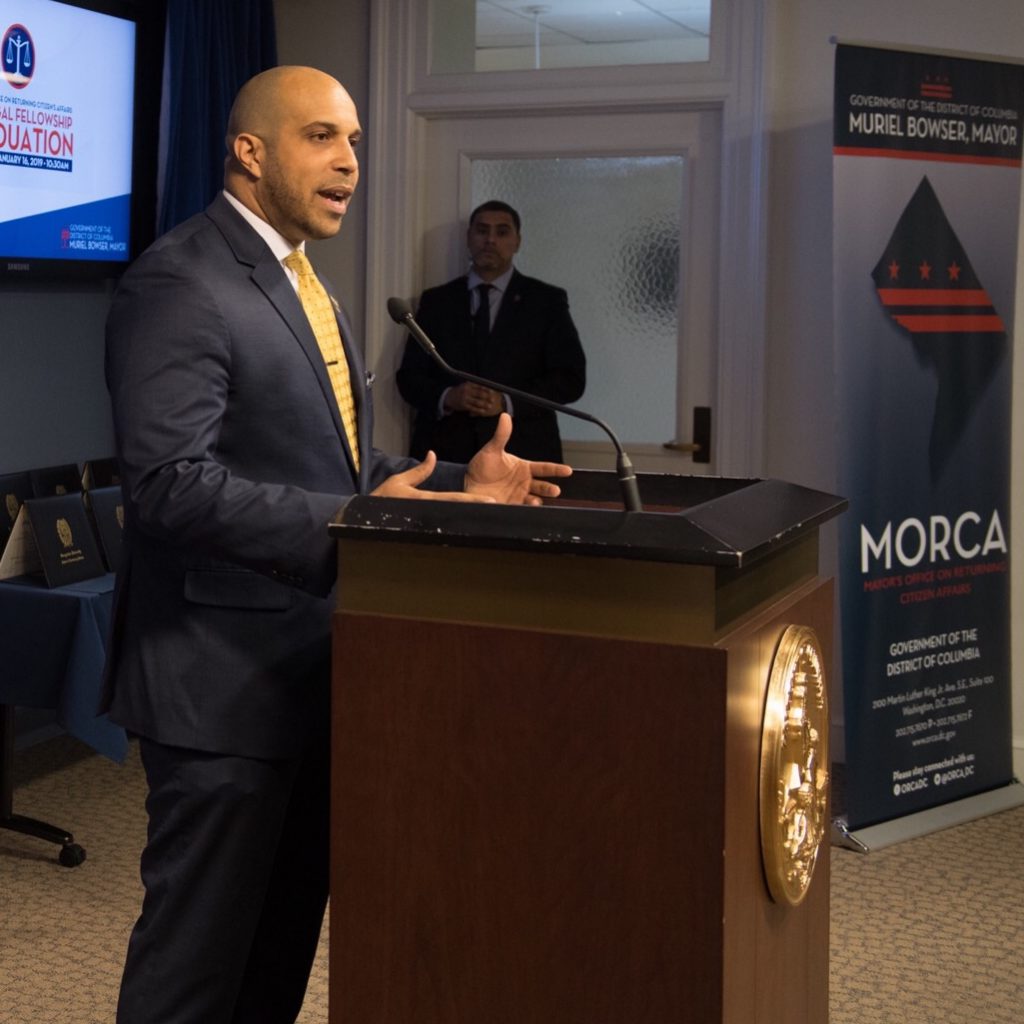
Prior to his arrest, Ferguson interned as a paralegal while attending West Virginia University. Like Washington, he spent much of his prison time being a law library bookworm. After a legal team led by former U.S. Attorney General Eric Holder helped him gain exoneration in 2013, Ferguson had trouble returning to his field.
“I knew that if it was difficult for me, even with a lot of advantages that a lot of other people don’t have, it’s 10 times more difficult for the average person coming home from incarceration,” Ferguson said of returning citizens trying to find work. “We wanted to create an avenue for them.”
To do so, Ferguson sought Bowser’s support for the launch of a Paralegal Fellowship Program that would allow returning citizens — many of whom are adept at legal work — a chance to take a paralegal certificate course and subsequently work as paralegals at law offices in Washington.
The first graduates
Bowser gave the program a green light, and last week the program’s first nine fellows graduated from Georgetown University’s paralegal certificate course. They’ll now go on to complete a one-year fellowship with employers such as Covington & Burling LLP and the DC Office of the Attorney General. Among the graduates was Milford Washington.
“What you had here were nine men and women who worked their tail off and survived a rigorous program at Georgetown University,” DC Attorney General Karl Racine said after the Jan. 16 graduation ceremony. “We’re really thrilled that we’ve got a graduate who has started already at the Office of the Attorney General.”
Bowser, Racine and DC Council members Robert White and Charles Allen were among about 100 audience members who packed a Wilson Building room for the graduation ceremony. In her speech, Bowser called for diminishing the social stigma that returning citizens face when re-entering society.
“We talk about returning citizens as if they are some [faraway] people or some people that got dropped down from Mars or something when in fact they are us,” Bowser said. “They are our brothers, our uncles, our cousins, our friends, our sisters, our aunts, our nieces. They are Washingtonians.”
From homeless to hired
Washington’s journey to the fellowship program started in 2015 when he was fresh out of prison and applying for jobs. At an employment fair that year, Washington applied for a job at what he called a “highly regarded company” in the District. As part of a group interview that day, he and other applicants were asked to sign informational packets that included a clause allowing the company to do background checks, Washington said.
Later, Washington received what he thought was an offer letter in the mail. Instead the envelope contained a rejection letter along with paperwork from the background check the company conducted.
DC’s 2014 “Ban the Box” law prohibits District employers from asking about applicants’ criminal histories before making a job offer. Washington, who had reviewed the law while doing research in prison, filed a complaint with the DC Office of Human Rights.
Ferguson was that office’s lead “Ban the Box” law investigator at the time. And he was already on the lookout for smart, ambitious returning citizens to participate in the Paralegal Fellowship Program that he hoped to establish one day.
“He came in and submitted a complaint that was so eloquently worded and so on-point with the legal arguments that I immediately flagged him as somebody who could be a great participant in the program that I was imagining in its nascent form,” Ferguson said at the graduation ceremony.
Washington won a settlement with the company for a “significant” amount, he said. He will be working with DC Law Students in Court in the group’s eviction defense services department during his fellowship, with hopes of obtaining a permanent position there afterward.
Ferguson — who will go to Oxford University on a prestigious Marshall Scholarship in September to get a master’s in comparative social policy — emphasized the academic rigor of the Georgetown certificate program in his speech. Graduates are expertly trained and will add value to their employers for years, he said.
“The program started with 20 and ended with nine,” Washington said. “We’re the cream of the crop.”
Thanks for supporting this cause. I once told another inmate how he should proceed with his future.