


A dozen students at Tenleytown’s Woodrow Wilson High School were playing cards at a high-top table and relaxing on easy chairs in the senior lounge while on break between classes. Alex Wilson, the school’s director of academic development, approached the students and took an informal poll.
“Should we change the name of the school?” Wilson asked.
Some nodded, others shrugged, while a few, such as Cindy Sanchez, had strong opinions on the matter.
Sanchez, 17, a Wilson senior who will attend George Mason University after she graduates in June, said there’s no question the school should be renamed. “It’s kind of dumb that we have a racist figure as the name of the school,” Sanchez said.
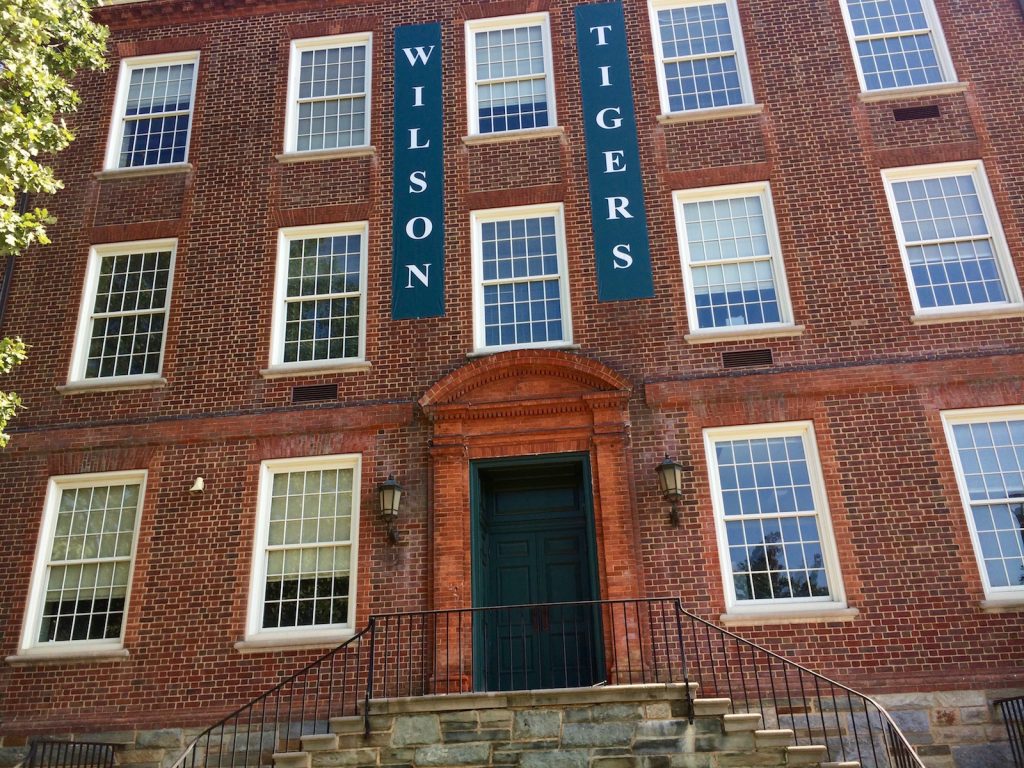
Neighborhood group DC History & Justice Collective and Wilson’s Diversity Task Force will pose the name-change question to the community at a public forum Tuesday at 7 p.m. in the school’s auditorium.
In 2015, three Wilson teachers started a renaming petition after Princeton University students tried to have the former U.S. president’s moniker removed from that university’s school of public and international affairs.
While the Wilson teachers’ petition took time to gain traction, the idea of renaming the school had been circulating in the community for some time, according to Judith Ingram, who is a member of the DC History & Justice Collective and whose children are a current sophomore and an alumna of Wilson.
Escaping Jim Crow
After the Civil War, Washington, DC, was a haven for African-Americans, and those who fled the South bolstered an already substantial black population in the nation’s capital. Without Jim Crow laws to contend with, thousands of black Washingtonians passed civil service exams and got good jobs in the racially integrated federal government.
Eric Yellin, a history professor at the University of Richmond, wrote in his book Racism in the Nation’s Service that after Wilson became president in 1913, his administration segregated federal government workers.
“What he did was bring into his administration a host of avowed, explicit white supremacists who went about segregating and destroying the careers of African-Americans,” Yellin said in an interview. “When African-Americans protested, Wilson argued that it was fair and it was best for black people to be segregated.”
Once Washington’s largest employer started treating its black employees as inferior, that dynamic crept into local culture and diminished the status of African-Americans in the District, Yellin said.
Wilson community members, Yellin said, will have to decide if Wilson’s racism outweighs the role his progressive policies played in improving the security and financial well-being of white Americans.
Diversity Task Force
Ward 3, where Wilson is situated, is 84 percent white. Wilson, however, has the most racially diverse student body in the DC Public Schools system. When Kimberly Martin started as Wilson principal in 2015, she noticed school policies that kept students separated, in spite of its diversity.
“Traditionally you could walk by and tell that a class was an AP class because it was all white,” said Alex Wilson, the academic development director.
The year she started at Wilson, Martin established the Diversity Task Force — made up of staff, parents and students — to tackle these disparities.
Wilson High expanded its honors classes to include all freshmen two years ago with the help of the task force. Before Wilson began the “Honors for All’ program, Martin said, some students were excluded from honors classes because their teachers didn’t recommend them for the program, which she attributes to discrimination based on the students’ race or ZIP code.
The task force has since helped establish gender-neutral bathrooms at the high school to include students whose gender identities don’t conform to the male-female binary.
Wilson, a member of the task force, said that diversifying the school’s predominantly white school newspaper staff and encouraging the theater department to put on its first production written by a black playwright are two areas the task force continues to address.
Martin appeared on WAMU’s Kojo Nnamdi Show last December and floated the idea of renaming the school after the Pulitzer Prize-winning African-American playwright August Wilson, best known for The Pittsburgh Cycle, a 10-play epic about the black experience throughout the 20th century.
Reno City
Martin, who has taken a neutral stance on changing the school’s name, said she hopes that the community engages in a robust discussion on race and reconciliation whether the school ends up changing its name or not. One potential name Martin found compelling is Reno City High School because it would pay homage to the settlement of former slaves that had existed in the immediate area, but was wiped off the map — in part to build the originally all-white Deal Junior High School — due to pressure by neighbors, developers and the federal government.
Neil Flanagan, an architect who grew up a block away from Fort Reno, recounted the community’s dismantling in the Washington City Paper. The November 2017 article explains that in 1867, former slaves who had been working for the Union Army in Washington settled just north of Tenleytown in an area known as Reno City.

Reno City was a thriving black neighborhood until developers and residents of nearby white neighborhoods, such as Tenleytown, devised a plan to expel Reno City residents from their homes in order to build a park. With pressure mounting from the government to sell their land in the 1920s and 30s, Flanagan writes, it was only a matter of time before all African-Americans in Reno City moved out.
The DC History & Justice Collective was founded in memory of Reno City.
Tim Hannapel, a member of the collective and a member of Wilson’s Class of 1977, described the collective as “a group of concerned neighbors who are seeking to acknowledge the contributions of African-Americans to DC and address the lost neighborhoods that were eradicated to make white neighborhoods in Northwest.”
Today, Fort Reno Park stands where the once-prosperous black settlement was demolished. Wilson High School — which opened in 1935, decades before the courts forced the school system’s desegregation — stands just south of the park.
Road map to a name change
Tuesday’s forum is the beginning of a longer conversation among students, teachers, alumni and community members about the merits of keeping or changing the high school’s name. If they reach a consensus farther down the road in favor of a name change, Advisory Neighborhood Commission 3E would be asked to draft a resolution and then send it to the DC Council, which would vote on whether to approve the proposal.
Lawrence E. Boone Elementary School in Southeast took that route to changing its name in 2018. Boone was a former principal of the school. Previously the school was named for Benjamin Orr, Washington’s fourth mayor and a slave owner.
Martin said she has heard the argument that removing Woodrow Wilson’s name from the school could superficially mask Northwest Washington’s troubled racial history. Name-change proposals also frequently draw criticism as political correctness run amok, and an affront to institutional traditions. No matter what the decision, Martin said she sees the discussion as an opportunity to honestly reckon with the community’s past.
As for other alternate names for the school, some of the students hanging out in the Wilson senior lounge had a couple of ideas.
“Barack Obama High School,” one student said. “Harriet Tubman High School,” said another.
The name of the country’s first African-American president is not in the running because the school can’t be named after a living person under DC law. A school named after Tubman, an abolitionist and political activist who was born a slave, would be the first DCPS high school in Washington named in honor of a woman.
What in the world- why does it seem like no one in DC actually works!? Who has time for this?!
I’m a wilson graduate and think that energy should be exhausted on everything else wrong with wilson like the fact that they fired an amazing principle because he was gay. Or maybe figure out how an entire classroom managed to jump out the window in a chemistry class when the teacher was using the bathroom? Just saying!
I’m with Ms. Shwarma – I am also a Wilson graduate (Class of 2010) I think there are many more systemic problems at Wilson (and DCPS writ large) that should be addressed; rather than something superficial such as the name. Changing the name to Harriet Tubman High isn’t going to wave the magic wand of diversity and close “the achievement gap”.
If we’re going to change the name, it should probably be a Latinx, non-binary, differently-abled person so we don’t have to change it again in 20 years.
I graduated from Wilson in 1967. Change the name.
When I initially commented I clicked the “Notify me when new comments are added” checkbox
and now each time a comment is added I get several e-mails with the
same comment. Is there any way you can remove me from that
service? Thanks!
Woodrow Wilson is no different than any other liberal democrat. He even speaks like them and just like Lyndon B Johnson the Democrats have a history of whites using blacks for votes. Use the lesser educated from the inner cities by bribing them with welfare and false reparations causes. Elizabeth Warren is no different than Woodrow Wilson and Lyndon B Johnson. I know the Democrats Parade that fraud Lyndon B Johnson around like a hero but he is no hero. They should stick with his racist quote about how he’d have N-word people voting Democrat for a life time.