


Protest at the National Gallery of Art highlights the issue of diversity in the art world
Radical Matriarchy, a New York-based art project focusing on the condition of women, staged a Valentine’s Day protest outside of the National Gallery of Art to call attention to the fact that 97 percent of the gallery’s collection was created by white artists and 90 percent by white men. Those numbers come from an analysis published by the MIT Technology Review, which reads, in part, “The percentage of black or African-American artists in the collection is precisely zero.”
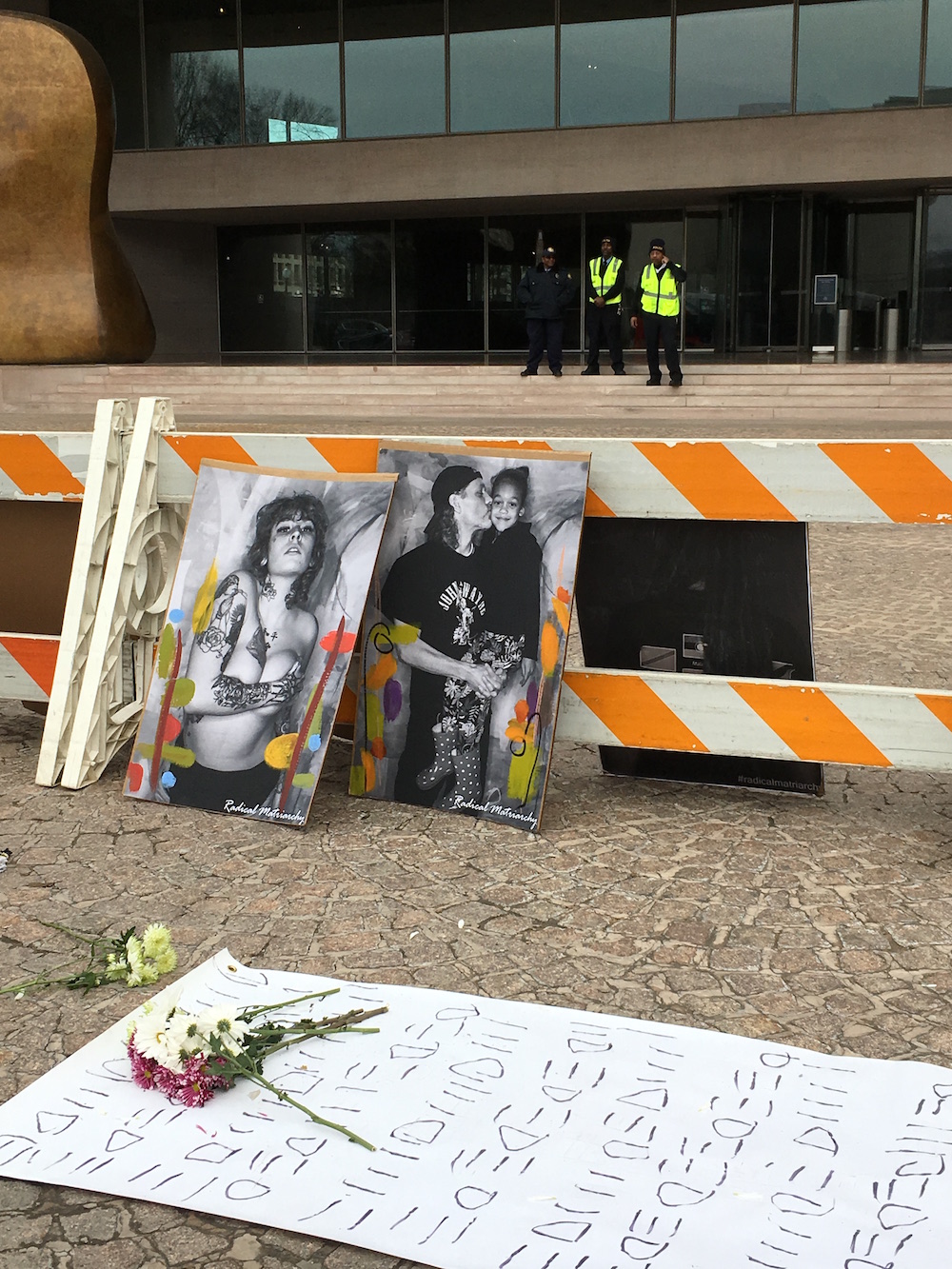
The protest — which took place for the duration of the museum’s operating hours on that brisk February day — was organized by Sister Leona (born Michelle Sutherland), who described her goal as “bringing the art of everyone else to the gallery to show them what they’re missing.” There were musical performances, poetry recitations, live painting and speeches throughout the day, which was dedicated to celebrating diversity in the arts. About 20 people were at the event in the afternoon, though the size of the crowd ebbed and flowed throughout the day.

When the National Gallery of Art opened on March 17, 1941, its initial holdings consisted of the personal art collection of financier and former Treasury Secretary Andrew W. Mellon, who donated it to the nation. According to gallery signage, the opportunity to see the collection in those first years during World War II gave “respite and inspiration to men and women in the armed forces.”
The Feb. 14 protest was a call for the gallery to reflect the current state of the country.
Mac Leisan, a student at the University of Maryland at College Park, took part in the protest by painting a canvas with “I love you” written in multiple languages. “Since it’s on Valentine’s Day, you can’t forget it,” she said. Leisan said she wanted visitors entering the National Gallery that day to “think about something while they’re in there … [as to] who’s being represented in there.” She particularly hoped that they’d consider the artist and not just the artwork, as well as the fact that mostly white artists are represented in the gallery notwithstanding DC’s diverse population.
Azar Senh, also a University of Maryland student, echoed his classmate’s sentiments on the power of protesting on what he called “a staple, orthodox go-out-and-get-people-flowers day.”
“It’s a reminder: Look outside your daily life, beyond your phone, beyond your TV screen,” he said. “There’s a lot of information being flooded in our direction, but it’s good to just take a minute and think about those who are not as fortunate or who are not being represented, who don’t have a voice.”
Radical Matriarchy’s flier about the protest referenced the same idea in outlining what the day’s activities sought to showcase: “Artists that no one is seeing, worldviews that no one is seeing, philosophy that no one is seeing, dreams of the future that no one is seeing.”
In an Instagram announcement about the protest, Radical Matriarchy explained the decision to bring its efforts to the nation’s capital. “The National Gallery of Art in Washington DC has one of the largest art collections in the United States. It also has a huge problem,” the group wrote.
Another post elaborated on the point: “We need your support in this effort to awaken and educate people to the fact that the only vision of art, society, and the world that anyone is seeing in one [of] our nation’s largest art [galleries] is by white men. We can change this and we will — with art.”
In an interview, Leona said her DC activities are an effort to expand her network and arts-related activities. “I’ve been coming here doing some activism work and just wanting to connect with the artists and activists here,” she said. “This project definitely connects me to a lot of people right away.”
She does not currently have plans for any future protests urging more diversity in the National Gallery of Art’s collection, but she said she is coming back to the District in early May to perform at Catharsis on the Mall, a free annual healing arts demonstration heading into its fifth year. Located on the National Mall just a few blocks from the National Gallery of Art, the event promotes “radical inclusion,” which essentially means it’s welcoming to all.
Though Leona described the Valentine’s Day protest as “a joyful event” — one of the protesters’ microphones was surrounded by flowers — her work draws some controversy. Facebook banned Radical Matriarchy from posting images of any protest signs that contained nudity, which were flagged as “sexual content.”
A few female protesters were topless with body paint at the National Gallery of Art protest. Radical Matriarchy’s whole movement is about resisting the sexualization of women’s bodies, so they are challenging the societal norm that allows men to go topless without issue though for women it is taboo. A few days later, Leona was arrested and charged with indecent exposure during a protest outside the Virginia statehouse urging lawmakers there to ratify the Equal Rights Amendment.
The press office of the National Gallery of Art declined to comment on the Feb. 14 demonstration, as did employees and police officers observing the protest. Gallery employees did, however, welcome those present to come inside to warm up from the cold weather and see the art.
The protest occurred in the last few days of the gallery’s exhibit Gordon Parks: The New Tide, Early Work 1940–1950, which showcased the work of a self-taught African-American photographer who worked his way up to shoot for major magazines like Life, Ebony, Fortune and Vogue. Though not a part of its permanent collection, the exhibit is an example of the diversity that the protesters were demanding.
On Dec. 11, the National Gallery of Art announced that its first female director, Kaywin Feldman, would take the reins March 11. She has been director and president of the Minneapolis Institute of Art since 2008 — where, the National Gallery of Art’s website notes, she “expanded the museum’s collection while also transforming the institution’s relationship to its city by opening its doors to community dialogue … and engaging with the defining social issues of our era.”
Those pushing for more diversity in the arts — a pressing issue in the art world — are hoping that Feldman will pursue a similar course in her work in DC.
Radical Matriarchy is not the only voice advocating for change. Since 2016, the National Museum of Women in the Arts has conducted a campaign each March during Women’s History Month called #5WomenArtists to promote gender equality in the arts. The museum found that most people could not name five female artists; the goal of the campaign is to change that.
This year’s Radical Matriarchy protest was a follow-up to Leona’s protest last year on Valentine’s Day outside the Metropolitan Museum of Art (MoMA) in New York City. Later this year, MoMA will close for about four months to diversify its canon, signifying a major shift in the art world and marking the culmination of the museum’s three-year expansion project.
“We feel that many, many regions that once seemed peripheral don’t seem that way any more, they seem central,” MoMA’s chief curator Ann Temkin told artnet news. “Figures who once seemed secondary now seem primary.”
In a news release about her appointment, Feldman called the National Gallery of Art “arguably America’s greatest treasure.” In an online announcement about the protest, Radical Matriarchy sent this message to the gallery: “We love you, but time to change now.”
Comments are closed.