


DC Public Schools plans to resolve an impending over-enrollment problem at School Without Walls at Francis-Stevens by increasing funding and creating three new classrooms, school system representatives said at a recent community meeting. The need to do so marks a turnaround at the Ward 2 school, which was re-envisioned in 2013 after being targeted for closure because of too few students.
Community members began pushing months ago for the city to meet the need for additional funds and space, attracting attention from the DC Council and three local advisory neighborhood commissions, including ANC 2A (Foggy Bottom/West End).
“We cannot wait until August when children show up to then try to hire teachers who fit in with the culture and the standards that we have enacted,” Walls parent Julian Wright said at a DC Council public roundtable on Feb. 12. “At that point, there will be no one in the pool.”

An unusually large influx of students from its two feeder elementary schools contributed to over-enrollment in the sixth-grade class at School Without Walls at Francis-Stevens for the 2019-20 school year, principal Richard Trogisch told ANC 2A last month. The school is expecting 17 students from Ross and 16 from Thomson — which, when combined with Francis-Stevens’ own fifth-grade class of 40, far exceeds the 50 sixth-graders the school is currently equipped to handle.
Francis-Stevens may also face an increase of students from an in-boundary apartment building that the Chinese Embassy is constructing in Sheridan-Kalorama for its employees — an issue brought up by Ward 2 Council member Jack Evans at the council roundtable. Trogisch told The Current that the apartments could mean about 40 more elementary students for Francis-Stevens, although he added that he has not been in contact with the embassy on whether the building’s future residents are interested in sending students to the school.
The pre-K through eighth-grade school at 2425 N St. NW has dramatically increased enrollment after pairing in 2013 with School Without Walls High School, a high-achieving magnet school a mile away. Francis-Stevens touts its “rigorous college preparatory, humanities program that incorporates global and local resources in an experiential and interdisciplinary methodology to teaching and learning” on its DCPS profile. Half of the students live outside of Ward 2.
Walls at Francis-Stevens currently has 497 students, according to the Office of the State Superintendent of Education’s website. That’s a marked increase from the 2017-18 enrollment of 473 students listed on that year’s DCPS enrollment audit. For the current school year, the school also had an extensive waitlist of interested applicants through the My School DC lottery at every grade, including 172 students who sought placement in the sixth grade.
At the roundtable, Evans called for the city to allot $600,000 for new teachers and recommended repurposing some of the school’s gym space for classrooms, on the advice of the Local School Advisory Team (LSAT) at Francis-Stevens.
DCPS officials subsequently provided updates at the Feb. 20 meeting of ANC 2A. Teresa Biagioni, director of school planning, said the agency had adjusted its enrollment projections for Walls to account for the overflow, which will result in a commensurate funding boost.
“Our team develops enrollment projections; we do that for every school and every grade across the city. And sometimes there are things we don’t get right based on community context, and that’s why that back-and-forth with the school is really important,” Biagioni said.
“Since we are increasing the projections … we’re committed at our facility department to create three additional classrooms ready to be open come August for the next school year,” added Janice Szymanski, director of facility planning and design at DCPS. She said that her office was planning to hire an architect and contractor to look at ways to increase class space, such as by replacing the computer lab with a laptop cart.
At the council hearing, Wright — a member of the LSAT at Francis-Stevens — called for the city to move faster with its planned renovation of the school, which is funded for $74 million in fiscal years 2022, 2023 and 2024. “Housing [these] students in an aging facility that has become too small for our growing school population is creating an immediate crisis for the upcoming school year,” he said.
Wright described Francis-Stevens — now a top choice for families across the District after having been on the verge of closure in 2013 — as “a victim of its own success.”
Francis-Stevens parent and LSAT chair Cedric Hendricks echoed that thought at the ANC meeting. “We’ve taken a school that … was under-enrolled and facing closure, and worked with the administration and the faculty there to turn it into a jewel,” he said.
When the school — then known as the Francis-Stevens Educational Campus — was slated for closure as part of the school system’s consolidation efforts, community members waged a prolonged campaign to convince officials to instead allow the merger with School Without Walls High School under a single principal. At the time, Francis-Stevens enrolled 224 students, including just 16 sixth-graders, according to the DCPS enrollment audit for the 2012-13 school year. Enrollment grew to 284 the next year once the school was reconstituted as School Without Walls at Francis-Stevens and placed under Trogisch’s leadership.
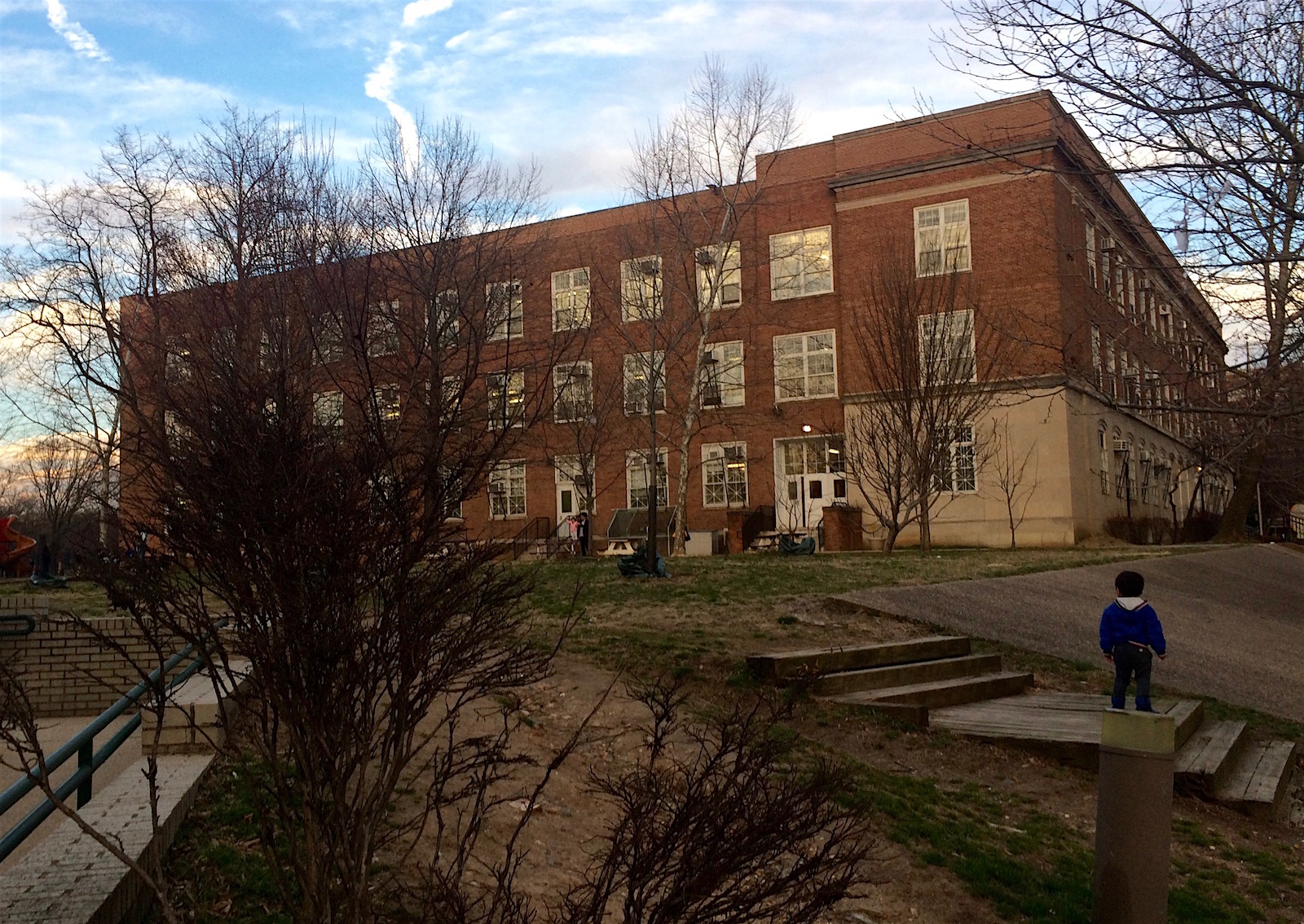
The high school is located within ANC 2A, which encompasses the Foggy Bottom/West End neighborhood, but the Francis-Stevens site falls just beyond its northern border with ANC 2B (Dupont Circle). The Francis-Stevens enrollment zone includes students in Foggy Bottom/West End as well as those living in Sheridan-Kalorama and in areas of Dupont Circle west of Connecticut Avenue NW and south of Massachusetts Avenue NW. Both ANC 2B and Sheridan-Kalorama’s ANC 2D joined ANC 2A and the school’s LSAT in prodding for action on Walls last month, noting in their resolutions that completion of the Chinese staff compound will “inevitably result in a significant increase” in enrollment for the coming school year. Both resolutions urged creation of six new classrooms by repurposing the smaller of the school’s two gyms, ideally in time for the 2019-20 school year.
ANC 2A chair William Kennedy Smith said his commission had met at different points with Evans, DC Council Chairman Phil Mendelson and Education Committee chair David Grosso to try to secure resources for the school from DCPS.
Despite the commitment for the three new classrooms, the proceedings at the council roundtable and ANC 2A meeting reflected underlying concerns with management from DCPS.
Evans stressed the need to ensure that any renovations start on time — in June — to be ready for September. “That’s not the way DCPS works,” he said. “Rather, we don’t do anything until September comes and goes: ‘Now, oh my gosh, what do we do with all these kids? Maybe we can put some trailers in the parking lot or something.’ That’s ridiculous, and I will not allow that to happen.”
In its Feb. 20 resolution, ANC 2A noted its attempts to reach out to DCPS about the enrollment overflow since October 2018, without hearing back until the meeting that night. The commission criticized “a pattern of non-responsiveness called out for years by community groups as a real barrier to effective long-range planning at the school.”
Smith remarked after passing the resolution that with DCPS’ commitment for more funding, the final hurdle was nailing down the exact dollar amount.
Comments are closed.