


Fire department’s lack of reserve fleet of ladder trucks poses looming budget question
The deployment of several new fire engines over the past month and a half is helping to address some of the long-standing problems with the city’s fleet of vehicles and equipment, but a recent DC Council oversight hearing made clear that it will take years to fully address a dire situation.
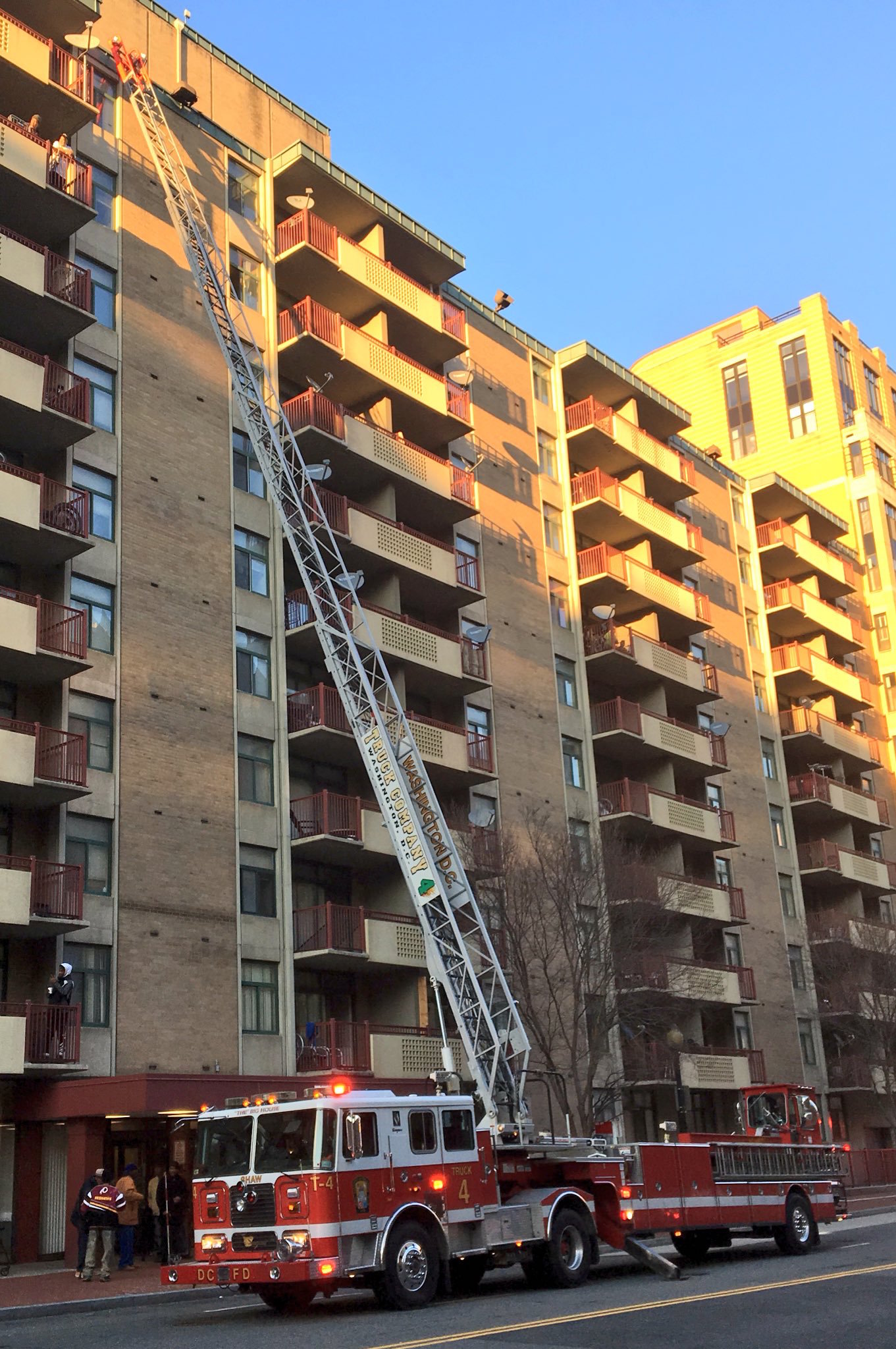
The DC Department of Fire and Emergency Medical Services has no reserve fleet of ladder fire trucks, so there’s no replacement available if any of the 16 trucks are out of service for maintenance or repairs, Chief Gregory Dean said in his testimony last month. Seven new trucks are expected by September 2020 — including three by the end of this summer — but those will replace vehicles that are already so old and heavily used that they may not be suitable for continued use.

The oversight hearing took place before the council’s Committee on the Judiciary and Public Safety, chaired by Ward 6 member Charles Allen. At the hearing Allen said he was growing “increasingly anxious about where we are in this capacity as we talk about our ladder trucks.”
It’s one of the looming issues expected to factor into the council’s upcoming review of the fiscal year 2020 budget and capital plan. The mayor is scheduled to unveil her proposal Wednesday. The DC Council will hold a series of hearings through the end of April — including an April 24 hearing on the DC Fire and Emergency Medical Services Department (FEMS) — before voting on a final document on March 14 and 28.
In a March 7 interview on WAMU’s Kojo Nnamdi Show, Dean responded to questions about the lack of a reserve fleet and a history of inadequate funding to keep up with an appropriate fleet-replacement schedule.
“We’re working very closely with the council and the mayor to be able to procure enough apparatus so that we actually have a reserve fleet,” Dean said. “By having that reserve fleet, that allows us to continue our purchase plan that we have in place for replacement of apparatus, and it allows us to be able to keep all our units in service.”
At the council’s Feb. 11 performance oversight hearing on FEMS in preparation for the upcoming budget review, union leaders and agency officials testified that resources have not kept up with rising demand as the District’s population has grown.
The new arrivals in Anacostia, at Franklin Square, in Lincoln Park and on Barracks Row in the Capitol Hill neighborhood are fire engines that pump water and cary hoses and other tools, but it’s the trucks with large, mounted ladders that enable firefighters to reach upper floors when responding to a fire. It’s the latter category where the District has a particular shortage, but the trucks are more costly and take longer to procure.
Dean told the council that the absence of a reserve fleet of ladder fire trucks means that if a truck goes out of commission, there is no replacement for it.
Dabney Hudson, president of the DC Firefighters Association IAFF Local 36, said this very scenario happened recently. As of the date of the hearing, Hudson said that the ladder trucks serving Columbia Heights and the U Street NW corridor had been out of commission for eight days and 6.5 days, respectively. He added that Shaw’s fire engine was also out of service for 18 hours at one point the week before the hearing.
“Members of this department continue to respond to calls without the resources they need, such as quality front-line and reserve apparatus,” Hudson said.
FEMS currently operates a fleet of 16 ladder trucks, which according to Dean should be accompanied by a reserve force of 10 trucks — but the District has none. Dean said that FEMS will receive three new trucks by the end of the calendar year — including a new Seagrave aerial tower — and another four by the end of fiscal year 2020, but these trucks will go toward replacing the existing stock rather than building a reserve. He said the agency will evaluate the trucks replaced to see if any are viable for use as reserves.
The truck shortage has created controversy in the past. Last November, The Washington Times reported that neither ladder truck dispatched to the three-alarm fire at the Arthur Capper Senior Public Housing in Capitol Hill was functioning properly. There was no reserve at the time, and the fire department was forced to call up a ladder truck that was undergoing repairs.
Hudson said FEMS received 205,000 calls in 2016 compared to 145,000 calls in 2005 — when the District last expanded its capacity to handle emergencies, according to Hudson. In the years since, he said, the union has brought its concerns to the council repeatedly.
“Although we have asked many questions, provided testimony, suggested purchasing plans in our view of how to improve the agency and services we provide to the community, many of the issues we question remain,” Hudson testified.
The agency’s shortcomings extend beyond just the vehicle fleet. Hudson also highlighted a lack of training for drivers and for FEMS personnel as well as the fact that many firefighters do not have a complete second set of equipment. Although all firefighters have a second coat and pair of pants, Hudson said that items such as helmets and gloves have not been provided.
“At times we are managing by crisis, allowing small issues to manifest to a point where [we] have to create [an] immediate resolution that is oftentimes [a] reactionary response with limited options, as opposed to a strategic, long-term decision,” Hudson said.
Other areas of the agency’s fleet, however, have seen some capital improvement in recent years. Dean said the council and mayor’s office have provided FEMS with enough funding since 2015 to follow a vehicle replacement schedule recommended in a report by consulting firm BDA Global. However, the complexity of ladder trucks presents unique difficulties to FEMS beyond funding, Dean said, requiring a procurement process that takes more than a year.
With ambulances, Dean testified that his agency has had a full reserve fleet since 2016. In the first quarter of fiscal year 2019 the department gained eight new fire engines, and it’s scheduled to receive six more over the rest of the year. The engines being replaced by these new units will become part of the reserve fleet if they are in suitable condition, he said.
A spokesperson for Allen wrote in a March 8 email to The DC Line that Allen is committed to securing funding for new apparatus for the FEMS fleet and for a new maintenance facility in this year’s budgeting process. FEMS is currently working with the Department of General Services to identify a new location for the facility.
Comments are closed.