


Amid ANC stalemate on Woodley Park bike lane, bike advocates and local critics both stress concern for safety
In a tie vote greeted as a victory by cyclists, an advisory neighborhood commission in Ward 3 recently deadlocked on a resolution condemning a proposed new bike lane along Woodley Place NW. Last month’s ANC 3C meeting became a flashpoint in a debate between bicycle proponents and other area residents as the commission considered weighing in on the plan announced Feb. 6 by the District Department of Transportation (DDOT) to provide cyclists a way to avoid two busy nearby commuter routes — Connecticut and Cathedral avenues NW.

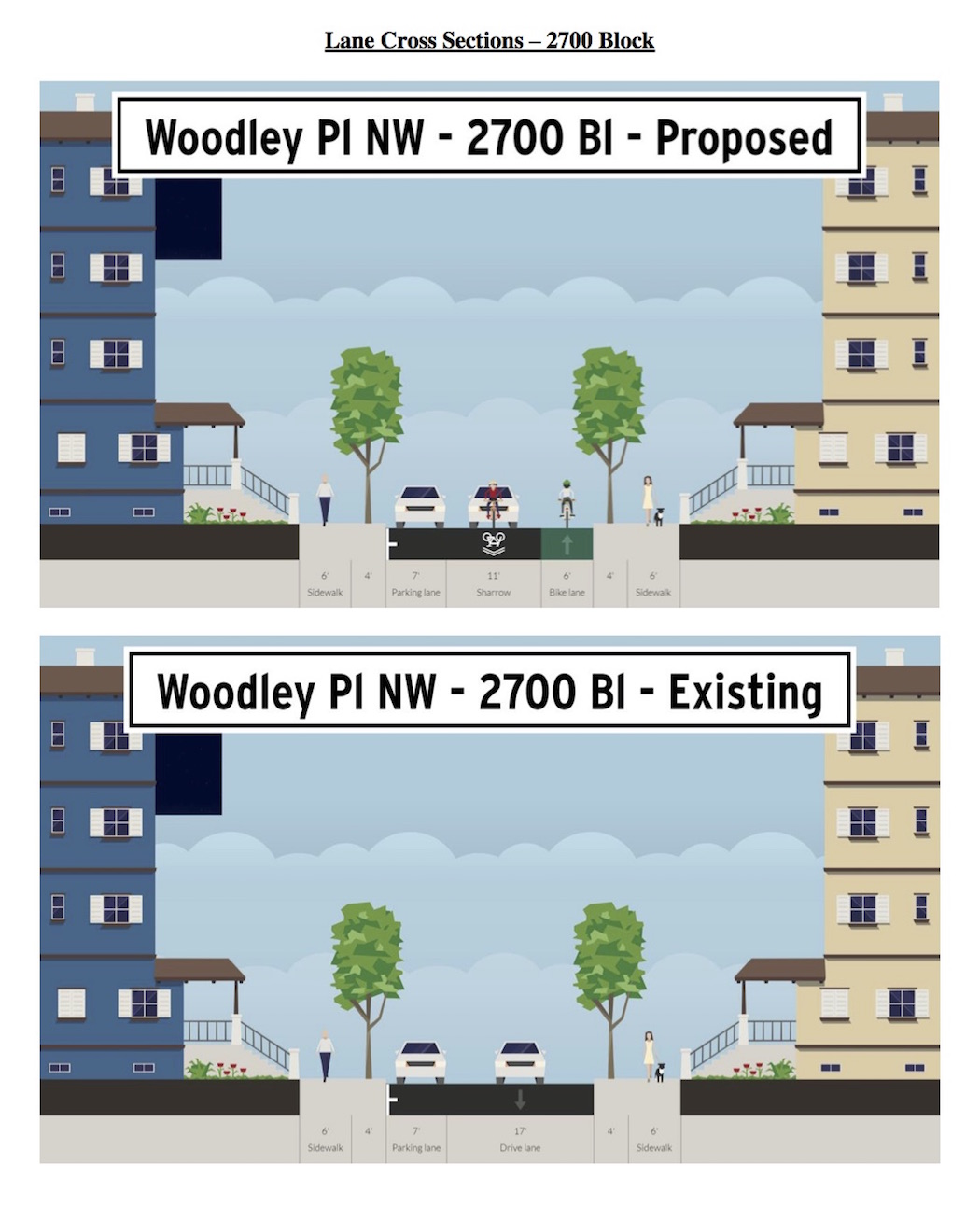
Installation of a 6-foot-wide contraflow bike lane — where bikes can travel against the flow of traffic — on Woodley Place between Cathedral Avenue and Calvert Street NW is meant to provide a safe alternative for cyclists traveling between Adams Morgan and the Ward 3 neighborhoods to its west, according to city transportation officials. A DDOT spokesperson wrote in an email to The DC Line that the department will decide how to proceed after reviewing public comments received prior to the March 21 deadline.
The standing-room-only meeting on March 18 was unusually heated. When the bike lane issue came up, nearly half the audience queued up in two lines to give testimony, with a noticeable age difference: Detractors of the proposal skewed older than the more numerous supporters, who wore bright yellow stickers given out by a local urbanist group, Cleveland Park Smart Growth.
Advocates of the new bike lane argued that it would improve Ward 3’s biking infrastructure, especially for casual or inexperienced bikers, without removing parking spaces, a frequent point of contention for similar proposals. “I certainly have heard from people with families and children, who are not interested in biking on Connecticut at all, and this would be very helpful as they try to get downtown,” said Josh Rising, founder of Ward 3 Bicycle Advocates and author of a March 15 post on the bike lane on the Greater Greater Washington blog.
Opponents held that the introduction of bike lanes along the two-block section of Woodley Place would dangerously increase the street’s bike traffic, interfere with deliveries and parking, and cause traffic issues at the intersection with Woodley Road. At that intersection, Woodley Road separates the northbound one-way traffic of the 2600 block of Woodley Place from the southbound one-way traffic of the 2700 block. They also called into question the safety of contraflow lanes on the relatively narrow stretch of Woodley Place.
“When DDOT offers examples of contraflow, they are on much wider streets [and] they are on streets that have high-use destinations that contraflow lanes deliver bikers to very directly,” said Roger White, a Woodley Place resident. “Approval would be tantamount to saying DDOT can put a bike lane anywhere it sees bikes.”
Commissioner Lee Brian Reba, whose district includes the proposed bike lanes, introduced the resolution condemning the proposal and noted that in a survey of the 107 houses on the two blocks affected, 92 percent of the 90 respondents signed a petition opposing the plan.
According to Bob Ward, a Cleveland Park resident and member of the steering committee for Cleveland Park Smart Growth, the ANC’s deadlock reflects a broader change in the neighborhood than just the addition of bike lanes. “Last night’s ANC 3C meeting resulted in two big wins for smart growth supporters, and demonstrated the local appetite for progressive change in [the] area,” he wrote on Cleveland Park Smart Growth’s website, referring to the bike lane vote and an unrelated recommendation to the Historic Preservation Review Board. “While neither proposal would garner much attention elsewhere in the city, here in ANC 3C they are signs that the times are changing.”
The tension between different constituencies in the neighborhood was also visible in the commission’s proceedings. Commissioner Jimmy Dubois introduced an amendment to the resolution that would have replaced the entirety of the text with language supporting the bike lanes. The amendment failed on a 4-4 vote, after commissioner Angela Bradbery recused herself due to a conflict of interest. The resolution itself also failed on a 4-4 vote, with the same commissioners allying on both votes. Commissioners Jason Fink, Robert Finley and Emma Hersh voted with Dubois on both votes.
Steve Seelig, a member of Ward 3 Bicycle Advocates, also linked the vote on bike lanes to larger transitions in the neighborhood. “[I’m] still actually surprised that in this day and age there would be four members of an ANC that supposedly agree with Vision Zero concepts who would vote against having bike lanes in a place where it makes eminent sense to have them,” he said in an interview, alluding to the mayor’s goal of improving pedestrian and cyclist safety. “This ANC has consistently been against change … [After the next election] hopefully there’ll be more people who will be cognizant and behind these types of issues.”
Still, the bike lanes’ opponents maintained throughout the meeting that safety is their highest priority. “There are too many issues relating to traffic concerns along Woodley Place not to have an abundance of caution. And if you adopt a policy of ‘safety first,’ then you have to say, ‘Are we sure?’” Reba said. “The residents and cyclists that live along Woodley Place have said, ‘No, we are not.’”
Comments are closed.