


Capital Projections: Institutional crisis edition
Capital Projections is The DC Line’s selective and subjective guide to some of the most interesting arthouse and repertory screenings in the coming week.
BY THE GRACE OF GOD
French director François Ozon has been a reliable and mischievous source for arthouse fare — from the thrilling mystery of Under the Sand to the period drama Frantz. His plots are often built on narrative switcheroos, but his latest puzzle, based on real-life events, is a straightforward tale whose complexities come from the betrayal of a sacred trust.

Like the 2015 Oscar winner Spotlight, which dramatized The Boston Globe’s early 2000s investigation into a preist accuesed of child molestation, Ozon’s latest addresses charges of pedophilia in the Catholic Church. What makes this drama more moving than its American counterpart is its emphasis on the victims rather than on the journalists who expose the transgressions. Set largely in Paris, By the Grace of God focuses on three men who come forward to accuse a now elderly priest (Bernard Verley) of abusing them when they were children. Alexandre (Melvil Poupaud), the first to press charges, remains a faithful Catholic, while François (Denis Ménochet) has become a staunch atheist, and the troubled, epileptic Emmanuel (Swann Arlaud) seems to have suffered most from the experience.
As the film tells each man’s story, the tone shifts from Alexandre’s dry letter-writing campaign to François’ more aggressive investigation to Emmanuel’s damaged. haunted life. Poupaud subtly conveys his character’s conflict; while his faith may waver due to his experience, he persists, not for revenge but in hopes of cleaning up the church. Yet the most sensitive performance comes from Verley, who has worked with such directors as Eric Rohme and Luis Bunuel. The veteran actor is remarkable as Father Preynat; he admits his wrongdoing, but even though he is the film’s clear villain (along with the church officials who turn a blind eye), he manages to make the figure something more than just a two-dimensional monster.
Ozon began the project as a documentary, but by dramatizing the case, which has yet to be resolved in court, he better captures the conflicted emotions at its heart, and the urgent need to clean up church hierarchy.
Watch the trailer.
Opens Friday, Oct. 25, at Landmark E Street Cinema. $12.75.
CYRANO, MY LOVE
I kind of rolled my eyes at the prospect of this historical comedy-drama, based on the life of French playwright Edmond Rostand. Did we really need another 19th-century period piece? But as it turns out, the first feature from director Alexis Michalik (who has worked primarily as a French television actor) vividly celebrates live theater and confirms the magic of cinema.
The film begins as a 20-something Rostand (Thomas Solivérès) is struggling with the failure of his latest play, a stuffy, leaden work starring the legendary Sarah Bernhardt (Clémentine Célarié). Edmond has a wife and two young children, but it’s hard to make ends meet given that inspiration seems to have left him. When the veteran actor Constant Coquelin (Olivier Gourmet) arrives at his door asking to commission a new work, Edmond has to come up with something quickly, and he soon finds real-life inspiration as he helps his friend Léo (Thomas Leeb), a handsome but inarticulate actor, court Jeanne (Lucie Boujenah), a pretty young stage dresser. How does Edmond help his tongue-tied friend? If you know the plot of the perennial Rostand favorite Cyrano de Bergerac (or the 1987 cinematic update Roxanne), you’ll recognize the device: Edmond writes love letters to Jeanne as if he were Léo. But is Jeanne, smitten by the eloquent correspondence, really falling for Edmond?
Matching up Rostand’s personal life with his signature work isn’t a particularly inventive conceit, but the script — adapted by Michalik from his own stage play but using much of Rostand’s dialogue — sings thanks to an enthusiastic, attractive cast that breathes fresh life into its well-worn tale. And the swooning camerawork from Fellini collaborator Giovanni Fiore Coltellacci helps transform the film’s largely stage-bound action into visuals that capture the delirium of its scrappy featured players.
Watch the trailer.
Opens Friday, Oct. 25, at the Avalon and Cinema Arts Theatre. $12 to $12.75.

INHUMAN KISS
The Freer and Sackler galleries wrap up their October series of Thai Ghost Stories with an evocative 2019 thriller that depicts one of the Southeast Asian country’s most formidable mythological creatures. Set in rural Thailand in the 1940s, this supernatural tale tells the story of three childhood friends, two boys and a girl, whose adolescence is tormented by more than the usual changing-body issues. Noi (Oabnithi Wiwattanawarang) and Jerd (Sapol Assawamunkong) are both in love with their pretty friend Sai (Phantira Pipityakorn). But the teenage girl is horrified to learn that the onset of puberty has transformed her into a dreaded krasue. At night, the demon takes over, detaching from her body with tentacles that help her capture and feed on livestock — and humans. While villagers frightened of Sai are determined to destroy her, the boys hope to protect and cure her, their love unwavering.
Director Sitisiri Mongkolsiri treats this romantic horror show like an arthouse drama, taking time to establish the peaceful village life of rural Thailand. While the plot is essentially a bloody teen romance, it’s loaded with symbolism. Set amid a backdrop of looming war in Bangkok, Sai’s purity comes under attack from supernatural forces that seem to represent the struggles Thailand was then facing, and the boys’ devotion thus reflects a nationalistic fervor. When the slow pacing unravels for an over-the-top final act, Inhuman Kiss turns into a wild nightmare vision that’s hard to forget.
Watch the trailer.
Friday, Oct. 25, at 7 p.m. at the Freer Gallery of Art. Free.
DAUGHTER OF THE NILE
As part of the series Taiwan Cinema Rediscovered, the AFI Silver Theatre and Cultural Center will screen a new digital restoration of this 1987 crime drama from director Hou Hsiao-Hsien (Flowers of Shanghai). Taiwanese pop star Lin Yang stars as Hsiao-yang, who seems like a typical 19-year-old in some respects: She works at KFC, goes to night school and has a crush on her big brother’s best friend. The thing is, her brother Hsiao-fang (Jack Kao) is a gangster who inhabits a dangerous neon underworld that draws in his little sister. Martin Atkinson of the Village Voice called the film “a quintessential modern family tragedy we walk into like uninvited and invisible guests.”
Watch the trailer.
Sunday, Oct. 27, at 3:15 p.m. (a free screening made possible by the Taiwan Academy of the Taipei Economic and Cultural Representative Office in the U.S.); Tuesday, Oct. 29, at 5:15 p.m.; and Wednesday, Oct. 30, at 9:20 p.m. at the AFI Silver Theatre and Cultural Center. $13.
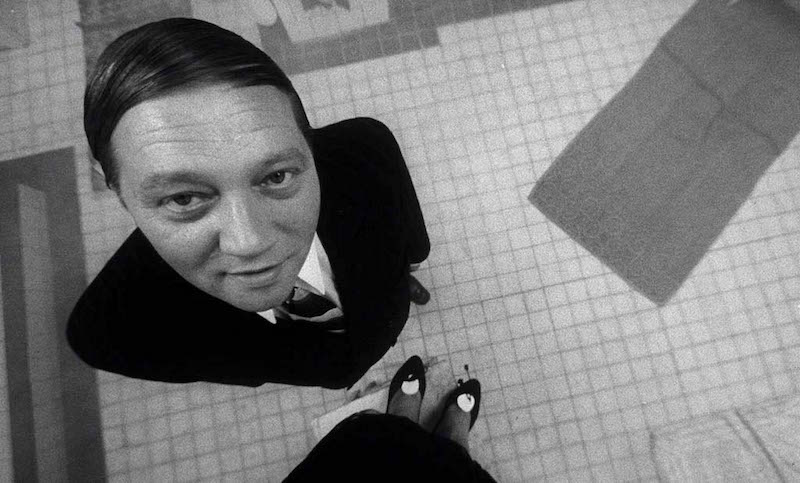
THE CREMATOR
The AFI Silver Theatre and Cultural Center launches In and Out of the Czechoslovak New Wave, its monthlong retrospective of Czech director Juraj Herz, with a 1969 black comedy that’s a perfect fit for the Halloween season. Set in Nazi-occupied Prague, this darkly expressionistic film tells the story of Karel (Rudolf Hrušínský), a mortuary worker who believes that cremating bodies frees the souls of the departed. Based on a novel by Ladislav Fuks, the movie was banned in Czechoslovakia shortly after its release and was not released in its native land until 1989. The Cremator‘s morbid subject doesn’t quite sustain its bleak drama for the length of the film, but there are some unforgettable images here. The New Yorker’s Anthony Lane wrote: “As a contemporary of the great animator Jan Švankmajer, Herz practiced a surrealism that is bare of whimsy and armed with aggression; one image splinters into the next, and, in the opening scene, full of caged beasts, you feel the prowling presence of Kafka.”
Watch the trailer.
Saturday, Oct. 26, at noon; Sunday, Oct. 27, at 11 a.m. and 8 p.m.; Monday, Oct. 28, at 5:15 and 9:30 p.m.; and Tuesday, Oct. 29, at 9:30 p.m. at the AFI Silver Theatre and Cultural Center. $13.
Comments are closed.