

jonetta rose barras: The boot that Jack Evans made, and finally was given — ethics reform in DC, Part 1
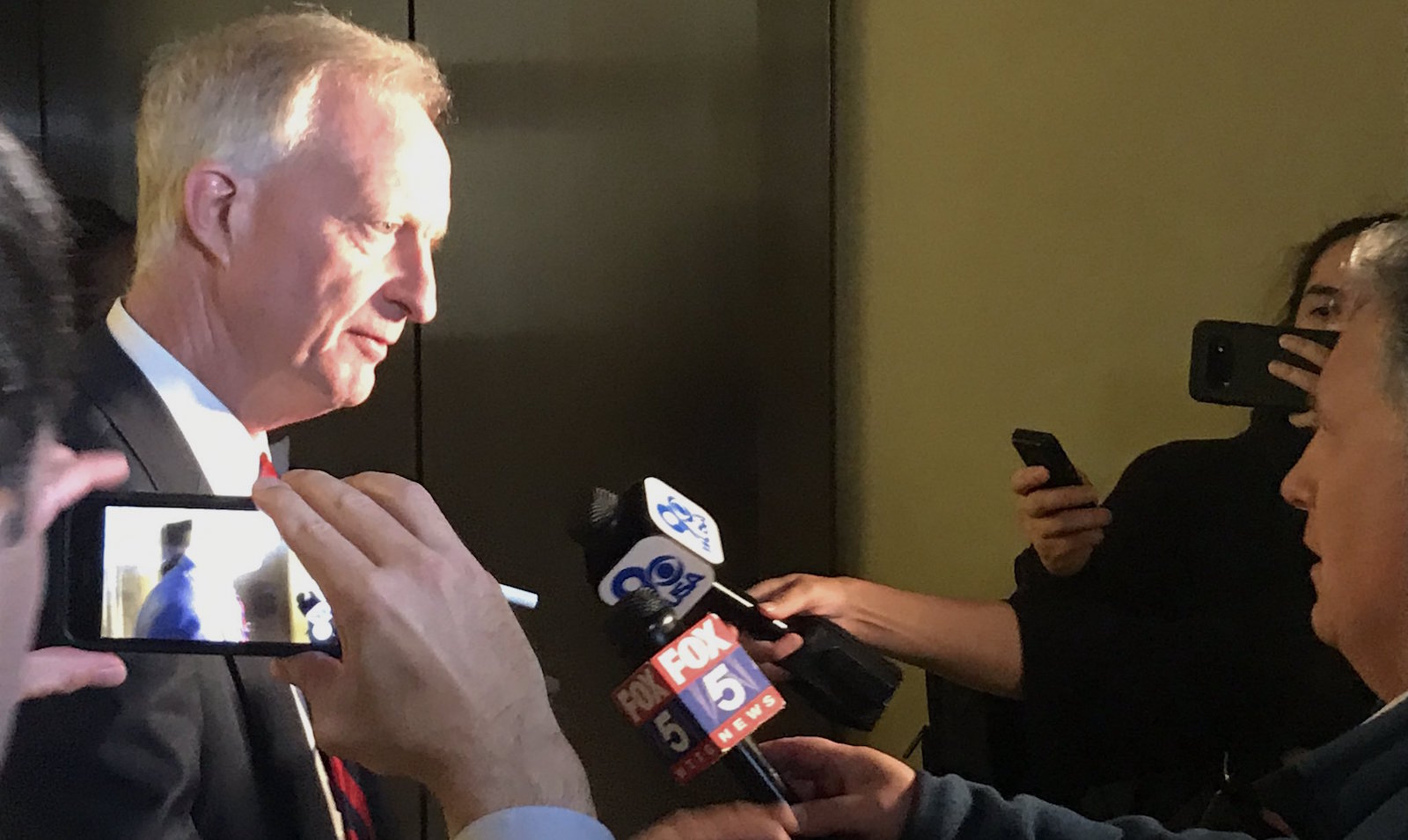
Around 9:30 Tuesday morning, as DC Council members ended their breakfast before the scheduled legislative meeting, some lawmakers seemed uncertain about what would happen when the special committee — created to examine the Jack Evans ethics scandal — gathered later that day. “I don’t expect us to vote on the punishment today. There isn’t any real consensus,” one member told me just before walking into the council chamber. “Maybe by the end of the day there will be.”

By 2 p.m., all 12 council members of the ad hoc committee had, in fact, reached consensus and chose a punishment for their colleague’s serious ethical violations: expelling the man who often boasted of being the city’s longest-serving council member.
Public pressure, scandal fatigue, personal grievances of council members against Evans, the general perception that he’s unforgiving and arrogant, and a highly competitive political climate all helped fuel the council’s unprecedented decision. Equally important, Evans seemed to have become the local doppelganger for what’s been playing out on Capitol Hill, as Democratic congressional representatives make the argument that President Donald Trump used the powers of his office for personal and political gain.
Ironically, that same generic charge haunted Evans, a Democrat, for the past year, as citizens learned of missteps and wrongdoing through news articles and the findings of multiple ethics probes. The council had struggled with an appropriate response. The Ward 2 representative was reprimanded earlier this year for using government resources to distribute two emails designed to land him jobs at two local law firms; in those documents he essentially peddled his influence as a legislator and chair of the powerful Committee on Finance and Revenue.
Evans was stripped of his chairmanship of that committee this summer. Later, the Board of Ethics and Government Accountability, through a negotiated settlement, fined the Ward 2 council member $20,000 for ethics violations involving the two emails.
Last month, the council received a report from O’Melveny & Myers, a law firm hired to conduct an independent investigation of the intersection between Evans’ private business activities and his actions on the council between 2015 and the summer of 2019. O’Melveny found at least 11 violations by Evans of the legislature’s rules and codes of conduct. Evans did not disclose as required his relationship with several private businesses and did not recuse himself from voting on matters for which those private clients stood to benefit. Moreover, Evans was paid as much as $430,000 between 2016 and 2019 from clients of NSE Consulting, the firm he created. He was its sole staffer, which meant all of that money essentially went into his personal checking account. Those were some of the factors that played into council members’ Dec. 3 vote.
Evans misjudged the public’s appetite for scandal in an environment when they have been overwhelmed by it at the national level and seemed determined not to forgive it in their own front yards. He thought his outsize contribution to the city’s growth and development would mean that he would receive a pass for any missteps — except that there have been far too many over the years. Finally, he did not accurately take the temperature of people next to whom he has sat for years; he did not understand their growing dissatisfaction with him — his agenda and his style.
“Citizens expect us to be the best. Not just our best selves, but a cut above everyone else. Yet, in fact, we are just ordinary people,” Council Chairman Phil Mendelson said in a prepared statement after the vote. “Nevertheless, citizens have the right to hold us to basic standards of trust, honesty, and integrity. We hold ourselves out to exemplify these standards when we run for election, and when we fail to uphold these standards, our troubles are our doing.”
Evans declined to comment for this column. However, he has admitted that he committed some violations, while disputing the extent portrayed by O’Melveny & Myers. Further, Evans has claimed it was never his intent to commit any violations and that much of what he did was to provide standard constituent services or follow through on his well-established public policy agenda. Those arguments proved impotent.
Ward 3’s Mary Cheh, chair of the ad hoc committee, said the “course is set” for Evans to be expelled from the council for “gross misconduct,” a power granted by voters when they approved a charter amendment in 2012. The committee will meet Dec. 10 to approve its report that will be submitted Dec. 17 to the full council. According to its rules, the legislature must then hold a public hearing no sooner than one week after receiving that report; Evans will be invited to appear. However, because of the holidays, neither that hearing nor the final formal vote to expel is expected to occur until January.
At the height of his career, Evans had been one of the most impressive legislators in our city, with an enviable legacy. He played a major role in reshaping DC’s police department; directed tax relief for businesses, both commercial and nonprofit; pushed for construction of four sports arenas as well as the city’s current convention center; expanded funding for arts and humanities; and instigated redevelopment of several key neighborhoods through the formation of business improvement districts. Now, after a year filled with multiple investigations, including one still underway by the U.S. Attorney’s Office, and a poorly organized citizens recall effort, Evans’ political fate has been sealed. The Board of Elections decision Thursday morning to throw out the recall for insufficient valid signatures doesn’t change that.
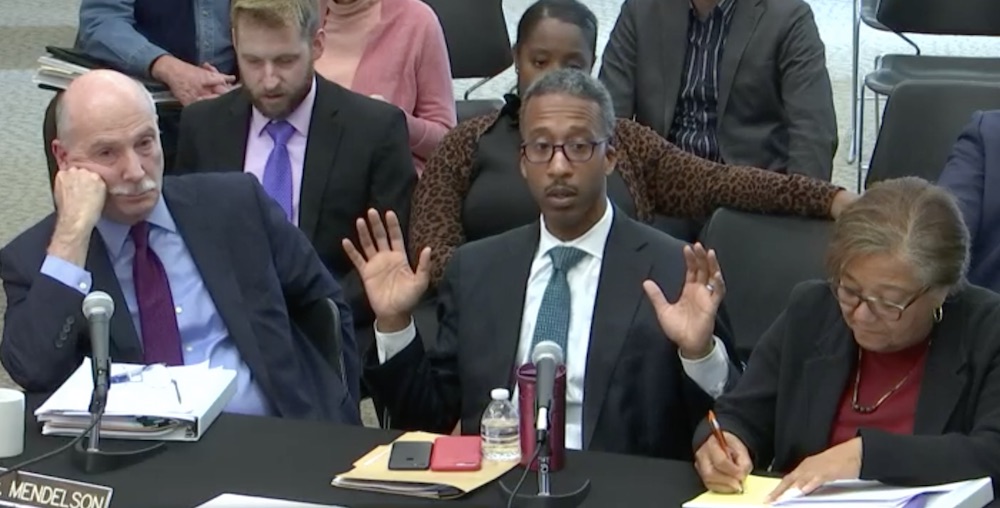
In explaining his vote to expel, Council Chairman Pro Tempore Kenyan McDuffie said several of his colleagues had made compelling arguments but that the “case was [also] made by Mr. Evans himself.” McDuffie cited a pattern of behavior involving “use of government resources, colleagues and the use of staff” in what amounted to “the most egregious abuse of power I’ve witnessed.”
“It was conscious, concerted and deliberate,” added McDuffie, a former federal prosecutor.
The 12-member ad hoc committee, which excludes Evans, may have presented itself as a special body of the council. For all intents and purposes, however, it is the council. Unless two or more of those who voted on Tuesday change their position, Evans will become the first DC Council member in the history of Home Rule to be expelled from office — unless he opts to resign before the legislature takes action. Either way, there is little doubt that this episode of his career will be prominent in future accounts of his tenure.
Most members were rightly concerned about public trust, as Mendelson articulated. In 2012, after three council members were forced to resign due to federal felony or misdemeanor charges, Mendelson was elected by his colleagues as acting chairman, carrying the burden of refreshing the legislature’s image and restoring its reputation. Now less than a decade later, he once again is being forced to act as the trust architect for the legislature while assuaging concerns of residents with disparate views on what should and should not have happened.
Trust was certainly an issue in this scandal, but politics also played a starring role. Even as all 13 members of the council are essentially members of the Democratic Party, there have been growing divisions in both policy and general ideology. In recent years Evans has become the unwitting symbol of socioeconomic issues that progressives and their council allies — Elissa Silverman, David Grosso, Charles Allen and Robert White, among others — have highlighted, including income inequity, gentrification and criminal justice discrimination. Often these issues have been wrapped in the jargon of class and race.
Robert White characterized the various opportunities Evans has been given as “an exercise of extreme privilege.” That word privilege was used more than once during Tuesday’s deliberations. And Silverman cast Evans as having acted on behalf of a “group of powerful business leaders and lobbyists.” Translation: rich white men.
On Tuesday, Allen recast the racial and class components of the council’s heated debate one year ago on Metro fare evasion. Evans, who at the time chaired the board of the Washington Metropolitan Area Transit Authority, had opposed the plan to decriminalize the offense, explaining that the transit agency stood to suffer an annual revenue loss of $25 million. (Earlier, I wrote against passage of that bill, which eventually became law.) Ignoring that argument, Allen characterized Evans’ stance as encouraging punishment of poor black people who commit crimes of poverty — but being unwilling to accept punishment for his own actions.
In the present context, that argument boxed in every African American legislator, giving them no place to run. They had already been hammered by many constituents who believed a double standard was at play, because black politicians — namely Kwame Brown and Harry Thomas Jr. — had been forced to resign. Trayon White noted that people constantly stopped him on the streets of Ward 8, asking, “What are you going to do about Evans?”
Thus, the thinking goes, Evans hadn’t just committed any old ethics violations — he had given the advantage to rich white people, who were trying to claim the city for themselves, pushing out blacks and the poor. That narrative played out in bits and pieces through the last year, gaining its maximum traction and advantage on Tuesday.
With several council members facing re-election — Robert White, Trayon White, Brandon Todd and Vincent Gray — and political progressives including those associated with DC Working Families Party, DC for Democracy and Jews United for Justice Campaign Fund becoming more active in various campaigns, incumbents could not run the risk of appearing too timid, or unwilling to punish obvious wrongdoing by one of their own.
Don’t perceive the unanimity on the ethics vote as an indication that the progressives and the moderates on the council — or in the community, for that matter — have stopped fighting each other. Nor should anyone think the city has reached closure on the Evans scandal.
Interestingly, there is nothing currently in the law that would prevent Evans from picking up qualifying petitions in February and running for office in the June primary, or waiting until later to run in the November general election as an independent. That little twist and other gaps that have become apparent in the council’s ethics regime underscore why the legislature should get busy instituting a host of reforms.
This post has been updated to omit a reference to Michael A. Brown since he did not resign from the DC Council; he was already out of office when he was charged and pleaded guilty to bribery.
jonetta rose barras is an author, a freelance journalist and host of The Barras Report television show. She can be reached at thebarrasreport@gmail.com.
Jonetta: The issues with Jack Evans is just the tip of the iceberg of these types of problems with the DC Government. I wonder when the residents are going to come to their senses and kick them all out of office. Colbert King’s article about the D C residents not caring about their elected leaders rings true. Good job here.