

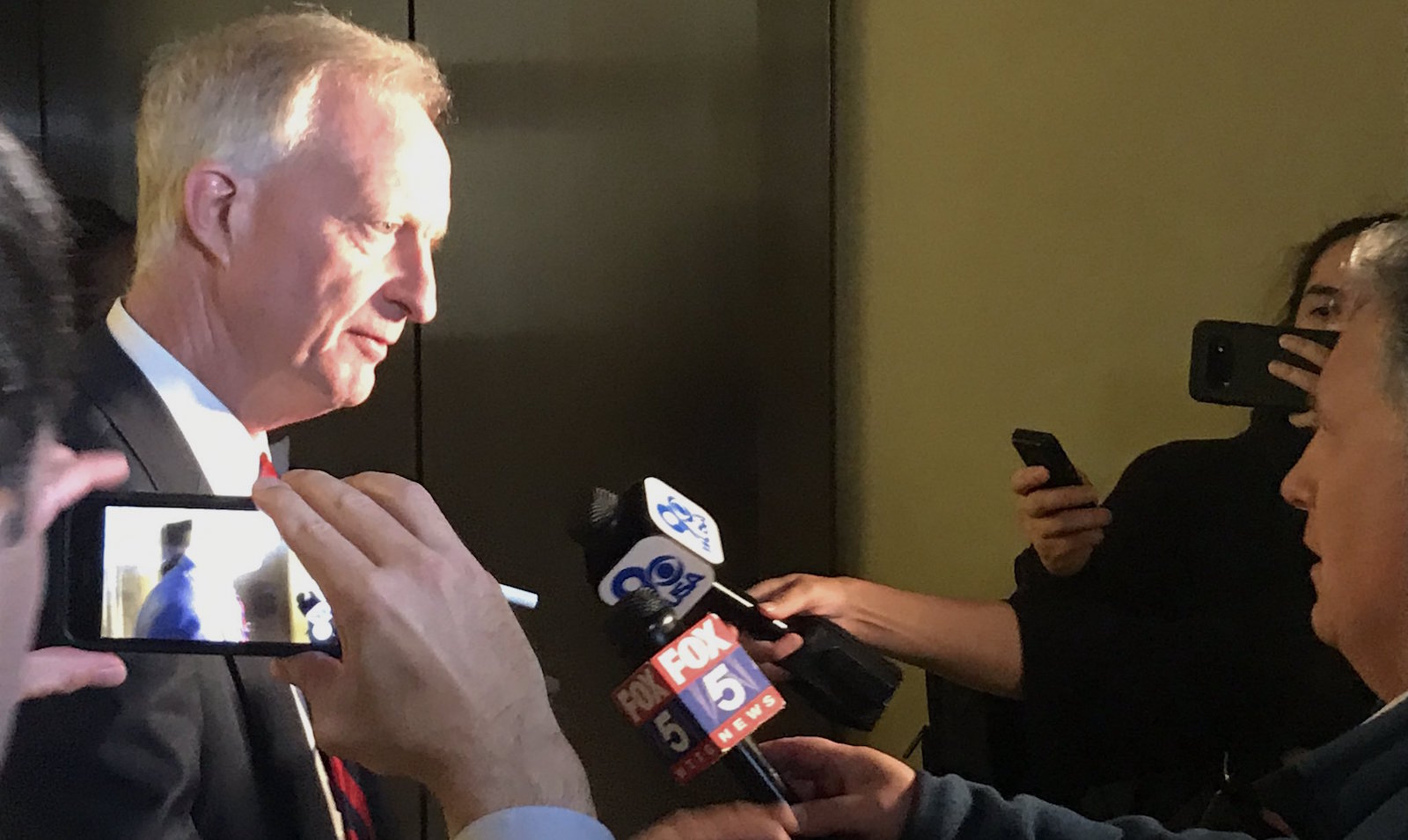
Jack Evans received a long list of developers from EagleBank while the bank was his client
In September 2016, DC lawmaker Jack Evans and Ronald D. Paul, then head of one of the largest community banks in the region, traded emails about a list.
The list — obtained through a public records request and reported here for the first time — is a six-page Excel spreadsheet with the names of 57 entities involved in local real estate. Most are major development firms that have driven a range of projects, including some of the DC area’s most transformative developments this decade: The Wharf, CityCenterDC and Amazon’s planned second headquarters in Northern Virginia.

While released in a heavily redacted form, the list appears to contain contact information for people linked to the entities. Along with the email exchange between Evans and Paul — who at the time served as CEO and chairman of Bethesda-based EagleBank — it offers new clues about the early months of Evans’ behind-the-scenes business dealings through his home-based firm, NSE Consulting. The documents also shed light on the ties between Evans, the veteran Ward 2 council member, and EagleBank, in which he has owned stock for over a decade and for whom he was a paid consultant.
Evans’ secret business dealings were the subject of official investigations commissioned this year by the DC Council and the Washington Metropolitan Area Transit Authority board’s ethics committee, precipitating his political demise. But neither investigation acknowledged the spreadsheet or the communications surrounding it in the written findings. This was despite the fact that, in both probes, Evans told ethics investigators that in 2016 he asked Paul, his longtime friend, for a job at EagleBank and Paul suggested he instead work as a consultant for the bank. (All DC Council members except the chairman are allowed to hold second jobs.)
In an interview conducted by council investigators, Evans recalled meeting for coffee that year with Paul and Bob Pincus, then the bank’s vice chairman. “That was pretty much the genesis of it,” Evans said of his consultancy.
The Paper Trail
The emails between Paul and Evans transpired a month after they signed valuable contracts between their respective businesses. In August 2016, according to the council’s investigation, NSE struck consulting agreements with both EagleBank and RDP Management, a Bethesda-based real estate company owned by Paul.
Unknown to the public and Evans’ fellow council members, the contracts stated that over the subsequent year Evans would receive total payments of $37,500 and $25,000 from EagleBank and RDP, respectively. Evans — who was originally elected to the council in 1991 and is currently its longest-serving member — agreed to provide what the contracts simply called “information and advice, regarding business matters.”
On Sept. 2, 2016, Paul relayed the entity list in an email to Evans: “Jack, Sorry for the delay, but things have been crazy at the Bank,” he wrote. “Attached is the list that Bob and I prepared. By copy of this letter, I am asking our assistant, Jane Cornett to schedule a time that the 3 of us can get together to discuss the right approach.
“Jane, know schedule is crazy but this is important,” Paul continued. “Breakfast, lunch, drinks, meeting, whatever works. Always available on cell.”
Hours later, Evans simply answered “Ok,” according to another email obtained through the records request, which was made to the council under DC’s Freedom of Information Act.
The entities on the list are arranged in alphabetical order, beginning with DC-based developer Akridge and ending with Potomac, Maryland-based developer Willco Cos., once a client of NSE’s and the only such client on the list.
In between are other major players in the DC-area real estate market, including: the Bernstein Cos., the Bozzuto Group, Conrad Cafritz, Donatelli Development, Douglas Development, Edens, Foulger-Pratt, Grunley Construction, Hines, Jair Lynch, JBG, the Lenkin Co., Lerner, Mid-City Financial Corp., MRP Realty, the Peebles Corp., PN Hoffman, the Rappaport Cos., Rock Creek Property Group, StonebridgeCarras, Telesis Corp. and Urban Atlantic. Many of the list’s developers have financed their projects with loans from EagleBank, public records show.
Also on the list are a retail brokerage, an insurance brokerage and a nonprofit community health center — all local. The insurance brokerage, the Meltzer Group, executed a referral deal with a subsidiary of EagleBank in 2010, according to the Washington Business Journal.
The exact purpose of the list is unclear, as Evans, EagleBank and Paul all either declined to comment or did not respond to requests for comment. However, in an unsworn interview with the council’s investigators this fall, Evans said Paul gave him the list as a favor while he was starting up his consultancy and looking for clients.
But, according to the investigation, Evans “could not identify any NSE services that he provided to EagleBank or RDP, besides being generally available if either company needed him.” Evans was not placed under oath for any of his four interviews with the ethics examiners, which lasted 12 hours total.
In 2017, the annual fees that EagleBank and RDP would owe Evans jumped to $50,000 each, under extension contracts. The examiners said they did not find any “documentation regarding the precise end date[s]” for NSE’s agreements with those companies.
The later versions of the contracts specified that Evans would provide EagleBank and RDP “information and advice regarding the metropolitan Washington, D.C. business community, including strategic issues relating to jurisdictional competition, transportation, and real estate, including landlord introductions and, where requested, liaising with landlords.” The lawmaker would additionally offer them “information and advice about federal matters and opportunities.”

“Just as a Friend”
Today, Evans faces likely expulsion from the DC Council and a federal investigation by the U.S. Attorney’s Office for DC over his use of public office. (He has not been charged with a crime.) Legislators are poised to finalize his ouster in January, following various revelations about his alleged misconduct. He stands to be the first DC Council member ever to be expelled.
The council’s investigation into Evans was steered by white-shoe law firm O’Melveny & Myers, which issued a wide-ranging, 100-page report last month. Yet neither the entity list that EagleBank’s Paul sent Evans in 2016 nor the associated emails between them was divulged in the report.
These documents were also left out of the hundreds of exhibits attached to the report. They were discussed only for a few minutes in the O’Melveny team’s final interview with Evans.
According to a transcript of that Sept. 23 interview, the investigators presented Evans with copies of the list, the email from Paul and a contemporaneous email Evans sent to his scheduler, Windy Abdul-Rahim. “This is important to CE,” the latter email pointed out, per the transcript. “Must get scheduled ASAP.” Evans told the O’Melveny attorneys that “CE” — presumably shorthand for “Council member Evans” — referred to him.
When asked about the meaning of the list and Paul’s message, Evans said Paul “was trying to identify potential clients for me … NS[E] … just to be helpful … just as a friend.”
“It looks like a lot of these clients are in the real estate development business,” noted Steve Bunnell, one of the O’Melveny lawyers. “Is that fair to say?” Evans responded: “I don’t know, Steve.” Bunnell then asked him whether there was “a particular industry you thought might be promising for your business.” “No,” replied Evans. “These were — again[,] a list from Ron Paul.”
Several breaths later, Evans said he knew who “a lot” of the people on the list were, but denied that he sought business from them for NSE, with the exception of Willco. “There was nobody I attempted to get that I wasn’t successful other than that I decided not to go for,” Evans said, according to the transcript.
Evans also denied taking any follow-up action in connection with the list, other than possibly “sitting down, going through it” with Paul, and added that he did not know if Paul followed up with any of the entities. Evans recalled that “these were people Ron was going to contact on my behalf,” but said he did not know if Paul ever did so.
Bunnell, a partner at O’Melveny and seasoned former federal prosecutor who spearheaded the investigation, said his team could not comment for this story. The team last month presented its findings to the ad hoc council committee formed in October to consider the Evans affair.
Already this year, Evans was booted as the longtime chair of the council’s influential finance committee; he separately resigned from the board of Metro. In July, facing increasing public scrutiny, he shut down NSE. But he has both denied wrongdoing and expressed regret over his handling of certain matters related to the outside employment he has held.
A public hearing on Evans’ prospective removal is set for Jan. 7, with an ultimate vote expected to follow on Jan. 21. Even if he survives that vote, his current term is scheduled to expire at the end of 2020 and several challengers are running in the Democratic primary to take his seat. Evans has not declared his own candidacy yet.
The U.S. Attorney’s Office for DC did not respond to requests for comment.
The Dinner and the Stock
In 2016, the week after Paul transmitted the spreadsheet to Evans, the two of them appear to have met for dinner with Bob Pincus — then EagleBank’s vice chairman and, like Paul, a longtime friend of Evans’.
Included in the O’Melveny report’s attachments is an email from Sept. 11, 2016, that Pincus sent to Jane Cornett, EagleBank’s corporate secretary, and another bank colleague. “As you are aware, Jack, Ron and I had dinner Thursday and he would like to know,” he wrote. The surrounding email chain indicates that he was inquiring about Evans’ stock in Eagle Bancorp (EGBN), the bank holding company for EagleBank.
Cornett replied that Evans owned “2,047 shares.”
The O’Melveny team reported that the value of this stock fluctuated from $37,460 to $139,298 between 2013 and 2019, and that Evans did not properly declare it on his annual financial disclosure forms. This alleged failure violated the council’s code of conduct, the attorneys determined, one of Evans’ multiple alleged violations.
Evans’ own lawyers have said the missing disclosure was the result of a misunderstanding. He purchased the stock, in 2005, as shares in Fidelity & Trust — a bank where Pincus served as chairman and which merged with EagleBank in 2008. It was years later that DC’s disclosure rules changed to require reporting stock ownership even when the stock was not in an entity doing business with the District.
“As far as Mr. Evans knew and what the record seems to agree is that Eagle Bank had no such contracts with the District Government,” Evans’ legal team wrote in a Nov. 5 letter to the council’s ad hoc committee, in response to the O’Melveny report. “[A]nd when the form was later changed, no training was offered to put members on notice against importing their prior years’ reports.”
As documented by The Washington Post and local website District Dig in recent months, Evans in 2011 introduced legislation that, if passed, would have benefited EagleBank by diverting DC government funds to community banks just like it. At that time, Evans told the Washington Business Journal that the idea for the legislation came from EagleBank — specifically Pincus.
The bank told the Post that it was unaware of Evans’ “failure to disclose” his EGBN shares. His latest disclosure statement, filed days after the paper’s article, divulges EagleBank stock worth between “$50,001 [and] $100,000.”
More Investigations
Both Pincus and Paul, the former CEO and chairman of EagleBank, declined to speak with the council’s investigators, despite tailored subpoena requests, according to the O’Melveny report. The DC Line’s efforts to reach Pincus, who retired from EagleBank at the end of 2016, were unsuccessful.
Paul co-founded the bank in 1998 and was CEO until last March, overseeing its expansion to over $8 billion in total assets and 20 branches across the DC region. In a move that “rocked the business community” — as the Business Journal put it — he stepped down abruptly, citing personal health issues.
The announcement came just two weeks after he, EagleBank and RDP, Paul’s real estate firm, were named in federal subpoena requests to the District government. Then, in a quarterly earnings report in July, EagleBank revealed it was cooperating with government investigations and so its legal costs had spiked.
The bank’s report mentioned “the retirement of certain former officers and directors” and “the relationship of the Company and certain of its former officers and directors with a local public official” as issues that unspecified government agencies were examining. The next week, an EagleBank shareholder filed a class-action lawsuit against the bank over what the complaint called “materially false and misleading statements” about EagleBank’s business and policies.
The case is now pending in federal court, and throughout the year EagleBank has seen numerous departures from its staff and board, the Business Journal reported. A spokesperson for the bank told The DC Line: “Eagle is not planning to comment at this time regarding conversations/communications that occurred between Ron Paul, Bob Pincus and Jack Evans.”
“In fact, the dignity, discretion, restraint, and repentance with which Profumo lived his life after his fall were the last gasp of an old system of values. His honorable conduct—continued for years, away from the blaze of publicity—would now be almost inconceivable among the political elite.”