


Amid growing demand, DC Immersion Project works to boost dual language programs
When Vanessa Bertelli moved with her family from Shanghai to Washington in 2010, she was sure her children would have access to dual language education. It is, after all, the nation’s capital. A child of a bilingual family, Bertelli grew up in Switzerland speaking English and Italian, surrounded by multilingual classmates.
“Coming to DC and realizing that there were so few programs was really shocking to me,” she said.
Bertelli realized at a young age the value of multilingualism because she saw the positive effects it had in her classes. “Understanding that not everyone thinks like you is a huge part of being more tolerant,” she said. “I appreciate that, and want that for the place I’m living in.”
Bertelli began advocating for dual language programs soon after arriving in the District. In 2012 she joined a small community of parents and families working to start a dual language program in their neighborhood school, Garrison Elementary — an effort that was unsuccessful.
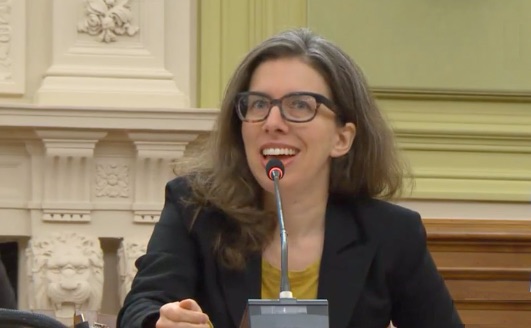
Seeing a need to inform DC families, educators and lawmakers of the benefits and options for language learning, Bertelli went on to launch the DC Language Immersion Project in 2014 alongside Jimell Sanders, now chair of the organization’s board. In partnership with multiple DC agencies, the group sponsored the city’s fourth annual Multilingual Education Fair on Jan. 25, drawing 145 exhibitors and a daylong stream of families to the Roosevelt High School atrium.
Through her work with the DC Language Immersion Project, Bertelli has sought to overcome what she describes as a “patchy” understanding among DC stakeholders of the benefits of Dual Language Immersion (DLI) programs for students across racial, ethnic, linguistic and socio-economic backgrounds. The group’s website highlights research suggesting that these programs lead to higher achievement and greater access to jobs.
Though many focus on the benefits for children in English-speaking families, experts say that DLI programs are among the most effective interventions for English learners (ELs), increasing students’ English proficiency and closing the reading gap — facts that motivate Bertelli to continue her efforts.
“If you don’t understand the language spoken in a classroom, obviously you aren’t going to be able to learn,” said Bertelli. However, only 20% of ELs in DC are enrolled in one of about two dozen DLI programs in DC’s public and public charter school systems, according to the DC Language Immersion Project.
“This is egregious,” she added. “Something is not working in the way that we approach this problem.”
To educate community members on the benefits, the DC Language Immersion Project began hosting events such as the Multilingual Education Fair. Held each January, the annual expo highlights immersion programs in the District, as well as alternative options for language learning, such as books, games, and after-school and study abroad programs. Since it began in 2017, the fair has grown to the largest event of its kind in the mid-Atlantic, organizers say. This year’s expo included a performance by Syrian American rapper and poet Omar Offendum and a panel on the power of multilingualism in the workforce.
The group’s efforts, in many ways, have already paid off. Back in 2014, Bertelli says, very few DC Council members even knew what dual language education entails. Five years later, eight members signed on in January 2019 to legislation introduced by Ward 4 Council member Brandon Todd to accelerate dual language programs in the District.
“Multilingual education is proven to boost cultural competency, reading, writing, and cognition. Dual language immersion also provides our young people with the skills they need to prosper in a globalized economy,” Todd wrote in a post on the Petworth News website when the legislation was introduced. “Yet many District students still lack sufficient and equitable access to multilingual education.”
Despite the strong initial support, the bill has remained in committee without a public hearing. A spokesperson for at-large Council member David Grosso, chair of the Education Committee, said the panel is waiting for the Office of the State Superintendent of Education to submit a “landscape analysis of the need” for dual language programs via a $200,000 study the council voted to fund at Todd’s behest when it passed the District’s 2020 budget. In addition, the Education Committee’s budget report called for specific goals from DC Public Schools on how to increase the number of seats within the next five to 10 years.
Despite support from many parents for language immersion — as evidenced by the long waitlists for schools with DLI programs — the school system lacks the means to keep up. A spokesperson for DC Public Schools said that one of the most challenging factors is finding qualified bilingual teachers.
Recognizing the growth of interest, DCPS is working on a long-term vision for supporting existing DLI programs and creating more. The DC Public Charter School Board also reports that DLI programs draw particularly high demand, but it does not necessarily give preference to these programs when new schools are being established. Among the four applications now pending before the board, two would establish new DLI schools — one offering Arabic immersion and the other both Spanish and Mandarin immersion.
The DC Language Immersion Project, now in its second year with salaried staff, is working to overcome challenges to expansion, such as limited access to qualified teachers and misunderstandings about what is required for instituting dual language programs. To address these challenges, Bertelli and other organizers recognize they need DC-specific research.
“As an organization, we’re adamant that we need data,” said Bertelli. “There’s been a number of guesstimates and theories on who’s in these programs [and] who’s pushing out who, but no one has the data,” she said, referring to concerns that programs “are gentrifying” and therefore serving fewer at-risk students than they otherwise could.
“If we really want to have in-depth conversations about how we address these issues, we must start off with data,” she added.

Bertelli and Linsey Silver, DC Language Immersion Project’s director of teaching and learning, reached out to staff at the University of Maryland’s National Foreign Language Center (NFLC), located in Riverdale. The two of them asked if the staff there could write something small about the demographics of DLI programs in DC.
That “something small” turned into a two-year research project conducted by NFLC and DC Language Immersion Project that was released in early November, examining the demographics and equity of DLI programs in the District.
“It was a very collaborative project,” said Rebecca Damari, director of research at NFLC and lead author of the report.
Damari and her colleague Catherine Palupa took on most of the data analysis; meanwhile, Bertelli and Silver helped frame questions, evaluate research, add context to the findings, and draft an extensive section dedicated to the history and value of DLI programs, both generally and in the District.
Among the main findings, the researchers discovered that DLI schools in the District had a more even distribution of racial and ethnic groups on average than did non-DLI schools. The authors use this finding to make the case that DLI programs provide an opportunity to work toward better integration in DC public education, which is still highly segregated.
However, DLI schools had smaller proportions of black students and higher proportions of Hispanic students on average, again compared to non-DLI schools. White and Asian students were distributed relatively evenly across DLI and non-DLI programs.
Another discovery was that a randomly selected DLI school in school year 2015-16 — the focus year of the snapshot analysis — could be expected to have 20.8% fewer at-risk students than a randomly selected non-DLI school that same year. Researchers attributed this to geography, since there is a noticeable lack of DLI programs in areas with high proportions of at-risk students. There are just two DLI programs total in wards 7 and 8, a gap that the DC Language Immersion Project would like to see filled.
“Even if at-risk populations were fully aware of the benefits of these programs and even if they deeply wanted them for their children, because of their location, these programs are not a realistic choice for most families,” Bertelli said of the difficult commutes that would arise because the existing campuses are clustered elsewhere in the District.
The researchers found that it takes families 28 to 68 minutes to travel from the closest Metrorail station in Ward 7 or 8 to the DLI programs included in the study. The two programs east of the Anacostia River, at Houston Elementary School and Elsie Whitlow Stokes Community Freedom Public Charter School–East End, were not included in the study because there wasn’t any data publicly available when the study began.
Another aspect of the analysis stemmed from concerns from parents and advocates that the enrollment in DLI programs has become whiter and wealthier. The team wanted to explore whether the rate of any changes have mirrored the demographic changes of DC public schools in general.
“The most startling finding to us was that the racial/ethnic change in dual language programs over the six years of the study was not an anomaly,” wrote Bertelli in an email, “but it was along the lines of the demographic shifts in DC schools overall.”
By and large, the study found decreases in proportions of black and Hispanic students, and increases in the proportion of white students, in both DLI and non-DLI schools. The rates differed, but only by 2% or less for each group.
The report recommends that DC officials establish more DLI schools in less affluent neighborhoods and give at-risk students a leg up in the lottery when it comes to getting seats in language programs. The report also identifies areas for further research to inform policy decisions.
“Much more needs to be done to ensure opportunity-boosting dual language programs are equitably available to students east of the river and to at-risk students in DC in general,” said Sanders.
For Sanders, Bertelli and the team at DC Language Immersion Project, the work is far from over. Their goal is to quadruple the number of seats in DLI programs by 2030, with more than 70% of the new seats located in low-income communities. Recently they’ve been working on a toolkit for administrators and research on how best to improve teacher pipelines.
Many people have been paying attention, like Ruth Wattenberg, president of the DC State Board of Education and Ward 3 representative. She’s noticed a growing demand for DLI programs in the city, and the ongoing popularity of Oyster-Adams Bilingual School, a dual-language school with elementary grades at its Woodley Park campus and middle grades in Adams Morgan.
Although she can’t speak for the board, Wattenberg hopes these programs will continue to grow in the District, and she praises the work of DC Language Immersion Project. “We’re beginning to get some traction on expanding these schools and making this work,” she said. “It should be a central part of what we’re offering. We’re an international city.”
Comments are closed.