

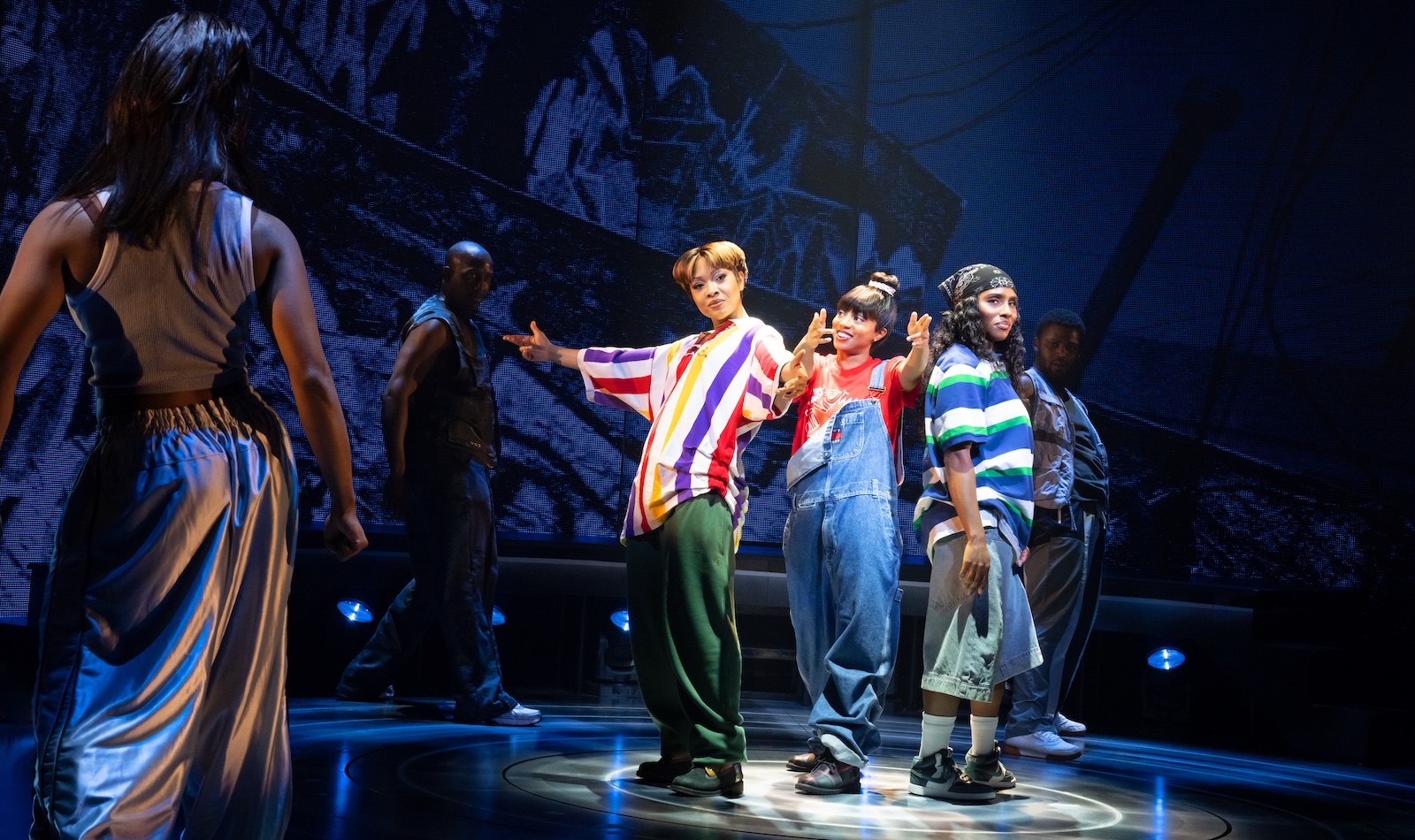
‘CrazySexyCool’ is more than a high-energy jukebox musical — it’s a portrait of survival
Performance reviewed: June 28, 2026
In Arena Stage’s CrazySexyCool – The TLC Musical, the first villain is easy to name.
He is Blake, a magazine editor who seems determined to exploit, expose and derail the influential girl group TLC at every turn. Played expertly by Josh A. Dawson, Blake is the kind of antagonist audiences immediately recognize: misogynistic, invasive, and hungry for the most intimate details of three young women’s lives. But as the musical unfolds, Blake begins to feel almost too small of a foil for the story being told.
Beyond the scandals, the fame, and the songs that changed the sound and style of a generation, this production — directed by Kwame Kwei-Armah — reveals that the deeper antagonist is life itself.
For anyone walking in expecting only a glossy jukebox musical full of R&B hits, hip-hop swagger, MTV nostalgia and 1990s attitude, the show’s emotional force may come as a surprise. The show is a high-energy, deeply felt journey that turns TLC’s rise into a story of sisterhood, survival, and the cost of fame. Unfortunately, the production falls just a bit short of its potential.
The music is smartly deployed, and the musical does not simply drop hits into the story for applause. Kwei-Armah uses the group’s most popular songs as emotional punctuation. Act 2 begins with the high-energy “No Scrubs”; “Unpretty” becomes an anthem before surgery; and by the time “Waterfalls” arrives near the end, the song resonates with the story’s sense of nostalgia and mourning.
Chloe O. Davis’ choreography is also sharp, especially in a thrilling MC Hammer mashup starring Christopher Henry Young and an energetic ensemble in “Ain’t 2 Proud 2 Beg / U Can’t Touch This.” But beneath the spectacle is a tender tale that delves into purpose and faith.
Holli’ Gabrielle Conway portrays Tionne “T-Boz” Watkins, who, living with sickle cell disease, was told as a child that it would cut her life short. Having survived well into adulthood, she goes on to have a child, only to face another devastating diagnosis. Conway carries a grounded strength that makes T-Boz’s physical battles feel neither sentimental nor decorative.
Jade Milan’s Lisa “Left Eye” Lopes is especially compelling in the moments when rage and pain become almost indistinguishable. After fire erupts during a concert scene, smoke fills the space, the turntable spins, and Left Eye runs against the rotation as if trying to outrun herself. The visual language becomes fractured and electrical, suggesting the short-circuiting of a mind under pressure.
It is one of the rare moments when the production’s technical elements — lighting, sound, projection — fuse with acting and movement to compellingly convey a psychological experience typically invisible to the audience. The sequence is a testament to the ingenuity of lighting designer Japhy Weideman, sound designer Gareth Owen, and projection designer Peter Nigrini.
Stoney B. Woods’ Rozonda “Chilli” Thomas brings warmth and steadiness, gradually emerging as an emotional anchor when the group has little reason left to hope.
This is a musical about the rise, rupture and resilience of one of the most influential girl groups in music history. Life keeps throwing itself at the three of them: illness, exploitation, heartbreak, bankruptcy, public scrutiny, romantic disappointment, artistic pressure and grief. Yet the show’s great emotional achievement is that it never flattens them into symbols or reduces them to suffering. It lets them be young women who are funny, wounded, stubborn and brave.
By the end, the musical becomes less about celebrity and more about humanity. It reminds us that behind every iconic video, every chart-topping song, and every carefully packaged image are people with bodies, wounds, histories and hopes.
The production leans heavily on projections, and the approach works best when the story itself calls for media: award shows, concert stages, television appearances, and the hyper-produced world of MTV. In those moments, the screens feel native to TLC’s universe. They reflect the machinery that helped make the group visible.
But the same projection-heavy language is less persuasive in more intimate settings. A hospital room, a bus ride, or Left Eye’s attempt to disconnect in a remote village does not always benefit from graphic reinforcement. In those quieter spaces, the projections can feel more illustrative than immersive. A projected forest does not necessarily create the sensation of spiritual retreat; at times, it reminds us that we are watching an image stand in for a place.
Still, the production’s momentum is undeniable. David Zinn’s set gives the musical a kinetic architecture, aided by fluid transitions, rising and disappearing platforms, and a stage that seems built for both concert spectacle and emotional collapse.
CrazySexyCool – The TLC Musical is full of feeling. It gives audiences the pleasure of the songs they came to hear, but also something deeper: a portrait of three women who faced down the industry, each other, and life itself, and still found a way to dance.
CrazySexyCool – The TLC Musical is playing through Aug. 9 at Arena Stage’s Kreeger Theater. The show runs approximately 2 hours and 30 minutes, with one intermission. Tickets are available at arenastage.org.
Comments are closed.