

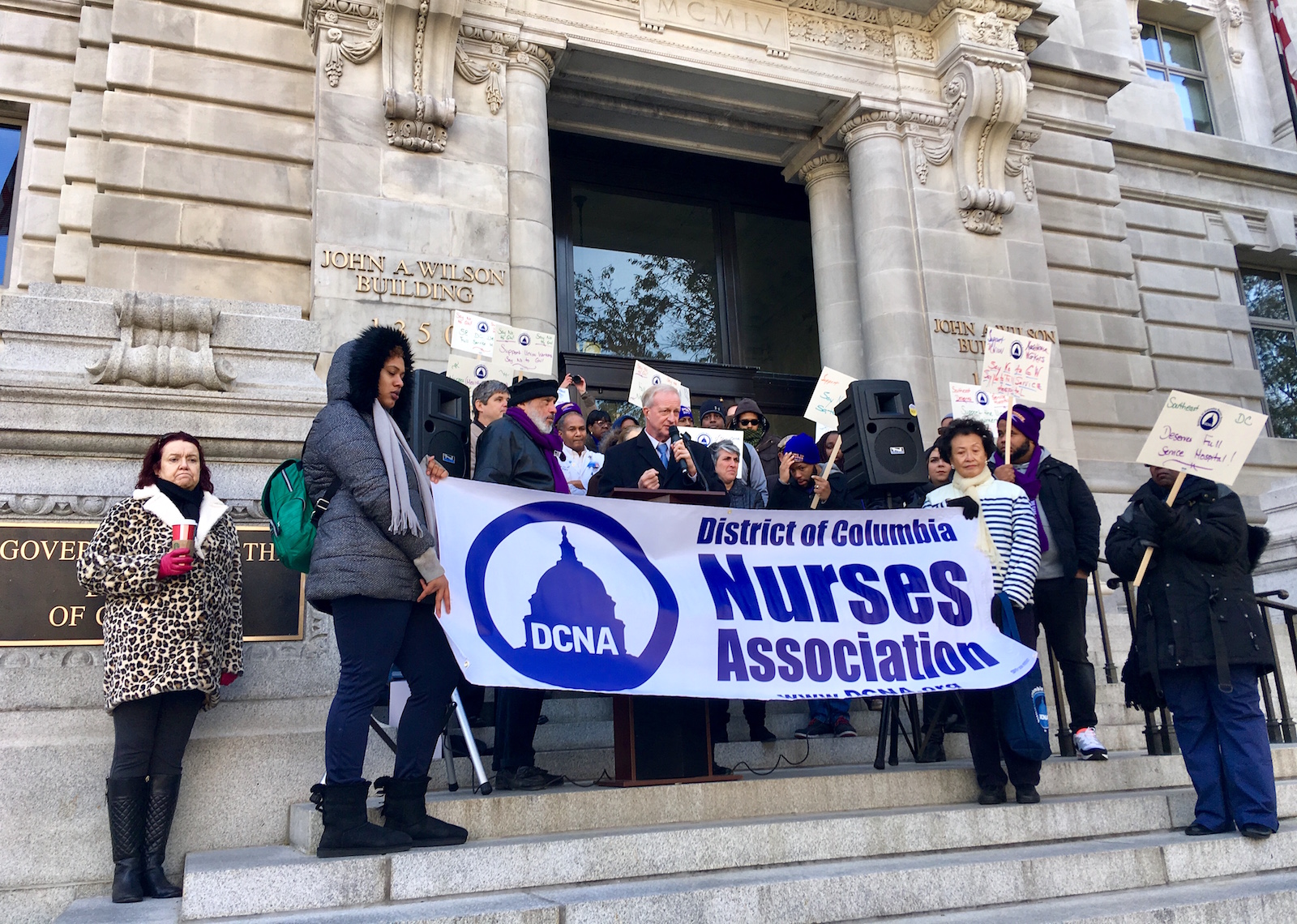
Silverman, Evans join unions to rally against East End hospital bill as key council vote approaches
After winning initial DC Council approval last month in an 10-2 vote, a bill to accelerate the timeline on a new Ward 8 hospital to be run by George Washington Hospital is encountering new resistance. Legislators are expected to consider amendments aimed at addressing some of the concerns as part of their final vote on the measure scheduled for Tuesday.
At a press conference Thursday morning, representatives from a rival hospital and labor groups joined two council members to blast the proposal as currently configured, calling for more transparency and oversight of the process. In the days since, Howard University Hospital took to social media to make its case for access to the planned East End hospital if the plan moves forward.
Ward 8 residents have the lowest life expectancy and the highest rates of chronic disease in the District. In 2010, the DC Department of Health found that Ward 8 had a life expectancy of just 70 years, compared with 86 years in Ward 2. Throughout the District, the average was 77.5 years.
To try to curb these disparities, Mayor Muriel Bowser announced in August that the city had struck a deal with George Washington University Hospital to run a new hospital in the ward on a site at the St. Elizabeths East Campus.

Though the prospect of a new hospital for the East End of the District elicited a mix of praise and relief, council members and GW Hospital have more recently drawn criticism for efforts to circumvent procedure. George Washington has agreed to operate the new Ward 8 hospital, but only if it is allowed by the city to build a new tower at its current Foggy Bottom facility. The legislation working its way through the DC Council would accelerate the timetable on both projects, citing urgent community need — upsetting community leaders in Foggy Bottom-West End neighborhood, who have decried the lack of input on a major development proposal.
In both cases, the council is considering waiving the Certificate of Need process, in which health care providers must demonstrate that the community needs their services. If passed, the bill would waive the certificate process on both the Ward 8 facility — which will have 150 beds under the existing proposal — and the Foggy Bottom add-on, which will have 270.
Washington City Paper reported last week that George Washington University opposes the expansion of the hospital facilities on the Foggy Bottom campus, casting some doubt on the viability of the deal. George Washington University is a separate entity from the hospital that bears its name, and representatives say the construction and expansion are not a “strategic priority” for the university.
Ward 7 Council member Vincent Gray, who chairs the Health Committee, is a strong supporter of the East End Health Equity Act, arguing that the city needs a new hospital east of the river as soon as possible and that GW is best-suited to fill the gap.
“The reality is that we have a health equity crisis in the District of Columbia, and if anything it has worsened,” he said at the council’s Nov. 13 legislative meeting. “There is no other hospital in the District of Columbia that has the capacity to be able to do what it is we are proposing to do.”
While the mayor has targeted a 2023 opening for the Ward 8 hospital, Gray said he wants the doors open by Dec. 31, 2021, “which is the same three years and two months that it took to fully build and complete the Nationals baseball stadium.”
Gray described the certificate of need process as unnecessary when the need for a hospital in Ward 8 is so apparent, and he defended the 270-bed expansion in Foggy Bottom.
“We’re not just building a hospital. We’re building a real health care system for the first time in the history of this city,” he said at the Nov. 13 session of the Committee of the Whole. “But the locus of much of the specialty services will be — necessarily so — located as a part of the campus that will be expanded in Foggy Bottom.”
The bill’s opponents on the council argue that GW Hospital should not be allowed to circumvent the process or bait the council with a quid pro quo deal.
“George Washington University Hospital and its owner, Universal Health Services, are giving us an ultimatum,” at-large council member Elissa Silverman said during the legislative meeting last month. “They’re putting the proverbial gun to our head. “Because of this approach, we might not get what our city truly needs.”
After an amendment to require a Certificate of Need for GW Hospital’s Foggy Bottom facility failed on a 9-3 vote, Silverman ended up voting for the bill as a whole, citing the dire need for a new hospital convenient to residents of wards 7 and 8. An earlier attempt to table the legislation failed on a 5-7 vote.
Council member Jack Evans — who represents Ward 2 and led the unsuccessful efforts at the Nov. 15 council meeting to derail the bill — called the Foggy Bottom expansion “completely unnecessary” at last week’s press conference, adding that the certificate process should be upheld for both projects.
“This provides transparency,” Evans said. “It provides neighborhood input, and it makes the case whether or not what we’re doing makes sense. That’s why we have the process. We don’t want to waive a process like that because all kind of shenanigans then take place when you take away the transparency.”

A Foggy Bottom resident who spoke at the Nov. 29 press conference urged that specialty services be located in Ward 8, at the new hospital. Patients should not have to travel across town to access treatments for serious diseases such as cancer, she said. GW Hospital has said that the campus expansion is necessary if Foggy Bottom is to accommodate patients from ward 7 and 8 receiving specialty care.
DC Council Chairman Phil Mendelson spoke against the bill at last month’s council meeting but did not attend the press conference. At a media briefing on Monday, he said he plans to vote against the bill again at Tuesday’s meeting even if an expected amendment to shift 50 of the proposed beds from Foggy Bottom to the St. Elizabeths East site is approved.
In her remarks at the press conference, Silverman said more scrutiny is needed on the specifics of the plan, with questions remaining about how much this new hospital would do for the Ward 8 community.
“The issue is, What kind of services will be put at that hospital in Ward 8?” she asked. “Are there going to be specialty services there to address some of the health care issues that are particularly prevalent east of the river? We want to make sure that the services are dispersed throughout the city.”
Other opponents of GW Hospital’s plans at press conference included the DC Nurses Association and SEIU 1199, a union that represents DC health care workers. Representatives of Howard University’s hospital and medical school also reiterated their testimony to the DC Council that without access for its doctors to the Ward 8 hospital and patient referrals, they might have to close.
The new Ward 8 hospital is meant to be a replacement for United Medical Center, the city’s troubled public hospital, where SEIU and the DC Nurses Association have a substantial presence.
“Everyone who is currently at United Medical Center and other areas needs to be taken care of in this new hospital,” Evans said at the press conference, drawing cheers from union members. “So I want to make sure that labor is included in all discussions going forward with the construction of this new hospital.”
No one at the press conference argued for maintaining United Medical Center, which has faced its share of controversies in recent years, including a few cases of questionable death. In August 2017, regulators ordered the hospital to close its obstetrics program because of dangerous mistakes by staff, leaving pregnant women with nowhere to deliver east of the river.
Universal Health Services — which has an 80 percent stake in GW Hospital, with George Washington University owning the rest — has been a frequent target of SEIU. The union has run a campaign against the company and launched a website, UHS Behind Closed Doors, to disseminate unflattering information about the health care provider. Many of the articles highlighted on the site, last updated sometime in February 2017, connect United Health Services to patient abuse and unsafe staffing.
SEIU and the DC Nurses Association are campaigning to move their staff to the new Ward 8 hospital, remain organized, and enter good-faith bargaining with GW Hospital.
Howard University Hospital draws more than half its revenue from residents of wards 5, 7 and 8, according to hospital administrators who say the deal could run them out of business if Howard physicians don’t have access to the new hospital. The Howard University College of Medicine says it trains the largest number of minority physicians in the region, and an admissions dean suggested during the press conference that closure would significantly impact the pipeline for minority doctors.
Howard began a social media campaign on Sunday opposing the hospital deal, using the hashtag #HowardMedicineMatters. A Howard University College of Medicine site implores DC residents to email their council members demanding greater access for Howard students. The school also held a rally and town meeting on Monday.
“We have worked very hard in Wards 7 and 8 for the past several decades,” Dr. Clive Callendar, a professor at the school, is quoted as saying in a post on the website. “To be excluded from participating in a new hospital East of the River is disastrous to our future.”
Ward 4 Council member Brandon Todd announced Monday night that he plans to support an amendment calling for GW Hospital and Howard to “work together to ensure a mutually agreeable solution through sincere and earnest negotiation” so that Howard students will have access to a training hospital in the East End. Gray plans an amendment to have DC study the feasibility of an “academic affiliation” for Howard at the new East End facility, according to a City Paper article today.
“I remain committed to expanding health care access across the city and fully expect that Howard will have a seat at the table as negotiations continue,” Todd said in his statement.
Kimberly Russo, the CEO of GW Hospital, has testified that the creation of an integrated health care system and the expansion in Foggy Bottom are necessary to make the Ward 8 project financially viable. GW will need the extra beds in Foggy Bottom, she says, to serve patients transferred from the Ward 8 hospital for more specialized services, including cardiovascular surgery.
“We have to expand to expand the health services on both the east end and the west end in order to create a full integrated comprehensive continuum of care to meet the needs of the residents,” she said at a hearing in October. “We do not believe that operating the east end hospital as a community standalone is fiscally viable.”
Comments are closed.