


Malcolm X teacher finds ‘sense of home’ in improving education and children’s lives
“Jambalaya.” The word typically refers to a large pot of Louisiana-style stew. It’s also the term Abimbola George uses to describe the melting pot of educational programs he’s helped introduce since 2014 at Malcolm X Elementary School in Ward 8.
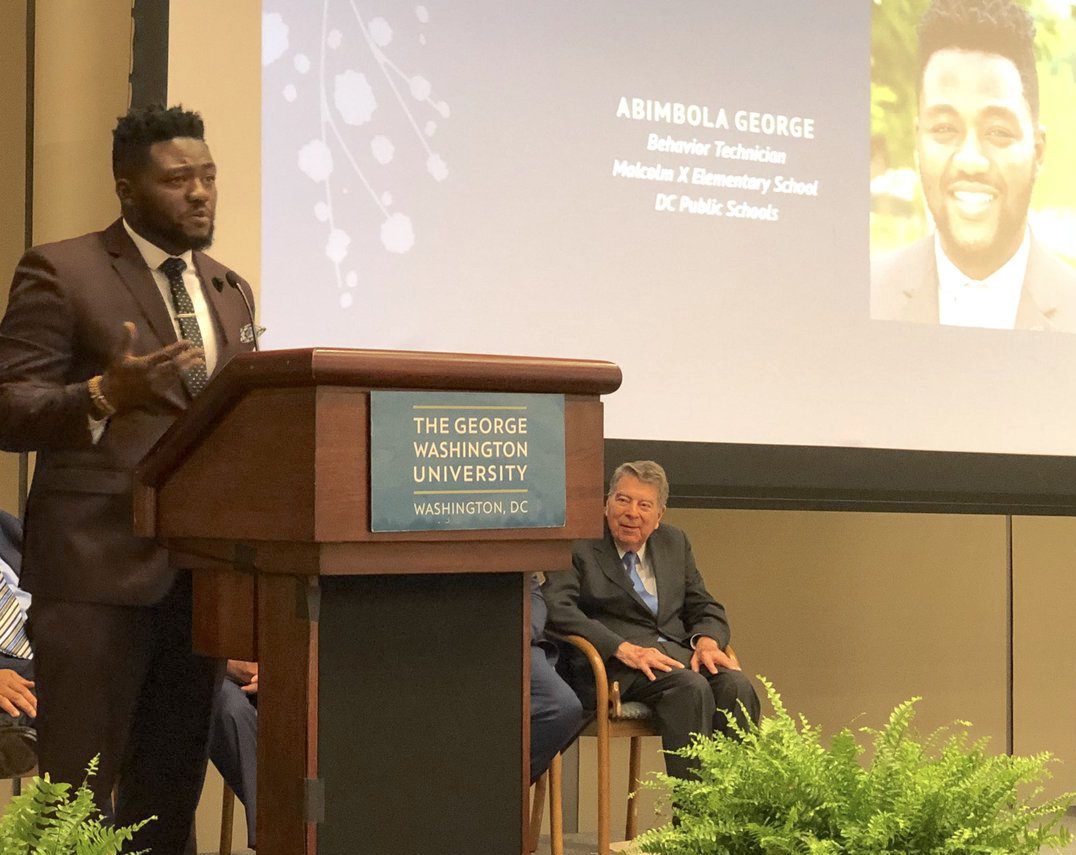
As a teacher and behavior technician for DC Public Schools (DCPS), George has spent a large part of his career researching and implementing innovative practices for educating and disciplining students. He received a Morris and Gwendolyn Cafritz Foundation Award this year for his contributions at Malcolm X Elementary, where he works with the principal, dean and other teachers to create a more positive and compassionate learning environment that addresses the unique needs of each student. The Cafritz Awards recognize outstanding performance by DC government employees.
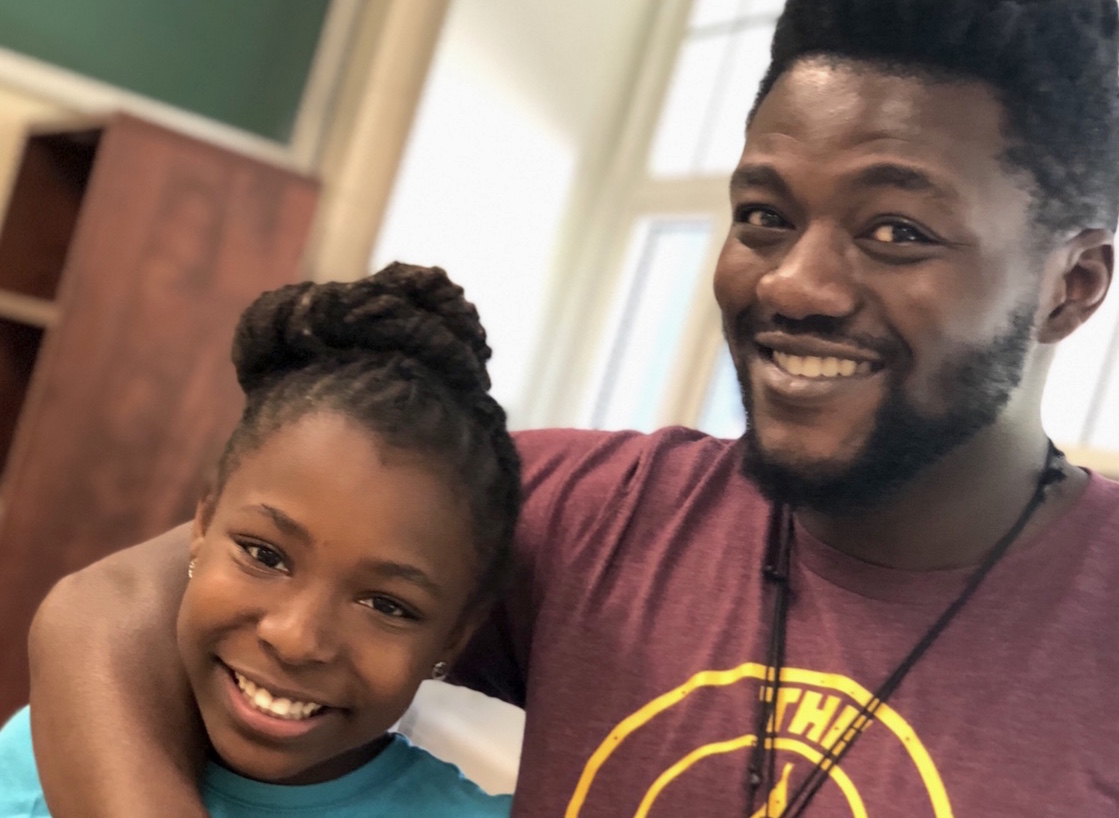
By transforming the school’s disciplinary system to focus on encouragement rather than punishment, George has sought to ensure that students at Malcolm X are rewarded not only for academic achievements, but also character growth.
“Sometimes as a community we tend to think of things in a one-size-fits-all model, but people are different and we need a customized plan for everyone,” George said in an interview.
According to the DC School Report Card portal, Malcolm X Elementary has an enrollment of 313 students, with 91 percent of them considered at-risk and 22 percent homeless. Given those demographics, George notes, many of the children at the 1500 Mississippi Ave. SE school understandably have priorities other than completing their math homework.
“If a kid is worried about if their parents will come home, or [about] electricity, it’s hard to teach them ‘1+1’,” George said. “We have to tap into that kid and find out what sparks them.”
George cites James Allen’s As a Man Thinketh, a 1903 self-help book that teaches mind-over-matter practices, as a guiding light for his methods in the classroom, including a rewards system that Malcolm X inaugurated at his suggestion soon after he arrived. The school’s use of the ClassDojo app allows teachers, parents and students to monitor behavior and performance and to encourage good conduct. The better a student behaves, the more points they receive — points that can be exchanged for prizes such as backpacks, footballs and dolls.
“The kids saw immediate value for displaying this behavior,” George said. “I wanted this to be a positive model that took away all negativity. We are flipping the paradox and celebrating children’s achievements.”
George learned about the Dojo system from a friend of his. Omoré Okhomina, who works part time as a coordinator for the National Center for Children and Family and has taught in various schools in Virginia, watched schools in his network successfully implement the system and introduced the idea to George in 2013.
“The system has been used in ways we could never even imagine,” Okhomina said of its effectiveness at Malcolm X and elsewhere. “Abi is using it at a macro level as a data-tracking system across multiple classrooms.”
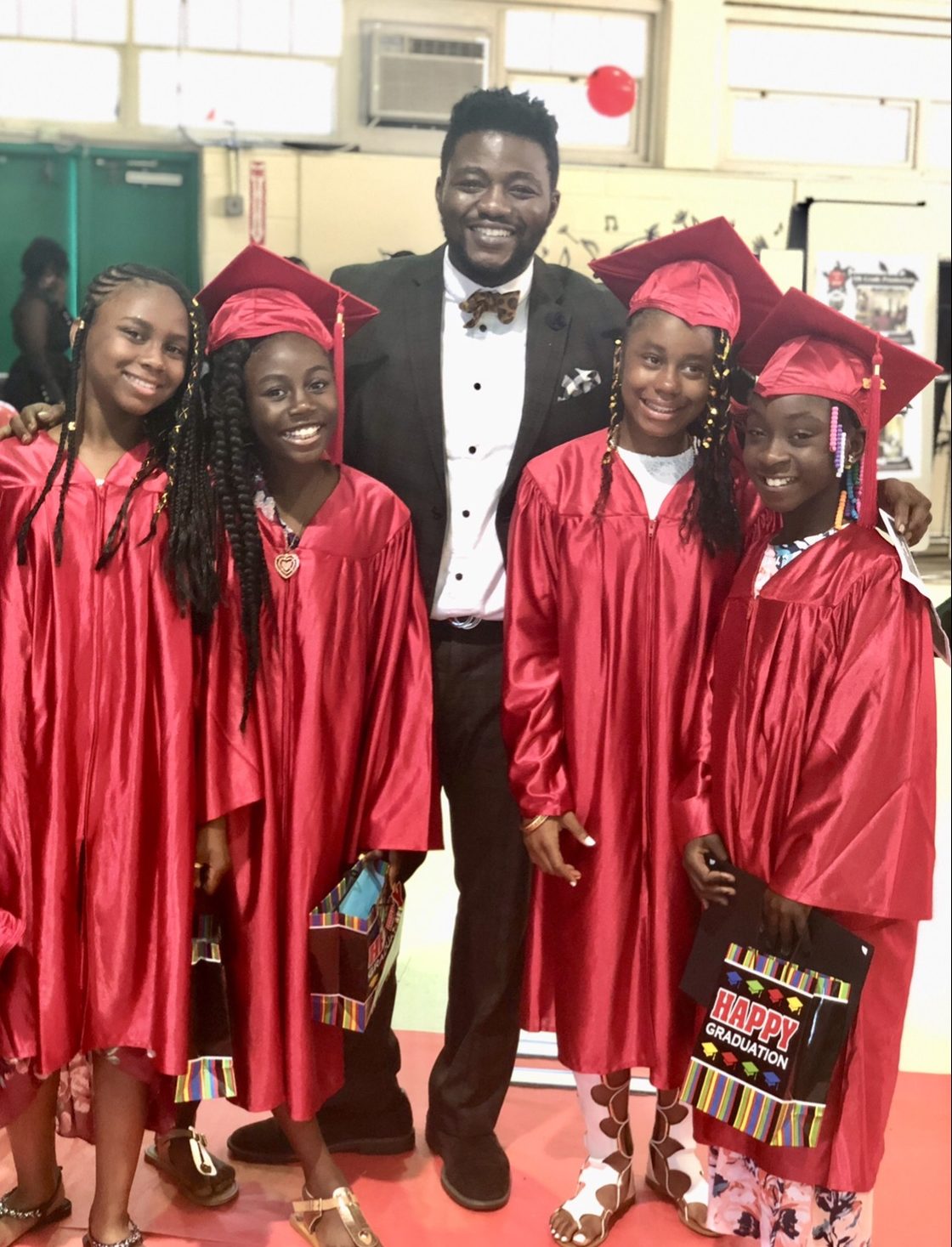
Although George did not start his teaching career as a behavior technician, it is undeniable that he is great with kids, helping them acquire the life skills they need. Discipline — especially self-discipline — has always played a large role in his life.
When George was 10, he parents sent George and his 12-year-old brother to live at a boarding house in Nigeria so they could learn more about their cultural heritage than they could at home in Florida. While the two of them were in Africa, the older boy died after being prescribed the wrong medication. George, who was 15 at the time of his brother’s death, returned home soon after. He went on to attend Howard University, where he graduated with a degree in political science.
“As an adult, people tell me I’m an old soul,” George said. “Not having your parents around forces you to make some difficult decisions.”
George had always been fascinated with public service, but the loss of his brother solidified his career path: He wanted to help people. While working toward a career as a lawyer, he volunteered as a community organizer — but then one day his mentor asked him to fill in as a substitute teacher for a class at Maya Angelou Public Charter School in DC. He loved it.
“I never thought I was good with kids,” George said. “But I really liked the fact that we are the molders.”
He immediately began implementing a holistic approach to educating “the whole” student — living by his guiding principles of instilling respect, responsibility and self-control in his students. In his second year teaching social studies to seventh graders at Maya Angelou’s Evans Middle School campus on East Capitol Street NE, he was pulled out of the classroom to join the behavioral team. Working with the middle schoolers there, George witnessed many hardships that set him on a mission to reform education.
“I remember there was this one incident where a child came into school with a bullet in his leg,” George told The DC Line. “Those kids had rough pasts … I kept thinking how we have to start earlier.”
That realization “propelled” George into elementary education. When he began at Malcolm X, he tried out a new approach. “I started leading character assemblies using the DCPS tenets in assemblies — empathy, care, love, kindness,” George said.
The assemblies have grown in popularity over time, and other teachers began taking turns leading them. Each morning, the whole school gathers in the cafeteria for the harambee — modeled on the Kenyan tradition of community self-help events, with the name coming from a Swahili word that literally means “all pull together” — and an exercise George found through the Children’s Defense Fund.
“We do chants that recognize mindfulness and reflection,” he said.
George’s work promoting parental involvement offers a firsthand view of the challenging circumstances some of the students face — on home visits he sometimes sees living rooms without furniture and doors without handles or locks. He introduced a restorative justice program that has helped students learn conflict resolution skills and participate in finding solutions when behavioral issues arise. Since he began working at Malcolm X, the school has seen suspension rates fall by 45 percent.
George has also helped bolster educational offerings at the school, particularly in science, technology, engineering and mathematics (STEM). That has included field trips and in-class presentations as well as robotics competitions and a school garden.
“Alongside his colleagues, he was a member of the first group of African-Americans to complete a fellowship with the University of Notre Dame that focuses on integrating STEM learning in schools,” says a biography on the Cafritz Awards website. “As a result, [Malcolm X] is a nationally recognized model STEM school. His students are able to gain exposure to resources in STEM education from educators that look just like them.”
Outside of work, George dedicates much of his free time to improving the lives of the children he works with, but he also enjoys traveling — he regularly visits Nigeria even though the trip requires an arduous 15-hour flight — and helping out as a volunteer at community events.
Though the District still has a long way to go in boosting the education system and providing a positive environment for children, George said, he’s gratified to win the Cafritz Award in recognition of his contributions toward fulfilling both goals. And he’s fully invested in improving the one place he truly feels he can call home: DC.
“Growing up all over, I didn’t really have a sense of home,” George said. “So once I knew DC was home, I just want to do the best I can for the kids here.”
Comments are closed.