


Amid upswing in gun violence, McDuffie proposes a center for firearm research in DC
Can research play a major part in gun violence prevention? One DC Council member aims to find out with his latest bill.
Ward 5’s Kenyan McDuffie, who chairs the Committee on Business and Economic Development, has introduced legislation that would fund a center to study firearm violence in DC. The center would be based at an as-yet-unspecified local university or academic institution.
McDuffie says the center would address some of the core reasons youth and young adults resort to gun violence. The District experienced a 38 percent spike in homicide rates in 2018. So far in 2019, homicides are up 50 percent compared to the same time period last year.
He is particularly concerned with how gun violence affects black males. “This dates back to a few years ago when the District had a spike, and I was chairing the Committee on the Judiciary and Public Safety and was researching some of the gun violence in the District,” McDuffie said in a phone interview. “According to the [Centers for Disease Control], the leading cause of death for black males age 15 [to] 34 is homicide. So I looked around the country to see what was working.”
Research hubs such as the one proposed by McDuffie are being established or considered in states such as California, New York, New Jersey and Washington. “What we’re doing with the center for violence research is building on those data-based, evidence-based solutions by seeking to provide some research behind it to come up with additional solutions in the District of Columbia,” he said. “We have a culture of violence in the District of Columbia, and we really have to get to the root of why people would choose a gun to settle disputes.”
Ward 6 Council member Charles Allen, who chairs the Committee on the Judiciary and Public Safety, signed on as one of the co-introducers and spoke on behalf of the bill as part of its introduction at the council’s Feb. 5 meeting. The bill was also supported by Ward 1’s Brianne Nadeau, Ward 2’s Jack Evans, Ward 3’s Mary Cheh, Ward 7’s Vincent Gray and at-large members Anita Bonds, David Grosso, Elissa Silverman and Robert White.
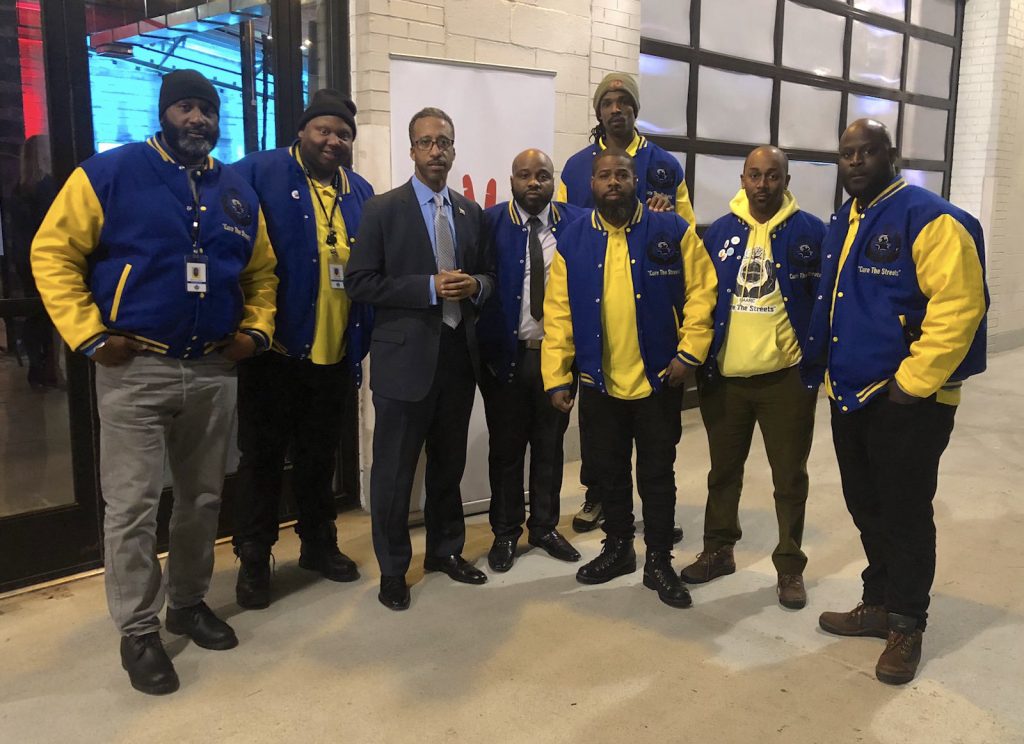
This legislation was introduced just a few days after Mayor Muriel Bowser’s announcement of a $6 million investment in the District’s workforce development and violence prevention efforts. That community investment will be funded through a 2018 settlement agreement entered into by AltaGas, WGL Holdings and Washington Gas as a condition of approval of the AltaGas-WGL Holdings merger. From the settlement, $2 million is earmarked for the violence prevention program Cure the Streets, which takes a public health approach to violence.
McDuffie explained that the proposed center would provide research to support the health-based approach to crime, which is also highlighted in the Neighborhood Engagement Achieves Results (NEAR) Act passed by the council in 2016. He expects the center to provide actionable research on aspects of gun violence.
“We’re looking at neighborhoods in wards 5, 7 and 8 and other neighborhoods where gunshots continue to ring out,” he told The DC Line. “People feel unsafe leaving their homes. They feel unsafe playing on playgrounds and allowing their kids to enjoy the amenities that our parks and rec offer. I believe that we can and we must end the violence. The center isn’t designed to supplant the things that we’re doing that are already working. It is designed to augment and provide additional resources.”
Gun violence research on a federal level has been stifled by a 22-year restriction on the CDC known as the Dickey Amendment. Under the amendment — named for Rep. Jay Dickey, an Arkansas Republican from 1993 to 2001 who was a National Rifle Association supporter — the CDC was not allowed to use federal dollars to “advocate or promote gun control,” which was interpreted in a way that stifled all gun violence research. Last year the language of that amendment shifted to allow such research, but the change has not yet led to substantial new federal efforts to study firearm violence.
Locally there are calls for officials to pursue new approaches to change the trajectory of firearm violence prevention — ranging from how to get illegal weapons off the streets to how to address root causes such as trauma. McDuffie acknowledges that the initiatives and laws that are in place so far are still not yielding desired results.
“We know there is a proliferation of illegal guns that flood urban jurisdictions and cities across America,” McDuffie said. “In spite of having really progressive gun laws we’ve still seen illegal guns come into DC. We’ve seen young men and women, primarily young black men, resort to gun violence to solve disputes. We’re seeing Attorney General Karl Racine and Del McFadden at the Office of Safety and Neighborhood Engagement implementing the NEAR Act and the health approach to crime prevention. On the other hand, I believe that there needs to be greater research to provide solutions.”
Allen’s Committee on the Judiciary and Public Safety is expected to hold a public hearing on the bill, though none has been scheduled yet. Gray’s Committee on Health will also provide comments on the legislation.
In his comments on the bill’s introduction, Allen said he sees the bill as a way to ensure officials take a holistic perspective by engaging experts in the field.
“It we truly are going to think about gun violence as a public health crisis … then an institute like this is I think exactly the direction we want to go,” he said at the Feb. 5 meeting. “It helps bring in the best thinking … as we work collaboratively and collectively to help make sure that we are a safe city and a just city.”
McDuffie — who introduced a version of the bill last June that had a public hearing in October but didn’t advance to a vote prior to the end of the council period — remains optimistic about the future of firearm research in DC.
“I truly believe that implementing this legislation and creating this center will allow this District to enhance its response to firearm violence,” he said. “I look forward to working with the mayor and other partner agencies to pass this legislation and get it implemented as soon as possible.”
This post has been updated to correct the name of the director of the Office of Neighborhood Safety and Engagement.
Comments are closed.