

Gordon Chaffin: Dog-walking gigs show DC’s economic divide
I’m a full-time local journalist — and, until my news organization gains enough subscribers to provide me a full salary, I am walking three to four dogs every weekday to cover my bills. I love dogs and feel rejuvenated by the daily interaction with such loving creatures. For me at least, dog walking definitely beats working as a barista or toiling away at a computer for hours trying to pitch freelance writing. As folks say, “we don’t deserve dogs,” and picking up a chunk of income spending time with them is a good deal.

After four months of daily dog walks, I’ve picked up on some interesting societal quirks, frustrating infrastructure omissions, and a disturbing undertone of DC’s recent economic success. As we celebrate Labor Day this year, the Democratic Party’s 2020 presidential candidates are pushing for public policies to guarantee things that unions used to deliver: stable, growing wages; reliable work hours; safe worksite conditions; and leave policies that value workers as worthy fellow humans who get sick and need respite. In today’s gig economy, those dignities are rare for the working and middle classes — especially those marketing their labor on gig economy apps.
The most popular dog walk request is midday during the workweek. When you have several clients per day, all desiring proximity to the noon hour, you end up fervently rushing between appointments in a few hours’ time. I knew people on DC roads were in a hurry, as a general matter, but it wasn’t until dog walking that I experienced the harried midday commuting crunch. Just because it’s 1:30 p.m. and traffic isn’t gridlocked on H Street NE doesn’t necessarily mean drivers are less likely to make a left as yellow turns to red. Your personal rush hour may not be 1:45 p.m., but I’ve come to realize how, at any time of day, DC’s roads carry people worried about missing their next appointment and under enough pressure that they forget to check all their mirrors.
As a bike commuter, I’m lucky that dog walking is a job that doesn’t require business attire. Because I work up a sweat stomping on the pedals, climbing hills and barely tapping brakes around corners to make my next appointment time, I’m thankful for the clients who leave water out for me and allow me to use their bathroom. I carry a microfiber hand towel, extra dog bags, and lock lubricant with me. Several times already, clients have gone weeks, maybe months with door locks about to fail — the ones you’ve got to jiggle, pull and push just to turn the key. Those locks always seem to fail when I try them, of course.
The app I use to offer dog-walking services, Rover, is used mainly by tech-savvy dog owners, so it’s not a representative sample. However, dog-owning, dual-income couples with 9-to-5 work schedules are much more heavily represented in the neighborhoods that have seen the most housing growth and redevelopment the past two decades. Capitol Hill, especially Hill East, is full of for-hire dog-walking activity. Columbia Heights, Petworth, Shaw, Truxton Circle, Bloomingdale and NoMa/Eckington each have lots of young families with schedules that necessitate paying a dog walker. And lots of young families can afford to do so. Wards 2, 3, 7 and 8 are pretty barren when it comes to clients of app-based dog walking, although I have done several repeat walks in Anacostia.
That brings me to the infrastructure gaps.
DC’s new and renovated housing needs a lot more bike parking. I often pull up to a new-construction luxury apartment building only to find a full bike rack — or none at all. If these buildings have hundreds of units, why did the developers and government agencies with approval think spots for two to four bikes was adequate? I often have to carry my bike into these buildings, up an elevator, and stash it in the client’s apartment so I know it’s secure. Beyond the parking, the District Department of Transportation needs to plan protected bike lanes as core transit networks. I’m not the only one mashing up the 15th Street Cycletrack in a huff: There are bike couriers, food app delivery cyclists, and other gig economy warriors.
Finally, dog walking in DC has shown me a disturbing side of our city’s economic inequality. Dog walking may not be a required expense, but it’s not exactly discretionary, either. Many dogs can go without a bathroom break for seven to nine hours, but owners who can afford walkers seem to prefer to avoid inflicting that discomfort on their pooches. Because of the cost — moderate for a few walks but hefty as a recurring outlay — and the app-based connection, I’m almost exclusively walking dogs from expensive and/or newly constructed housing. I’m becoming well-versed in the layouts of DC’s gut-renovated row houses and mid-rise apartment buildings with security camera doorbells.
I don’t mean to shame hard-earned financial success, and I’m thankful I can make money hanging out with dogs. But the divide between gig economy service workers like me and clients is unmistakable once you experience it everyday. I guess it really didn’t bother me until I was directed to enter a client’s building through the back entrance, opening into the basement level with trash room and service elevator. The request was something that caught me off-guard. “Oh,” I realized, “I’m supposed to be unseen here, slipping in and out of the gig as a lower category of visitor than a resident.” I’ve got a lot of privilege as an college-educated, white man so I don’t want to make more out of the back door than it is. But, still, it felt demeaning, leading me to wonder whether other service economy workers feel similarly when they’re made to be unseen and unheard.
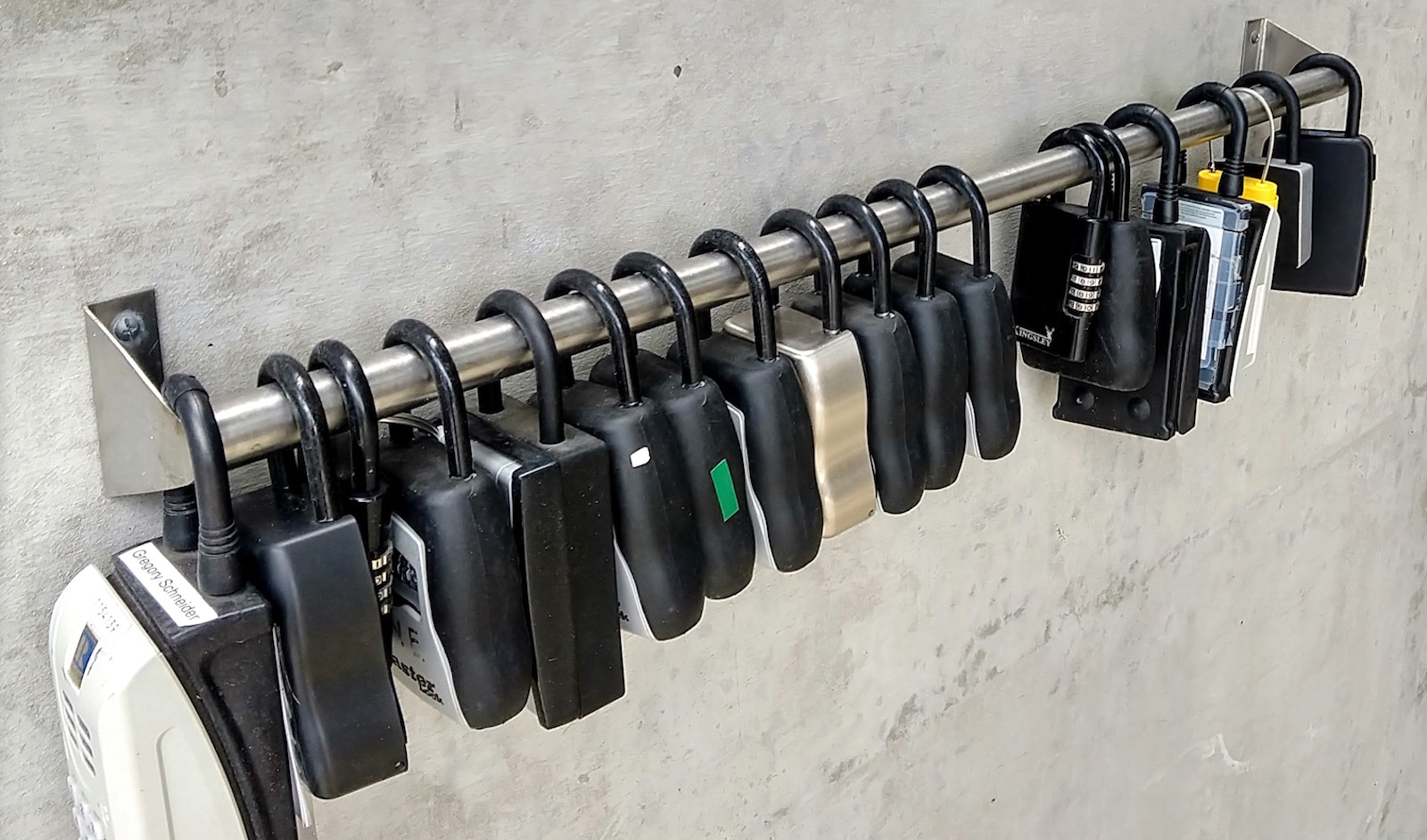
You’ve probably noticed lockboxes with spare keys hanging from railings and fences outside apartment or condo buildings in your neighborhood. That’s how I, and other gig economy workers, get into our clients’ homes. In many older, multifamily residential buildings, especially in Columbia Heights, you’ll see almost as many lockboxes as units. These lockboxes are so prevalent now that new-construction buildings are bolting steel or iron rods to their exterior walls for residents to place dozens of them — labeled with unit numbers or dog names.
Like child care or other service economy jobs requiring human labor, dog walking is expensive for the clients while simultaneously paying insufficient wages to the worker. I net $13.60 after Rover charges $17 per walk. I’ve got a few regular dogs, whom I love, and I wish I could charge their owners less. But, after commuting, I only make about $12.50 per hour, and that’s not a livable wage when I have to pick up all my own benefits. A sick day or vacation represents lost income.
I’m far from the only part-time dog walker in DC. We are just one of the many types of gig workers passing each other daily at the residential lockbox locations and front desks volunteering our IDs to a concierge for a client’s keys. I’ve met several home cleaning crews so far in my dog-walking shifts. I’ve helped a home chef carry groceries up to the fourth floor of a walk-up. We are part of DC’s growing cohort of “wealth work” — a cottage industry of contingent, contract labor benefiting from new economy wealth, but not earning enough to pay our full expenses or take time off because of the flu. We work unnoticed all around you, and that’s largely by design.
Gordon Chaffin is a reporter for Street Justice, a daily email newsletter covering transportation and infrastructure throughout the Washington region.
Comments are closed.