


Citywide incumbents face challenges from the left flank
Phil Mendelson isn’t interested in hearing his opponent claim to be the progressive candidate in the race.
Walking out of a debate where DC Council Chair Mendelson and challenger Ed Lazere traded barbs over education scandals, Mendelson rejected the notion that his rival had pushed him to the left over months of campaigning for the Democratic primary.
Lazere, a budget wonk on leave as head of the DC Fiscal Policy Institute, likes to tell supporters that Mendelson has played catch-up to him on progressive stands.
“How could I be playing catch-up when I have a record?” Mendelson asked, frowning. Then he stopped to add, with a hint of derision: “He understates how much he is to the left.”
Without a competitive mayoral primary, debates over the ideological future of the city have played out in two citywide Democratic primary races, the contests for DC Council chairman and for Council member Anita Bonds’ at-large seat. In a city that has seen a progressive wave hit its council in recent cycles, a new round of candidates is running to the left of incumbents, arguing they are best suited to address economic inequalities.
Jeremiah Lowery carries the lefty flag in the party’s three-way at-large race, which also features challenger Marcus Goodwin, a real estate professional. A recent environmental activist, Lowery — like Lazere — rejects liberal positions that more development can bring down housing prices and that more police can stem rising homicide rates. Neither Lowery nor Lazere has taken campaign money from developers or corporations.
These Young Turks bandy about terms like “community land trusts,” which turn land over to the public for housing. Both denounce tax breaks for developers and Amazon. Both support decriminalizing sex work and want to tax carbon emissions and redistribute the earnings to the poor. Lowery has the endorsement of the DC-area chapter for the Democratic Socialists of America. Both have the nod of Jews United for Justice, the DC chapter of the National Organization for Women, and the local teachers’ union.
“Probably socialists would be the better word” for Lazere and Lowery, said Bill Lightfoot, a longtime District political operative and former council member who currently chairs Mayor Muriel Bowser’s re-election campaign. “Right now the council is somewhere in between” progressivism and traditional liberalism, with Mendelson, 65, firmly in the former camp, Lightfoot said. “We really are in flux.”
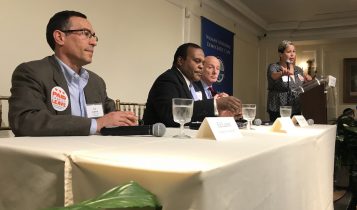
Attacks on the strength of Mendelson’s progressivism irk the chairman, who has shepherded homeless-shelter reform and a landmark paid leave law through the 13-person legislative body. At debates across the District, Mendelson has delivered full-throated defenses of his time on the council, which began in 1998 as an at-large member. He is running for his second full term as chairman.
Mendelson says he was “progressive before it was cool,” beginning in his days as an activist for tenants at Ward 3’s McLean Gardens during the 1970s and 1980s. What’s more, Mendelson argues, he can get things done.
“It’s easy for folks, when they’re campaigning, to promise this and promise that,” he said at a recent forum focused on criminal justice. “And you can see what I’ve actually done. I’ve walked the walk, so to speak.”
But for the progressive base operating at the cutting edge of lefty trends, Mendelson — with his penchant for fiscal pragmatism — seems to no longer excite. While his opponents argue to spend more on social services, Mendelson urges restraint. Dipping in the city’s $2.4 billion rainy-day fund is a non-starter for him.
Mendelson began as a “fairly progressive member of the council, but we’ve been increasingly dissatisfied with the way he’s been behaving since he has become chair,” Keith Ivey, an organizer with DC for Democracy, told a handful of his colleagues at a sparsely attended fundraiser in late May.
Mendelson raised $581,000 in campaign contributions during the primary campaign season, compared to Lazere’s $219,000, according to filings with the Office of Campaign Finance.
Barbara Green, a Ward 3 resident who has supported Mendelson “since the first day he took office,” said she will cast her ballot for Lazere.
“I’m a defector, because I so appreciate Ed Lazere’s values,” she said. “Despite the fact that we have this enormous surplus in this city, nothing changes.”
Mendelson still enjoys support from major unions, the Gertrude Stein Democratic Club, and DC Democrats for Education Reform.
Jamie Contreras, vice president of 32BJ of the Service Employees International Union, said in February the union was endorsing Mendelson for supporting worker-friendly policies. “His responsible leadership has been vital to protecting vulnerable residents and our tax dollars,” Contreras announced in a release.
SHIFTING PROGRESSIVE BASE
Outside of a forum hosted by Ward 3 Democrats, David Meadows, a longtime adviser to Anita Bonds, was lamenting the group had turned into the lefty DC for Democracy — which endorsed Lowery this year and a Bonds challenger in 2014. In the chairman’s race, DC for Democracy is backing Lazere.
Inside, no candidate got enough support on the night for an endorsement from the Ward 3 Democrats, but Lowery took 18 votes over Bonds’ 14, in no small part thanks to progressive activists who packed the church auditorium.
Bonds, 72, has served on the DC Council since 2012 and chairs the Democratic State Committee. Involved in District politics for decades, she was a longtime aide to former Mayor Marion Barry but has also worked in other administrations. Her campaign had $73,600 left to spend nine days before Election Day, according to the latest campaign finance filings. That’s compared to $53,000 for Goodwin and $1,500 for Lowery.
Housing affordability dominates the at-large contest, as Bonds chairs the DC Council’s housing committee. That has left her open to attacks from Lowery, 31, and Goodwin, 28, over issues like rent control, which Bonds hopes to reform with a bill sitting in committee. Both challengers are pressing for faster action.
If Lowery offers a revolutionary path, Goodwin follows a more orthodox route. During his time studying urban planning at University of Pennsylvania, Goodwin interned under former Ward 1 Council member Jim Graham and the Mayor Adrian Fenty administration. He criticizes the District for allowing displacement but does not blame the real estate industry, as Lowery often does.
“We need to ensure that working-class people can continue to live in the District of Columbia,” Goodwin said at the Ward 3 debate.
Lowery traces much of the city’s problems to its relationship with developers. At a forum on criminal justice issues, one man wearing a Goodwin T-shirt shouted Lowery down. Lowery had just attacked the mayor and his opponents for taking money from “big developers.” The man countered that Lowery was “beholden” to DC for Democracy.
“A progressive group? Get out of here,” Lowery snapped. “He’s talking about a progressive group that works on workers’ rights policies issues.”
In a three-way race susceptible to vote splitting, an endorsement from The Washington Post has boosted Goodwin’s momentum. He’s drawn $1,000 donations from developers and contractors like Omar Karim, a former Fenty crony. Other donors close to the Green Team circle of Fenty and Bowser include Michelle and Jeanette Fenty, developer Bryan Irving and political operative Joshua Lopez.
On housing issues, Lowery follows the platform of an energized and diverse group of activists who recently rallied against the mayor’s proposal to make it easier for developers to build large projects and avoid legal challenges. In a midterm year with expected low turnout, the District’s left flank hesitantly hopes for electoral success.
“I think that in many ways both of the candidates are very much in tone with what voters want and are interested in,” Eugene Puryear, a left-leaning criminal-justice activist who ran for Bonds’ seat in 2014, said of Lazere and Lowery. But “I don’t really get the sense that many of the other incumbents are unpopular.”
Before a recent forum on the environment that attracted only about a dozen audience members, Lowery conceded his contest has at times been a “sleeper.”
“I think this is a base race,” he said. “If you get your base out, then you put yourself in a really good position to win. Anita has a base. I believe we have a base.”
PAST CLASHES
A newcomer to campaigning, Lazere, 54, has at times been learning on stage.
During an education forum, Lazere and Mendelson were tossed a softball: How do you react to the mayor not spending money set aside by the DC Council for at-risk students?
Lazere passed on slamming the executive; he wanted to focus on the council’s chairmanship.
“[You] can’t duck when the question is asked about the mayor,” retorted Mendelson. “Because the mayor’s the one who actually controls how the dollars are spent at DCPS.”
Lazere admitted Mendelson had a point. “Phil’s right,” he said, then pledging to drum up a media firestorm if the mayor misspent education money.
Mendelson and Lazere have clashed in the DC Council chamber over recent years, usually over government spending. Since 2001 Lazere has meticulously pored over the District budgets that Mendelson has helped craft since 2012. Mendelson once blasted Lazere from the dais after the DC Fiscal Policy Institute said it supported the mayor’s plan for building family homeless shelters, despite criticism the city would pay above-market leases to politically connected developers. Mendelson overhauled the plan, slashing costs.
Implicit in Mendelson’s criticism was that lefty advocates like Lazere shrug away from high price tags on projects they support.
Lazere countered Mendelson during the back-and-forth in 2016: “At the risk of being provocative, last fall the council voted for a $60 million tax break for the Advisory Board, and I didn’t see any detailed analysis to suggest that that was the amount they exactly needed to stay in the city.”
Lazere has proposed spending more on affordable housing and public housing programs, while Mendelson calls for more oversight over how the Housing Production Trust Fund spends dollars. Both say that building more luxury apartments and condos won’t prevent the displacement of middle- and low-income residents.
“This race has been defined by who’s progressive or not,” Lazere told fellow advocates at the May fundraiser. “I choose to run because I felt like we needed an advocate inside the DC Council.”
This story has been updated to correct DC for Democracy’s endorsement of Lazere, not Mendelson, for DC Council chairman.
I am very happy to see Chris Kain and Cuneyt Dil have launched this sorely-needed new website. But you should have taken a few more minutes to edit this story. You need to correct the sentence at the end of this paragraph, which follows immediately after the heading “SHIFTING PROGRESSIVE BASE:”
“Outside of a forum hosted by Ward 3 Democrats, David Meadows, a longtime adviser to Anita Bonds, was lamenting the group had turned into the lefty DC for Democracy — which endorsed Lowery this year and a Bonds challenger in 2014. In the chairman’s race, DC for Democracy is backing Mendelson.”
DC for Democracy, of course, endorsed ED LAZERE, who is challenging Mendelson.
We have made the correction to the story. Thanks for reading and for pointing out the error.