

Coy McKinney: The case for a radical BID
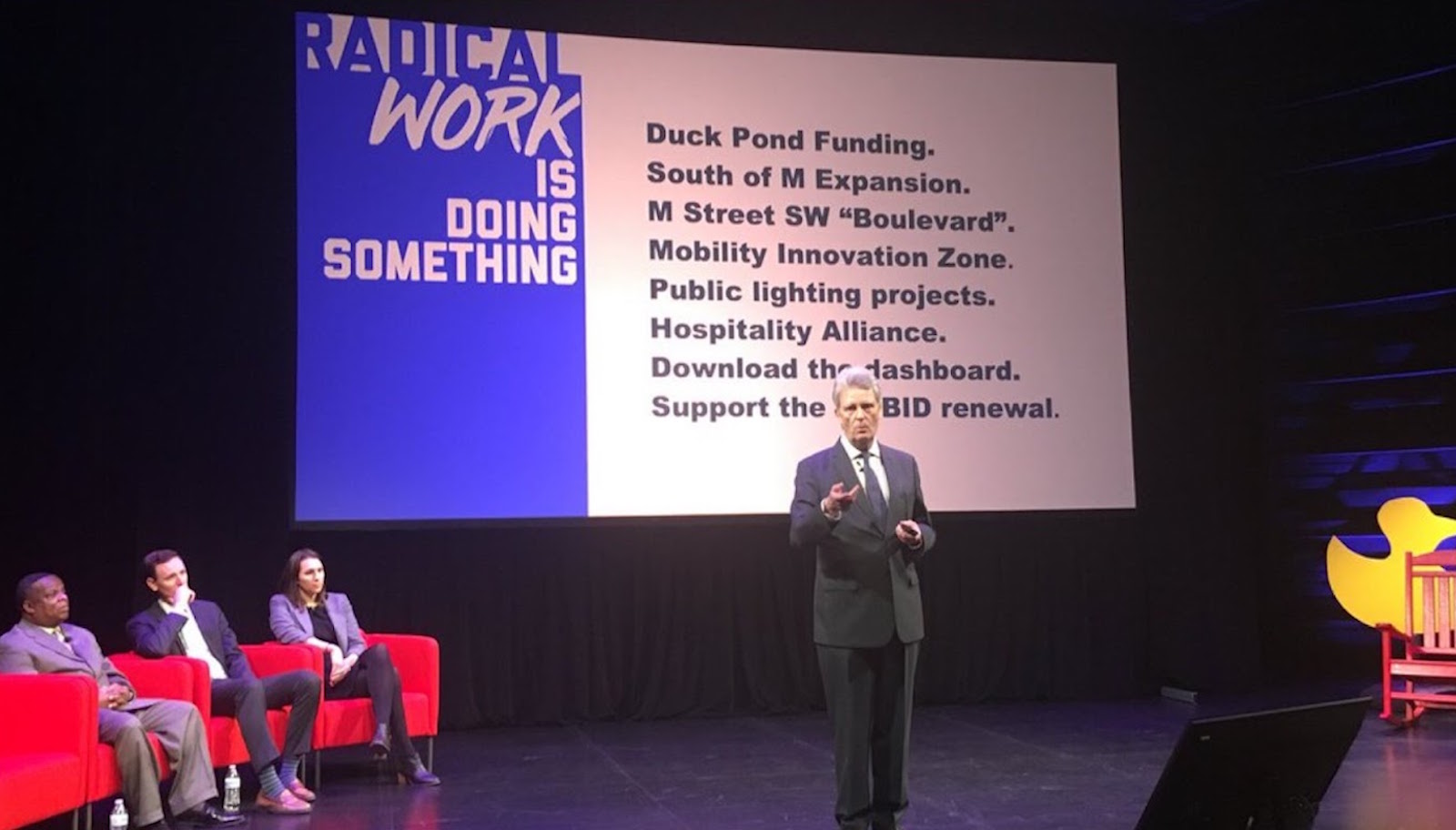
Two of DC’s most pressing issues are housing and income inequality. The District has the unique distinction of being the most “intensely” gentrified city in America, while simultaneously having the highest level of income inequality in America. Business improvement districts (BIDs) are uniquely positioned to improve both of these issues, but unfortunately, their current structure instead exacerbates an already dire situation.

Coy McKinney is a resident of Southwest DC.
Gentrification in DC has played out across racial and class lines. Generally speaking, an influx of affluent white millennials has displaced low- and moderate-income Black Washingtonians. The underlying driver of these dynamics has been capitalism, an economic system that prioritizes profit, usually at the expense of justice and equity. Due to America’s history with slavery, capitalism has always been intricately linked to racism. The two are like “conjoined twins,” according to Dr. Ibram X. Kendi, professor of history and the director of the Antiracist Research & Policy Center at American University. “The origins of racism cannot be separated from the origins of capitalism,” he says in an interview on Democracy Now! “In order to be truly antiracist, you have to be truly anticapitalist.”
Over the past two decades, as the District has pushed to add more residents, predominantly from the “creative class,” BIDs have assisted in attracting and retaining these newcomers. “BIDs have led or been instrumental in shaping the planning initiatives that have changed DC’s urban fabric,” writes Dr. Susanna Schaller, assistant professor of urban studies and planning at the City College of New York, in her new book Business Improvement Districts and the Contradictions of Placemaking: BID Urbanism in Washington, D.C. Schaller, who will discuss her research in a talk at the Mount Pleasant Neighborhood Library on Nov. 16, finds that higher-income and predominantly white residents flocked to BID areas more than they did to non-BID areas.
This targeting is exhibited by the language BIDs use in their messaging. For example, in tweeting about housing costs, the Southwest BID described Southwest DC as having the “perfect blend of accessibility and affordability.” The tweet included a chart showing that median home values were a little over $400,000 and median rents were $2,201 per month. These economic conditions are far from “perfect” for anyone making less than $88,000 a year, since they would be spending more than 30% of their income on housing, making them housing-cost burdened. On average, white households in DC make $134,000 a year, which has risen over the last decade; this is over three times as much as the $42,000 that the average Black household makes, a figure that has not changed during that same period of time. Either BIDs are applying an unacceptably low level of racial analysis, or they are specifically targeting affluent, white newcomers.
In some cases, though, BIDs have demonstrated the ability to reach beyond their business focus to address social issues. For example, the DowntownDC BID has worked on issues regarding homelessness, and the Southwest BID has co-hosted community suppers to bring members of the community together, among other initiatives. This shows they have some social consciousness. Despite these noted variances, however, BIDs at their core are geared toward business improvement, not social justice. This focus was exemplified by the NoMa BID’s recent open letter about homeless encampments in their neighborhood, which drew strong backlash from a resident and the National Law Center on Homelessness & Poverty. If BIDs are interested in mitigating their contributions to gentrification and income inequality, they must become allies in the fight for social justice.
Here are three suggestions DC’s BIDs could implement:
- Shift from a traditional nonprofit model to one with cooperative ideals and practices.
- Establish multi-stakeholder boards that include social justice activists, residents and small businesses.
- Broaden their focus to include an anti-racist framework to counter inequality rather than perpetuate it.
Ironically, BIDs are incorporated as nonprofits yet still exemplify the income inequality that is endemic to capitalism. Nationwide, income inequality has reached its highest level in 50 years. The Economic Policy Institute found that the average CEO pay is 271 times the average pay of their workers. To a lesser but still troubling extent, this can be found within BIDs as well. For example, in 2014, the executive director of the Southwest BID, Steve Moore, was paid $85,000, as reported on the organization’s 1099 tax form. He then received a 350% increase so that his 2015 salary was $300,584 — giving him the third-highest executive salary among the 10 BIDs in DC and about $100,000 more than the mayor’s salary. The following year, Moore’s base salary decreased to $237,255, but with retirement, other deferred compensation and nontaxable benefits, his total income was $278,935, keeping him in the top 5% of earners in the city. Meanwhile, members of the Southwest BID landscaping and cleanup crews earn $15 an hour, and “ambassadors” make $18 an hour. These wages are insufficient for the workers to live comfortably anywhere in DC, let alone the new buildings their employers cater to.
Altering the structure of BIDs would provide them with an equitable base that would help them pursue social justice activities genuinely. In contrast to traditional organizations, worker cooperatives offer a more balanced form of governance. In worker cooperatives, the workers are the owners, and the group makes decisions democratically. Economist Virginie Pérotin’s research, conducted out of Leeds University Business School, found that cooperatives in Western Europe, the United States and Latin America “are more productive than conventional businesses, with staff working ‘better and smarter’ and production organized more efficiently.” That’s in addition to reducing the worker-CEO pay ratio.
Currently, DC’s BIDs are prohibited from becoming cooperatives. That law should change, but in the meantime, BIDs can still adopt cooperative ideals.
A multi-stakeholder board would diversify the influences and activities of BIDs. Currently, real estate and property development interests are overwhelmingly represented on BID boards. These interests have wielded tremendous influence throughout the city to disastrous effects for low- and middle-income people. According to the Urban Institute, despite the city’s affordable housing crisis, “developers prefer to build upscale housing because it’s more profitable.” It’s shameful to put profits over people at a time like this. A BID board should include residents or other social justice advocates, using a participatory model that involves the community in strategy, development, and management of different campaigns and initiatives. It’s time for different voices with different ethical compasses to be a part of the decision-making process.
BIDs also need to adopt an anti-racist analysis for their planning. Race is too integral to DC’s socio-economic problems to ignore. BIDs could replicate a recent initiative of the YWCA of Dayton, Ohio: a 21-day racial equity challenge to better understand how institutional racial inequality manifests itself at the individual, local and institutional levels. Additionally, BIDs could become incubators of local worker cooperatives, or help establish neighborhood land trusts for affordable housing and small businesses. These initiatives dismantle systemic forms of oppression by building balanced, ethical and principled organizations and businesses.
The depth of the city’s inequality requires us all to be allies in the pursuit of justice. BIDs could be pivotal in determining better future outcomes — if they choose to lead by example.
Coy McKinney, a resident of DC since 2009 and Southwest since 2010, obtained a history degree from the University of British Columbia and is a graduate of the University of the District of Columbia David A. Clarke School of Law School. He teaches urban agriculture to high school students at Friendship Technology Preparatory Academy. This article is an abbreviated version of a 6,000-word, 20-page paper titled “A Radical BID: The Case for Business Improvement Districts to Function as Multi-Stakeholder Cooperatives That Advocate for Equity in Communities.”
About commentaries
The DC Line welcomes commentaries representing various viewpoints on local issues of concern, but the opinions expressed do not represent those of The DC Line. Submissions of up to 850 words may be sent to editor Chris Kain at chriskain@thedcline.org.
Comments are closed.