

Press Release: HealthHIV Launches the Opioid Learning Institute
News Release — HealthHIV
Contact: Lisa Frederick
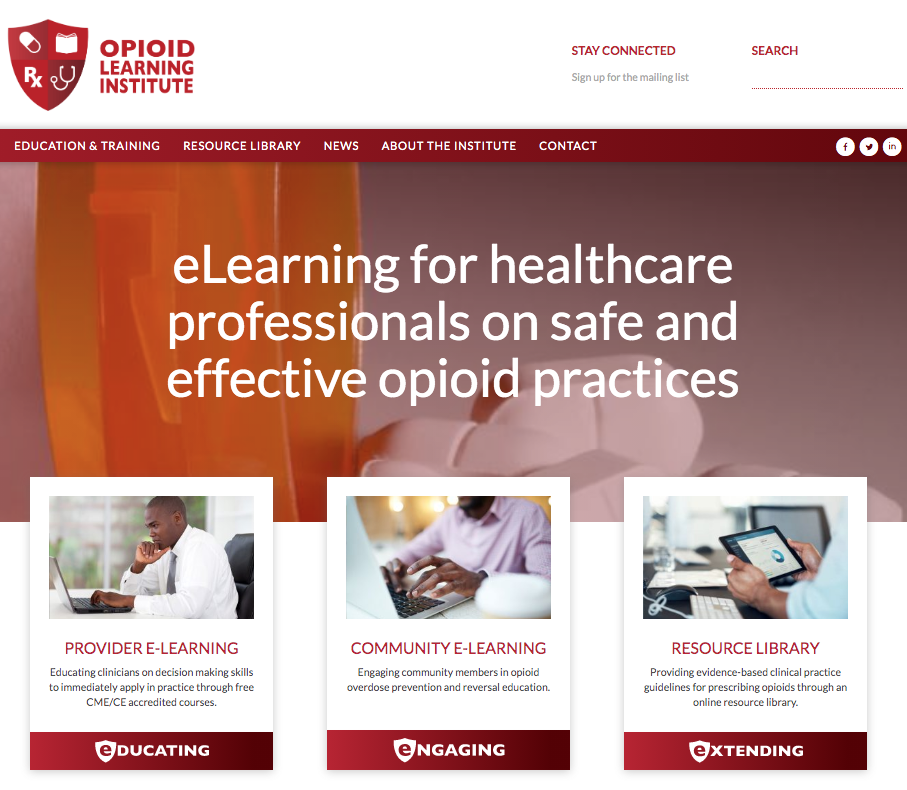
eLearning for healthcare professionals on safe and effective opioid practices
Washington, DC. HealthHIV announces the launch of the Opioid Learning Institute for providers, prescribers, and other healthcare professionals to become competent in the prevention and treatment of opioid use disorder. The Opioid Learning Institute, supported by DC Health HIV/AIDS, Hepatitis, STD, and TB Administration (HAHSTA), offers a comprehensive curriculum comprised of modules on safe and effective opioid prescribing practices, treatment of opioid use disorders, harm reduction strategies, alternative approaches to pain management, and other topics in the prevention and management of opioid use disorders.
Why the Institute is Needed:
In 2017, opioids were involved in 47,600 overdose deaths in the US, 279 of which occurred in the District of Columbia., Despite a reduction of overdose deaths to 213 fatalities in 2018, DC is still experiencing an average of 14 fatal overdoses per month. Residents must remain vigilant concerning the impacts of the epidemic. Since 2004, DC reports over 3,000 Emergency Department visits and over 3,000 naloxone (medication that reverses an opioid overdose) administrations by Emergency Medical Services.1,2 Despite these alarming overdose rates, under 200 DC providers are DATA-waived (a Drug Addiction Treatment Act waiver), allowing them to prescribe Buprenorphine, the gold standard treatment for opioid use disorder.
What the Institute Offers:
The Opioid Learning Institute offers a community training on overdose prevention, featuring a video that instructs community responders on using nasal naloxone to reverse an opioid overdose. This curriculum offers twelve (12) hours of continuing medical and other professional education credits. These topics enable providers to strengthen services and improve health outcomes. Resources are available on where community members can access free nasal naloxone, current news, and data on opioid use, prevention, care, and treatment. The Institute is expanding its offerings in assisting local service providers with overcoming challenges related to treatment and offering practical strategies for making strides in addressing opioid use disorders in DC.
How to Engage with the Institute:
Visit OpioidHealth.org to access free training and education materials, learn how to access free naloxone, sign up for the OLI listserv, and complete the following knowledge and skills-based modules.
| Modules Offered | Module Description |
| Opioid Overdose Prevention & Naloxone Education | Reviews the epidemiology of opioid overdoses in the US and instructs learners on how to identify and opioid overdose and administer nasal naloxone. |
| Treating Opioid Use Disorder: Primer for Clinicians | Discusses introductory information on opioid use disorder as a chronic disease, the functioning of medications for opioid use disorder, and a path towards receiving a buprenorphine waiver, when applicable. |
| After the Waiver: Translating Training into Practice, Advanced Topics in Buprenorphine | Discusses treating patients with opioid use disorders and accounting for unanticipated events such as injury and pregnancy. |
| Treating Acute Pain to Improve Outcomes and Reduce Opioids | Details mechanisms of pain and current best practices for treating acute pain. |
| Implementing the 2016 CDC Guidelines for Prescribing Opioids for Chronic Pain | Provides the clinical overview, research, and CDC guidance behind prescribing opioids for chronic pain; including information on initiating, dosing, selecting, continuing, and discontinuing opioids for chronic pain. |
| Development and Implementation of Evidence-Based Opioid Prescribing Guidelines for Surgical Patients | Details a case study of implementing post-operative pain prescribing guidelines by surgical area. |
| Cognitive Behavioral Therapy (CBT) & Mind-Body Techniques in Addressing Pain | Introduces CBT and mind-body approaches for addressing pain enabling learners to utilize these approaches in practice. |
| Acupuncture, Massage, and Self-Care, | Examines three non-pharmacological approaches to pain management with regard to their potential risks and benefits, integration into practice, and which patients are good candidates for these pain treatments. |
| Nutrition for Pain Management | Review the impact of diet and chronic illness on pain, exploring evidence-based diets that can help to alleviate pain. |
| Harm Reduction Approaches for Providers Addressing Opioid | Discusses harm reduction techniques for people who use opioids and how to hold patient-centered clinical conversations. |
| Patient-Provider Relationship in Addressing Addiction | Details effective patient-provider communication in addressing opioid use, describing models of communication, applying relevant content to the process of addressing opioid use disorders and the concern of stigma in clinical practice. |
| Epidemiology of OUD: the US and the District | Discusses the state of opioid use across the country and within the District of Columbia, reviewing epidemiological trends. |
These modules and other relevant materials can be found at the OLI website: OpioidHealth.org. If your organization would like to include its resources on the website, please contact the OLI Program Manager, Lisa@HealthHIV.org.
1 Drug Overdose Deaths. (2019). Centers for Disease Control and Prevention. https://www.cdc.gov/drugoverdose/data/statedeaths.html. Accessed November 1, 2019.
2 District of Columbia Opioids Dashboard. DC Health. https://dchealth.dc.gov/page/opioid-dashboard. Accessed November 1, 2019.
3 Office of the Chief Medical Examiner (OCME). (2019). Opioid-related Fatal Overdoses: January 1, 2014 to July 31, 2019. https://ocme.dc.gov/sites/default/files/dc/sites/ocme/agency_content/OCME%20Opioid%20related%20Fatal%20Overdoses%20AUGUST.PDF. Accessed November 7, 2019.
4 Buprenorphine Practitioner Locator. Substance Abuse and Mental Health Services Administration. https://www.samhsa.gov/medication-assisted-treatment/practitioner-program-data/treatment-practitioner-locator?field_bup_physician_us_state_value=DC&page=6. Accessed November 1, 2019.
Comments are closed.