

Press Release: Coronavirus (COVID-19): Know Your Rights
News Release — DC Office of the Attorney General
March 11, 2020
MEDIA CONTACT:
Office of Communications
WASHINGTON, D.C. – The Office of the Attorney General (OAG) is closely monitoring the Coronavirus (COVID-19) public health situation and following the Mayor’s emergency declaration issued today. OAG is also reviewing guidance provided by the Centers for Disease Control and Prevention (CDC) and the District Department of Health. To ensure that District residents know their rights, here are some important tips for consumers about scams, frauds, and price gouging; tips for workers about paid sick leave; and free health resources about Coronavirus (COVID-19).
Protect Yourself from Scams and Fraud
Scammers may attempt to defraud consumers by selling products that are ineffective at preventing the disease and spreading misinformation through social media and other channels. Other scammers may pretend to solicit donations to help coronavirus victims, but instead are stealing consumers’ money and personal information.
Here are some tips to protect yourself from these scams:
- Beware of emails claiming to be from the CDC or experts saying that they have information about the virus. For the most up-to-date information about the Coronavirus and prevention tips, visit the Centers for Disease Control and Prevention (CDC) and the World Health Organization (WHO).
- Consult a medical professional for questions about prevention and treatment. Ignore offers for vaccinations and be wary of advertisements for cures or treatments for the disease. While the best way to prevent this illness is to avoid exposure to the virus, the CDC and the DC Department of Health have tips to prevent the spread of respiratory illnesses.
- Do your own research before donating to a charity. Remember that an organization may not be authentic just because it uses words like “CDC” or “government” in its name or has reputable looking seals or logos on its materials. There are a number of independent online sources you can use to verify that a charity is legitimate. Use OAG’s free resource to learn more tips on how to avoid falling victim to charity scams.
- Report scams to the Office of the Attorney General (OAG): If you believe you have been the victim of a scam, contact OAG by calling 202-442-9828, emailing consumer.protection@dc.gov , or submitting a complaint online.
OAG works to educate District residents about their consumer rights, responds to individual consumer complaints, and takes law enforcement action when appropriate.
Report Price Gouging
The District of Columbia’s natural disaster consumer protection law is now in effect following the Mayor’s declaration of a state of emergency today. District law prevents any individual or company from overcharging for similar goods or services that were sold in the 90 days before the Mayor’s emergency declaration (e.g., overcharging for products such as sanitizer, tissue paper, cleaning and disinfecting products, among others). Individuals and companies that break the law are subject to fines and the revocation of licenses and permits.
Submit a complaint: OAG has established a rapid-response team to investigate consumer complaints about price gouging. If you believe you have been overcharged, you can report price gouging to OAG by:
- Calling (202) 442-9828
- Emailing Consumer.Protection@dc.gov
- Submitting a complaint online
Know Your Rights to Paid Sick Leave
The District’s Sick and Safe Leave Act (SSLA) requires most employers to provide employees with paid sick leave, which allows workers to take paid leave from work due to illness. Here are some answers to frequently asked questions about the SSLA:
- How do employees earn paid sick leave? Employees earn paid sick leave based on hours worked. The rate at which paid sick leave is earned depends on the size of the employer and is summarized in the table below:
| If the employer has: | Employees earn: | Maximum paid sick days earned per year |
| 100 or more employees | 1 hour per 37 hours worked | 7 days |
| 25 to 99 employees | 1 hour per 43 hours worked | 5 days |
| Less than 25 employees | 1 hour per 87 hours worked | 3 days |
- When can employees begin using paid sick leave? Employees can begin using paid sick leave after working for their employer for 90 days.
- What can employees use paid sick leave for? Employees may take paid sick leave due to physical or mental illness. The SSLA also permits employees to take paid sick leave for other purposes as well, such as caring for family members suffering from physical or mental illness and seeking medical diagnosis or care (including preventive care).
- What other rights do I have under SSLA? Paid sick leave is a right and employers cannot discharge, demote, or discipline employees for taking paid sick leave that they have earned.
- How do I report violations of the SSLA? If you believe your paid sick leave rights are being violated, contact the Office of the Attorney General by calling 202-442-9854. Workers can learn about their rights under District law and how they can get help if their rights are being violated at: https://oag.dc.gov/workers-rights.
OAG works to hold abusive employers accountable for wage theft, recover wages for workers who have been harmed, and educate workers about their rights.
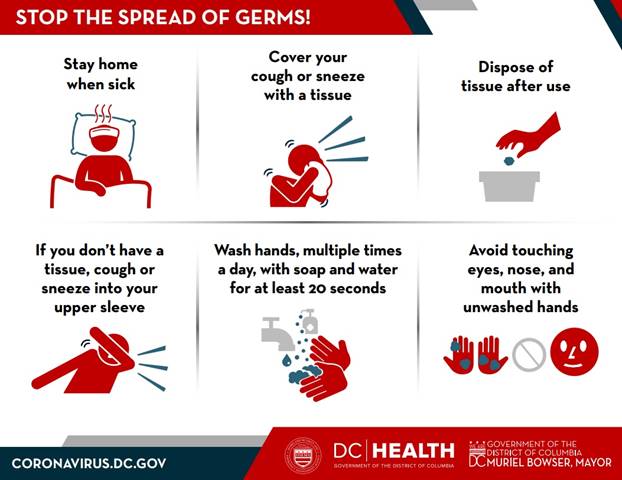
Prevent the Spread of Germs
While the best way to prevent contracting the Coronavirus is to avoid exposure to the virus, the CDC and the DC Department of Health have tips to prevent the spread of germs.
- Wash hands with soap and water for at least 20 seconds multiple times a day. An alcohol-based hand sanitizer can be used if soap and water are not available
- Avoid touching eyes, nose and mouth with unwashed hands
- Avoid close contact with people who are sick
- Stay home when feeling sick
- Cover your cough or sneeze with a tissue, then throw the tissue in the trash
- Clean and disinfect frequently touched objects and surfaces
###
Comments are closed.