


Art installation honors African-American military role during Civil War
Museum's 20th anniversary celebration highlights art's role in highlighting historical understanding
Celebrations are underway to mark the 20th anniversary of the African American Civil War Memorial and Museum. The four-day commemoration features panel discussions, re-enactments, book signings and a special acknowledgment of the arts in the retelling of this important American story.
Officially located at 1925 Vermont Ave. NW, this U Street fixture, despite not being a very large facility, has a substantial and focused mission. The African American Civil War Museum aims to inform the public about the contributions of the black military members who turned the tide in the Civil War. The displays draw a direct line from those brave men and women to the landmark achievement of civil rights in the United States. The first event of the 20th anniversary, held on Wednesday, was the rededication of the Spirit of Freedom memorial with remarks from Robert Stanton, the first African-American director of the National Park Service.
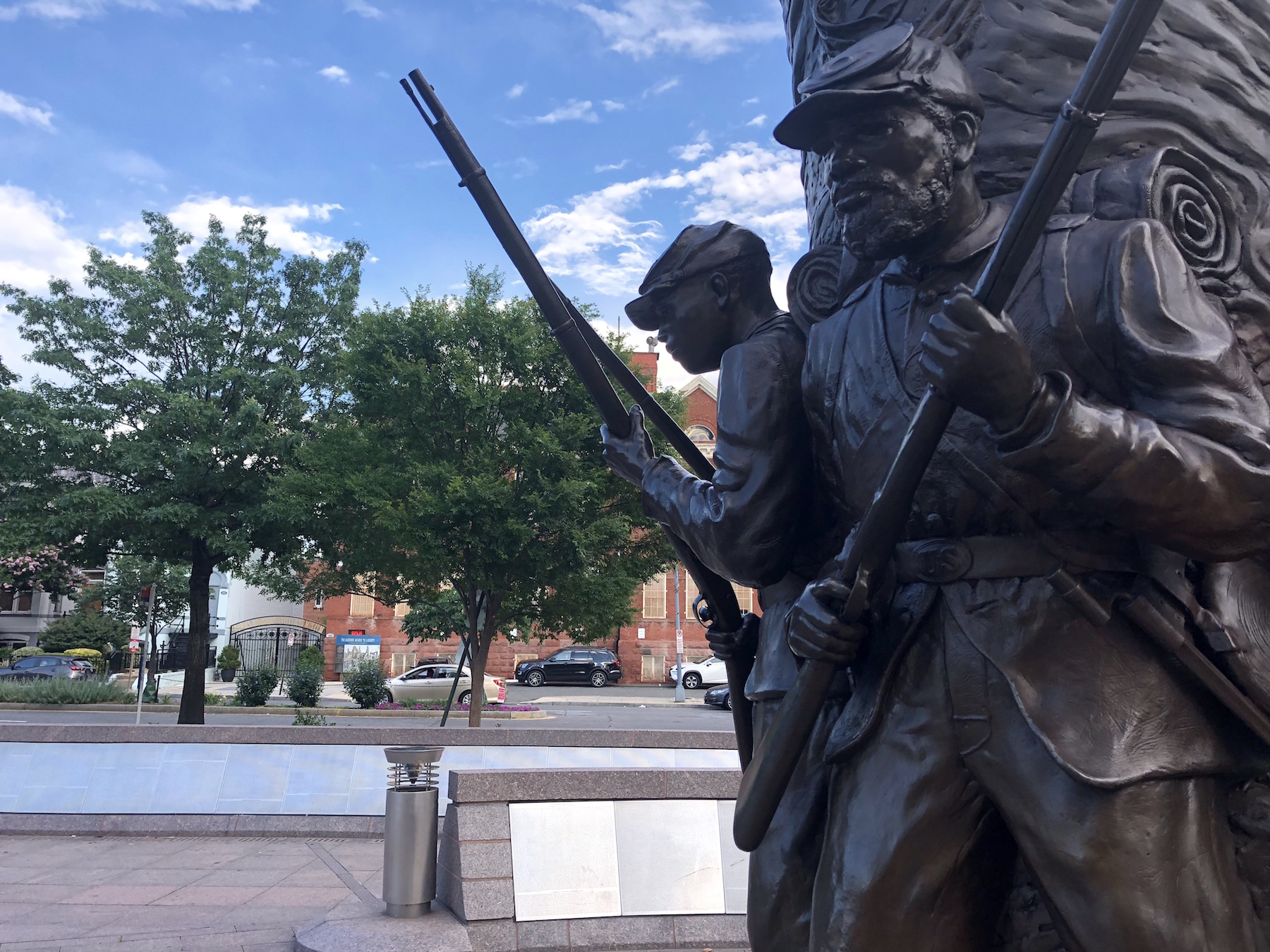
At 9 feet tall and cast in bronze, the Ed Hamilton work features four soldiers standing shoulder-to-shoulder forming a semi-circle. Three of the four soldiers are members of the United States Colored Troops, and the fourth is a U.S. Navy sailor. The statue is only part of the memorial that was finished in 1997. Behind it is a curved walkway with the inscribed names of the nearly 222,000 (correct) African-Americans who served in the military during the Civil War.
As part of this month’s anniversary celebrations, the African American Civil War Museum is host to a special commemorative installation through a partnership with Margery Goldberg’s Zenith Gallery. Artists Curtis Wood and Hubert Jackson, whose work has been featured locally and abroad, both focus on the impact of civil war, but their approaches could hardly be more different. Wood, who works in mixed media, patches together historical and other imagery to focus on particular themes. Jackson’s “Spirits of the Battleground,” on the other hand, takes actual items from historical sites and integrates them into his art in order to pay homage to the legacy of the fallen.
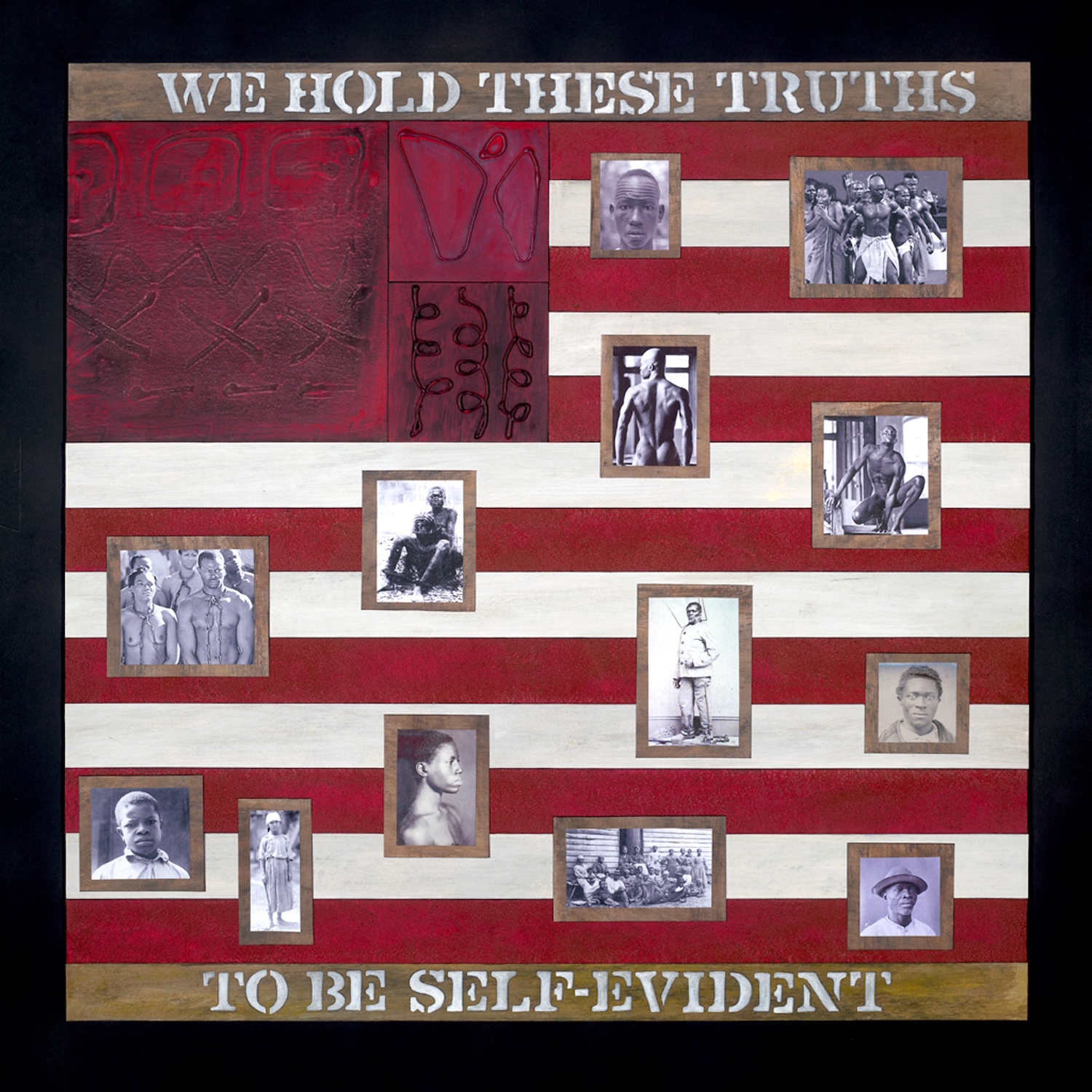
Wood’s exhibition presents eight different works, all beautifully framed and available for purchase. There are familiar faces and images, and then there are ones that draw you in for deeper inspection. “We Hold These Truths” is a well-executed juxtaposition piece of the American flag, with the stars that originally represented the 13 original colonies replaced by 13 photos showcasing the horror of America’s original sin, slavery. The deepness of the red used takes on new meaning in Wood’s reimagining; blue has been replaced by different symbols cast in the same dark crimson paint. At the top and bottom of the work, the thickly lettered words “We Hold These Truths to Be Self-Evident” hammer home this critique of America’s past.
Hubert Jackson’s “Spirits of the Battleground” may not be as forthright as Wood’s work but it is no less striking or emotion-evoking. The Culpeper, Va., native grew up surrounded by the history and legacy of the Civil War. Despite not having the best access to information because of the segregated and underfunded libraries Jackson was forced to use as a child, he developed a deep desire to learn more about the landmarks and the founders of his hometown.
After completing his arts teaching education at Virginia State University, Jackson moved to Washington to start his career as a public school art teacher. He would spend more than 30 years in the classroom. Early in his teaching career Jackson attained his Master in Fine Arts degree from Howard University, where he was taught by pioneering artist Lois Mailou Jones.
As Jackson developed his own style and creative process inside and outside of the classroom, he continued to be inspired by the place of his upbringing. In 2014, he started collecting items for the “Spirits of the Battleground” series. Even though Jackson spends a tremendous amount of time and resources researching the history of battles he portrays in these works, but he sees a deeper message in the work. “My focus is not on the historical aspect of the battles but much more on the spiritual,” he said in an interview. “I want to use this art to honor the lives of those who died on these spaces to affirm they are still with us.”
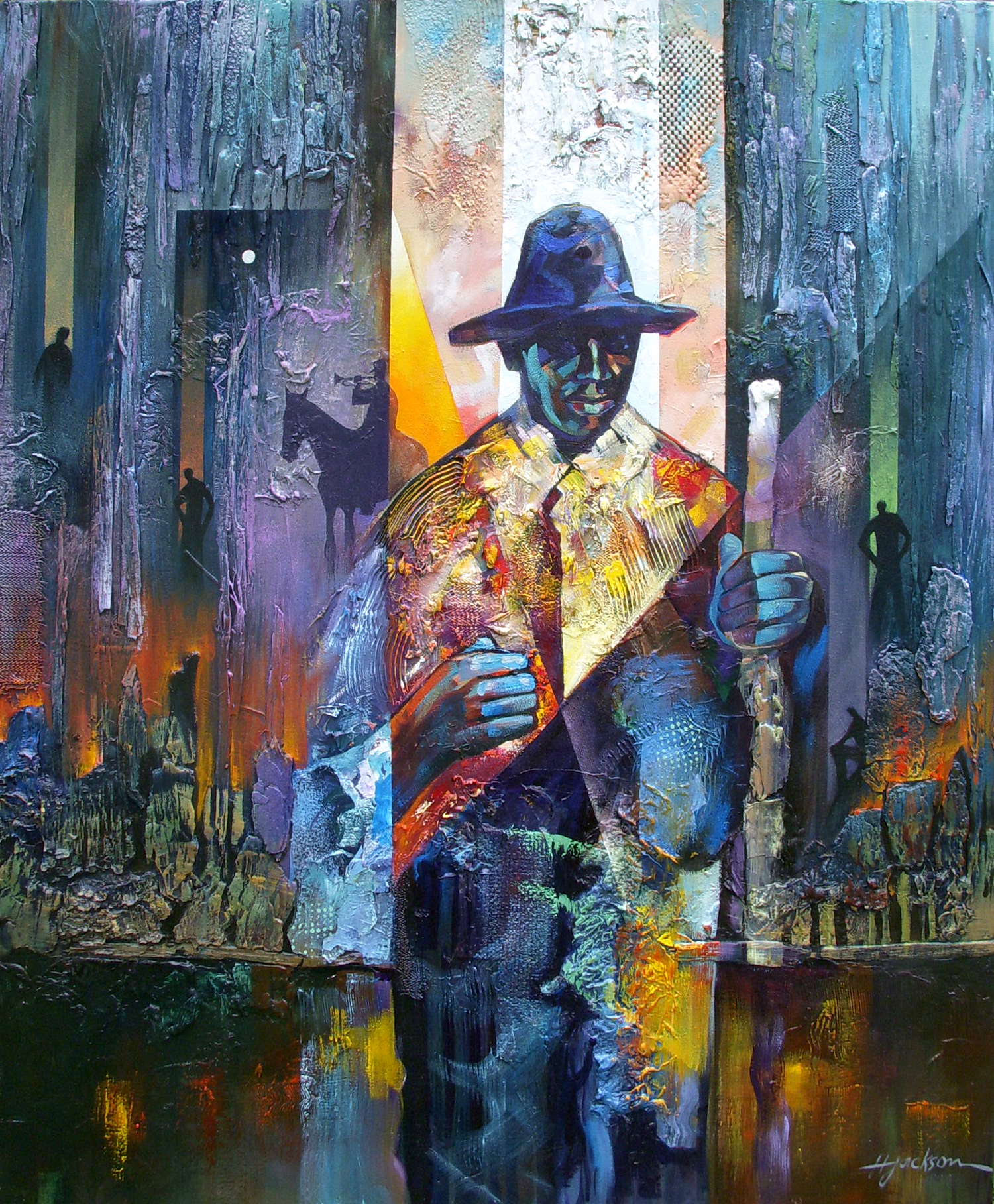
Jackson finished the last piece of his six-part collection earlier this month. Four of the paintings are connected to battlegrounds in Virginia, and the other two venture into a more personal space. Knowing that the bullets, tree bark and other materials you see in Jackson’s work come from the very place he is capturing adds depth to his art. However, his Charlie Wright and U.S. Colored Troops pieces both stand out from the rest of the collection. In these works we see front and center Jackson’s ability to tangibly connect the past with the present.
In deep blue and green tones, Jackson gives the often lost and forgotten a face and presence. Jackson said about the faces that he created in these two portraits: “While a lot of my work is more abstract, with these I wanted to show the faces. They could be people of today. They look like the people I have known all my life.”
There is something gratifying about a son of Culpeper, once denied full access to his own history, finding a way to create an approximation based on years of research and creativity. The refusal to be forgotten or marginalized is a theme that not only runs through this 20th-anniversary celebration, but may be the very reason this institution will be around for years to come.
Curtis Wood’s and Hubert Jackson’s work will be on display through Sept. 30 at the African American Civil War Museum, 1925 Vermont Ave. NW. Hours are from 10 a.m. to 5 p.m. Monday, 10 a.m. to 6 p.m. Tuesday through Friday, 10 a.m. to 4 p.m. Saturday and noon to 4 p.m. Sunday. Admission is free, and information about tours and other activities are available at afroamcivilwar.org. The museum is also on Twitter and Facebook as @afroamcivilwar.
While visiting the internet, I viewed your 20th anniversary exhibiting artist, both I have had the privileges of share exhibits with. In the past my unsuccessful attempt to try and exhibit wasn’t a successful collaboration. Hopefully in the near future my contact information will be of some use.
Best Regards
Warren Alan Jackson