


With DC General shelter set to close, Playtime Project opens new doors
Twenty-four-year-old Sherrice Evans first discovered the room full of toys and children after her daughter ran off to give a stranger a hug.
The stranger, who was a volunteer, and the Quality Inn ballroom full of toys were both part of a local nonprofit’s effort to offer homeless children an opportunity to play.
The Homeless Children’s Playtime Project began in 2003. It partners with homeless shelters and overflow housing sites to give children a chance to play with toys and read books under the watchful eye of staff members and volunteers.
Evans, a mother of three who has been living in hotels since Nov. 17, 2016, was concerned by her daughter’s sudden show of affection toward an individual she’d never met before, but she soon realized the benefit of Playtime. The volunteer explained the playtime session and let Evans sit in while her children played.
“The whole time the kids were paying me no mind,” Evans said with a laugh. “They were so occupied and playing. It was just a nice experience to witness my kids having in there.”

Playtime offers weekly programs, snacks and access to toys for children at emergency shelters and transitional housing sites, according to its website.
Until the beginning of this year, Playtime normally offered play sessions at the DC General shelter, but after Mayor Muriel Bowser announced a firm timetable for closing the hospital, the organization had to think of new ways to offer services to homeless families.
“We heard rumors that it was going to close for probably the past 10 years, so it was nothing new,” said Jamila Larson, executive director of Playtime. “We became desensitized to those rumors because they were always around us, so it was difficult when we found out it was actually going to close.”
DC General, a former public hospital, had been repurposed in 2010 into the city’s largest shelter for homeless families with space for more than 1,000 people, but over the years numerous problems surfaced. In 2014, 8-year-old Relisha Rudd disappeared from the shelter, and city officials responded by calling for it to be closed.
In January, Bowser provided new details for her long-standing plan to replace DC General with smaller facilities for homeless families scattered across the city, and her administration notified current residents of the shelter that it would be closed by the end of the year. Although the timetable for opening the first of those facilities has slipped since then amid construction delays, the mayor hasn’t pushed back DC General’s closing date or an August start to demolition of a nearby building. After the DC Council opted this month not to force a delay, advocates have begun a petition drive to put off the demolition work until all families have moved out.

Notwithstanding the debate surrounding DC General, the Homeless Children’s Playtime Project is working to ensure that homeless families get the help they need wherever they are being housed.
“We think it is our duty to go where the children are, and to make it possible we need to jump through any logistical hurdles we have to reach the kids,” Larson said. Playtime recently launched a plan to partner with two new shelter sites at the Days Inn and the Holiday Inn Express — both on New York Avenue NE near the U.S. National Arboretum — with the new programs scheduled to begin operating in September.
“There are over 300 families living in overflow shelter hotels with more than 800 children, representing that vast majority of children and families experiencing homelessness in our nation’s capital,” Larson said in an announcement of the group’s expansion to the two sites.
A hotel partnership is not new for Playtime. In January 2017, the nonprofit launched a program partnership with Quality Inn, also on New York Avenue NE. It also works with two transitional housing sites at New Beginning Temporary Shelter and Community of Hope.
In order to establish the initial Quality Inn program, Larson worked with the DC Department of Human Services; Choice Hotels, the Rockville, Md.-based lodging company that owns Quality Inn; and hotel management.
“DHS understands the value of recreation and opportunities for supervised play and social time for children,” Department of Human Services director Laura Zeilinger wrote in an email. “The Playtime Project is an esteemed private partner providing an invaluable service to children and families experiencing homelessness.”
Even though the department helped Playtime find space at the hotels, Larson and her staff face logistical challenges in operating the programs.
“We are not being asked or encouraged or invited — we are trying to elbow our way in,” Larson explained.

Initially, the volunteers had problems with toy storage at Quality Inn. And Larson faces new challenges with the recent partnerships at Holiday Inn Express and Days Inn. According to Larson, she dealt with 10 unanswered emails and sometimes had to reschedule appointments to see what rooms would work for her volunteers and staff.
Once she toured the space, she asked for use of a larger room at the Days Inn — either the ballroom or another large room used to distribute meals instead of the waiting room that was offered.
“We advocated, but we lost that fight,” Larson explained.
Despite such challenges, the program at Days Inn will accommodate 20 children and the one at Holiday Inn Express, with a dining room and closet space, can serve 25 children.
Along with hotel space issues, Playtime volunteers and staff are restricted in other ways, too. For example, they can’t decorate the rooms for the children.
“DC General is a lot bigger than [Quality Inn], so there is more versatility and more rooms,” said Tiesha Edwards, a Playtime site manager for the overflow shelter. “They were able to paint the rooms, add furniture and run programs how they want to. Here, we are in a hotel — there are rules.”
Even though the ballroom at Quality Inn isn’t painted, that doesn’t stop the volunteers from making the space appealing to children each week.
On a recent visit, the volunteers file into the room and unpack. Bins of toys, a large kitchen set, and child-sized chairs and desks are brought in from the hotel storage room.
By 6:45 p.m., Edwards opens the double doors to waiting families. Children ages 3 to 7 immediately run in, and soon enough the ballroom is full of the chatter and laughter of kids having fun.
“It is important for every child to play, not just children experiencing homelessness,” said Larson. “But we also know those are the kids who do not usually get as many opportunities to play. … Try to have a healthy childhood while living out of a hotel for nine months where you can’t run through the hallways and have to share one single room with your entire family and you don’t have a playground outside.”
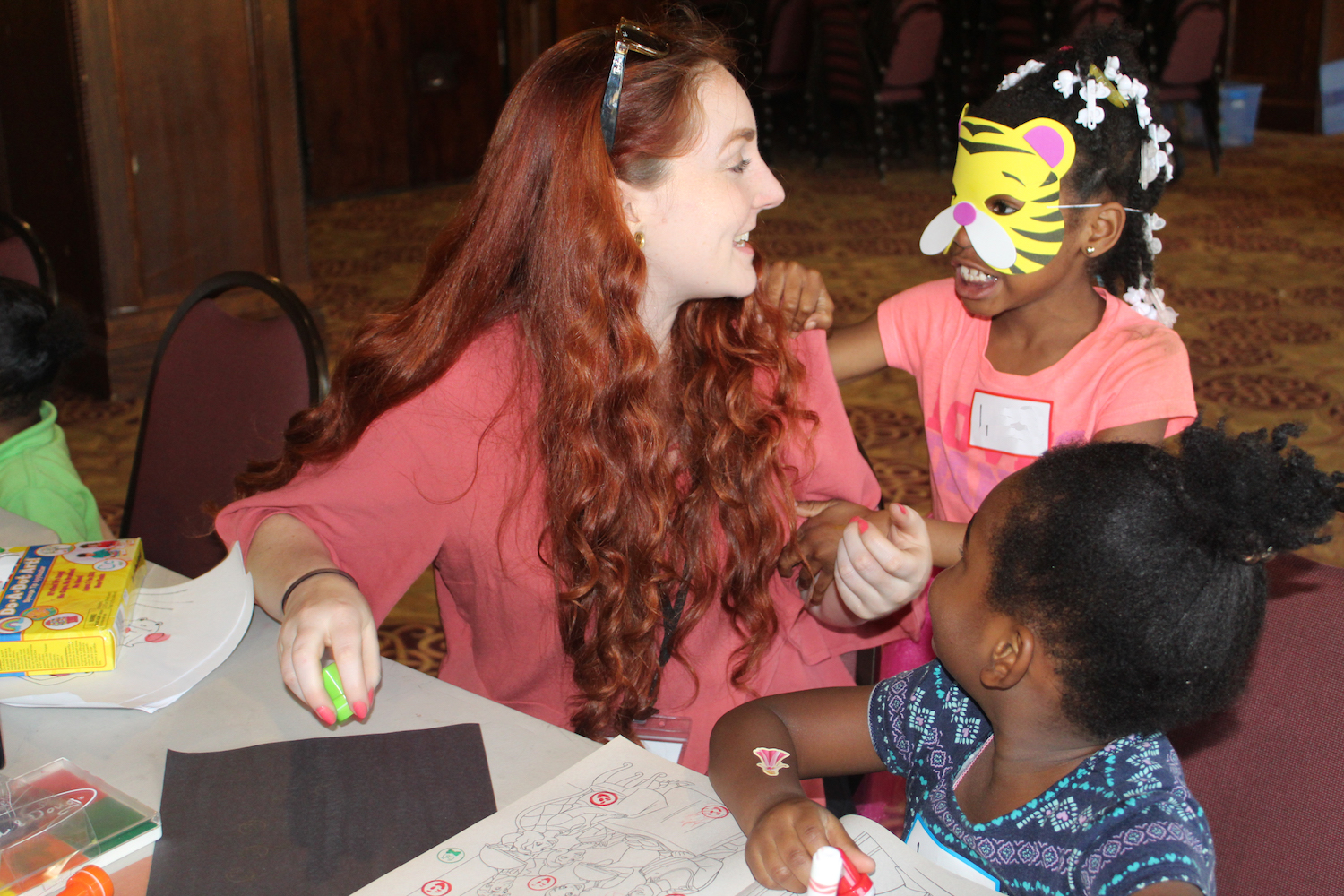
Meanwhile, the children bounce from station to station to play with baby dolls or pull on costumes to become a princess or superhero. When they grow bored, they run to another makeshift station for something new.
A couple of young children plop down onto a mat with a decorated map and immediately start to build train tracks out of blocks.
Kids gravitate toward the toy kitchen set and barter for the plastic apples or lemons from the kids stationed at a nearby toy cash register.
When two running children collide and chaos erupts, Edwards is there to take charge and make sure the kids get back up and continue to create their little worlds of play. The volunteers, who were initially quiet while setting up the room, now respond to the youthful behavior with smiles and renewed energy.
Evans signs in two of her children — 3-year-old Luna and 5-year-old Timothy — and talks to volunteers.
After taking her kids to the Monday sessions because that is her day off from work, she said she noticed a change in them — especially her son.
“He’ll play, he’ll laugh, but if you ask him something he usually just goes into himself,” Evans said. “But since we’ve been going, [the volunteers] ask Timothy how he feels … [and] he’ll be like, ‘I’m happy that I am able to see you,’ and my son [will] go and give them hugs.”
Though the hotel is not always a place she will let her kids socialize, Evans believes her children are in safe hands with the volunteers and staff of Playtime.
“It’s just a magical hour and 15 minutes. All they want to do is tire your kid out and show your kid that there are other people in the world who aren’t parents that do care,” said Evans.
[…] news stories in The Washington Post and The D.C. Line as well as my blog post last month have shed light on the barriers Playtime is encountering in […]
[…] Read more of this story here. […]