

Press Release: Auditor’s Economic Forecast Model Shows Slow, Steady Growth
News Release — Office of the DC Auditor
For immediate release
Contact: Diane Shinn
Independent report differs slightly in revenue growth projections and GDP growth from the Office of the Chief Financial Officer
March 23, 2022 (WASHINGTON) An economic model developed for the Office of the D.C. Auditor predicts slow but steady growth in the District of Columbia’s gross domestic product and in District government gross revenue through 2026, D.C. Auditor Kathy Patterson said today.
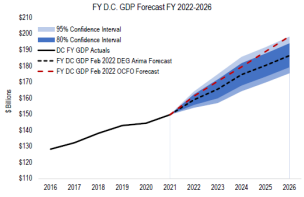
A report prepared by the District Economic Group (DEG) is generally consistent with forecasts published by the District Office of the Chief Financial Officer (OCFO), but the independent assessment shows slightly slower growth in gross domestic product, and slightly higher growth in District revenue over time than shown in the OCFO projections.
The D.C. Auditor is required to certify revenue projections by the OCFO whenever the District borrows money through new bond issuances. ODCA contracted with DEG in 2019 to provide a regular and independent assessment of District finances. The report released today, Modeling the D.C. Economy, Revenues, and Debt Service Obligations for the Office of the D.C. Auditor: A Methodology Report, updates and expands a 2019 model, adding market factors to capture the ongoing impact of the pandemic. The new forecast model includes information on commercial office and retail space, hospitality, and multi-family housing market data, adding greater sensitivity to forecasts on revenue streams that may grow at different rates than overall GDP.
“DEG’s new model provides greater flexibility in forecasting the District’s revenue streams than the initial model and is able to accommodate sudden changes in the District’s economic landscape,” Patterson said. “When it’s used for our next revenue certification we’ll be able to encompass more discrete economic factors than previously.”
Among DEG’s findings in developing the model:
- While the forecast of total FY D.C. GDP has an upward trend throughout the forecast period, the forecast of the real estate, rental, and leasing industry’s contribution to D.C. GDP is nearly flat through FY 2026.
- Income tax revenues were not impacted by the pandemic, consistently increasing from fiscal year to fiscal year through the pandemic.
- In contrast, sales and excise tax revenues substantially dropped between FY 2019 and FY 2020 and dropped slightly further in FY 2021 and are not predicted to recover to and surpass pre pandemic levels until FY 2023.
- The pandemic’s impact may turn out to be on property tax revenues, the District’s second largest source of revenue, which DEG forecasts to decline slightly through FY 2026
GDP and Revenue
The report’s February 2022 GDP forecast for FY 2022 is $159 billion, roughly 1.45% less than the OCFO’s February 2022 estimate of $161.3 billion. Though similar for FY 2022, the DEG and OCFO forecasts differ through the rest of the forecast window, with the OCFO’s forecast higher in each fiscal year.
The comparative forecasts for gross revenues feature similar growth paths through Fiscal 2026, but the DEG forecast is slightly higher in FYs 2024-2026, resulting in a forecast of $11.23 billion for FY 2026 which is 1.25% higher than the OCFO FY 2026 forecast of $11.09 billion.
# # #
The mission of the Office of the District of Columbia Auditor (ODCA) is to support the Council of the District of Columbia by making sound recommendations that improve the effectiveness, efficiency, and accountability of the District government. Learn more at www.dcauditor.org.
Comments are closed.