


Journalism as vocation: legendary DC journalist Bruce Johnson’s memoir honors those who came before, inspires those who will follow
In a phone interview with The DC Line just a few weeks before he passed away on April 3, longtime DC broadcaster Bruce Johnson said his dedication to journalism may have stemmed from the calling he felt as a teenager to become a missionary priest.
“I consider this a vocation,” he said of his career as a journalist. “This was never just a job.”
By the time the legendary WUSA9 reporter and anchor retired at the end of 2020, he had won a host of honors, including 22 Emmy Awards. He had been inducted into the Washington DC Hall of Fame and the Society of Professional Journalists Hall of Fame. Johnson — the recipient of an honorary doctorate from Northern Kentucky University, his undergraduate alma mater — is also recognized in the Kentucky Journalism Hall of Fame. His image is featured on the mural outside the famed DC restaurant Ben’s Chili Bowl.
“It wasn’t so much that I found journalism,” said Johnson, who was 71 when he died of a heart attack. “Journalism found me.”
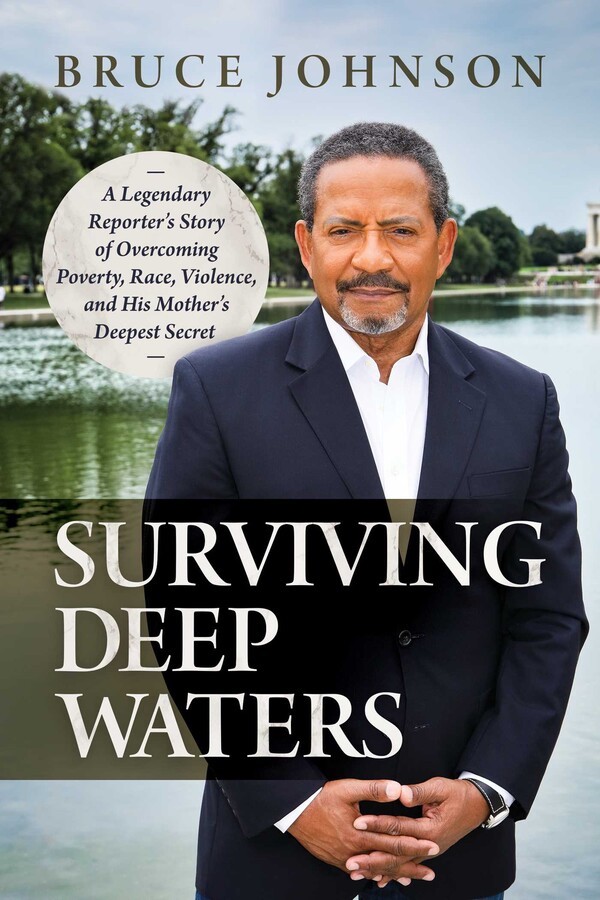
Johnson — who had just recently published a memoir, Surviving Deep Waters — had faced a number of health challenges over the years. In the summer of 1992, he suffered a heart attack while on assignment with WUSA9. He later interviewed dozens of heart attack survivors for his 2009 book, Heart to Heart: 12 People Discover Better Lives After Their Heart Attacks.
In 2018, Johnson was diagnosed with non-Hodgkin lymphoma. Later that year, after four rounds of chemotherapy treatments, he was cancer-free and chaired the Lymphoma Research Ride, which raised $5 million.
In Surviving Deep Waters, Johnson pays tribute to the people — especially family members and newsroom role models and mentors — who played a role in his life and professional success. Blending their stories with his own, the book is a source of inspiration for journalists and anyone working to bring positive change to their workplaces and communities.
“My story has never been about just me,” Johnson writes. “This African American has been carrying the aspirations of a mother, a grandmother and entire communities of black folk. They had done the heavy lifting long before I was born.”
His mother, Mary Johnson-Marbry, was a key figure in Johnson’s life. Born in 1928, a year prior to the start of the Great Depression, she was raised by her grandmother. The family fought hunger and was evicted so often that they rarely bothered to unpack. Yet Johnson’s mother became the first in her family to graduate from high school. She also earned a bachelor’s degree in social work from the University of Louisville at age 52.
Already married, divorced, and caring for four sons at the age of 22, Johnson-Marbry was determined “to provide a better life for her boys,” Johnson writes. While dealing with racism in the segregated South, she made great sacrifices and took crucial steps that would set a course for her son’s life as one of the best-known and highest paid journalists in the nation’s capital.
After her first marriage ended, Johnson-Marbry cooked, cleaned and babysat for a white family who lived in St. Matthews, a wealthy community outside Louisville. She adopted the family’s faith, baptizing and raising her children in the Catholic Church. To send her boys to Immaculate Heart of Mary Catholic School, she made a special arrangement with the priests: She would pay what she could in tuition while Johnson and his siblings made themselves available seven days a week to clean and help raise money for the school.
“I learned perseverance from my mother,” Johnson writes.
At the age of 13 or 14, Johnson felt called to become a missionary priest. “I was made to believe that as a child of God, I was also a citizen of the world,” he writes. He attended boarding school at Sacred Heart Seminary in Cincinnati, where he improved his academic skills, excelled at sports, and embraced the peace and quiet of his surroundings there.
By the age of 15, Johnson fell in love with a girl named Elaine Taylor when she and her family visited Louisville over the summer. But even as his focus shifted to girls, he retained his desire for a higher calling. “I wanted the life I had discovered in Cincinnati, but I wasn’t able to do without a wife and children,” he writes.
Johnson writes that he was part of the second wave of African American and female journalists who were instrumental in diversifying the field of journalism. His role models included Jim Vance, Max Robinson, Ed Bradley, Bernard Shaw and Michele Clark. “These are people that I look up to. They were the first wave,” he says in the book.
Johnson also names the editors and news directors who opened doors for him in broadcast news and with whom he perfected his craft. In 1972, Al Schottelkotte, then news director at Cincinnati’s WCPO-TV, took a chance by hiring Johnson for his first job as a journalist.
Johnson watched Schottelkotte closely, learning everything he could about beat reporting and breaking stories. “I don’t know what his motive was,” Johnson says of Schottelkotte. “I don’t know if he set out to make me a protégé, but that’s what he did.”
Jim Snyder at WTOP-TV (which later became WUSA) brought Johnson to DC in 1976. In the decades that followed, Johnson became a highly regarded reporter whose colleagues and audiences came to expect him to break news in his coverage of DC crime, poverty, politics, racial discrimination, and the leading figure of DC politics — the late Marion Barry.
Despite Johnson’s sustained success, as Courtland Milloy writes in a recent column for The Washington Post, “there were still times when he was forced to contemplate whether a White editor had made an offensive remark because he was a racist — or just a jerk.”
In Surviving Deep Waters, Johnson writes about one occasion when he asked a white news director why he wasn’t on the list to cover hurricanes. The response: “You’re not covering the hurricane because your hair doesn’t blow in the wind.” Johnson was never assigned to cover hurricanes, despite pointing out to the news director that such a comment was grounds for a lawsuit.
One evening, as Johnson was trying to finish a script, another news director snapped, “Bruce, why don’t you speak English?” “It sounded like a racial slur!” writes Johnson, who by then was an award-winning broadcast journalist and the author of two books. The tense situation that ensued led him to conclude that it was a setup designed to provoke him.
Earlier in his career, Johnson also endured various kinds of snubs. In Cincinnati, he was never invited to the newsroom’s social events. News director Schottelkotte never invited him to his home or introduced Johnson to his family.
During his interview with The DC Line, Johnson compared his experiences as an African American journalist with those of the women he worked with over the years. “They had to teach men how they should be treated,” said Johnson. “You go along to get along, but that doesn’t mean it wasn’t painful,” he added.
As a young journalist, he realized that he was not in a position at that point to change racism or sexism in newsrooms, Johnson said in the interview. His goal was survival. “And then when you got to the point where you had survived, and you were somewhat thriving and had some seniority, then you can begin to make change.”
But from the start he was showing the people running newsrooms and television stations that his reporting — and the stories he wanted to cover — had value, he said.
Johnson said sometimes he distrusted the way that other reporters — at his own station and in other newsrooms — covered certain kinds of stories. Crime, for example: “The problem was how we cover those stories of people getting shot. They became just numbers,” he said.
While covering a shooting, he wanted to hear not just from police but also from a parent who had lost a child, while striving to do so with sensitivity. “Their parents, their mothers are entitled to tell their stories,” he said. “That mother had dreams and aspirations for her child.” He might ask, “What do my viewers need to know about this person, about your son or your daughter?” The question would give a parent an opportunity to remember their child who was no longer there.
“Reporters’ values ought to reflect the communities that they serve,” said Johnson. Journalists ought to be curious, and they shouldn’t judge, he added. “Don’t write the story before you get there.”
In his book, he writes that he wished more journalists had been at the U.S. Capitol to provide eyewitness coverage of the insurrection on Jan. 6, 2021. “I thought it was a bad day for journalism,” Johnson explains. More journalists should have followed the insurrectionists after police escorted them down the steps of the Capitol and things had calmed down, he adds. His questions for the insurrectionists would include, “Why are you so angry? What had this country done to you?”
Johnson writes that, in retirement, he expected to continue the productive, necessary dialogue inspired by Black Lives Matter protests about “race and commitment to equality on every front. Police, politics, socio-economic conditions, health disparities.”
In the months before his death, Johnson participated in the ongoing national debate about the state of the journalism industry, which in recent years has experienced multiple rounds of cost-cutting measures, resulting in dwindling resources for many newsrooms and layoffs of veteran staffers. Publication of his memoir led to numerous invitations to speak on college campuses. Some students at these events expressed concerns about limited resources and a lack of training for new journalists being hired to positions without the preparation and skills they need to succeed. Johnson said that to help address these problems, it is important for industry veterans to talk to those who are entering the business. “How can we help you?” he suggested as an opening, urging dialogue rather than a lecture. “I’d put it that way.”
Surviving Deep Waters is a valuable resource for having those conversations, with many timeless lessons contained within its pages. In the interview, Johnson said he wrote it while looking back at his career. Eerily foreshadowing the weeks ahead, he added: “With far fewer days ahead of me than behind me, it’s the kind of book I wish I had had when I came into the business.”
Surviving Deep Waters: A Legendary Reporter’s Story of Overcoming Poverty, Race, Violence, and His Mother’s Deepest Secret by Bruce Johnson (288 pages, $28) was published in February 2022 by Post Hill Press.
I read on my newsfeed about Bruce Johnson and what he had expressed in his book I love you both Johnson and I miss you yes your book should go out to all the young students that are looking to be a journalist least they can get a steppingstone from what you have expressed in your book