

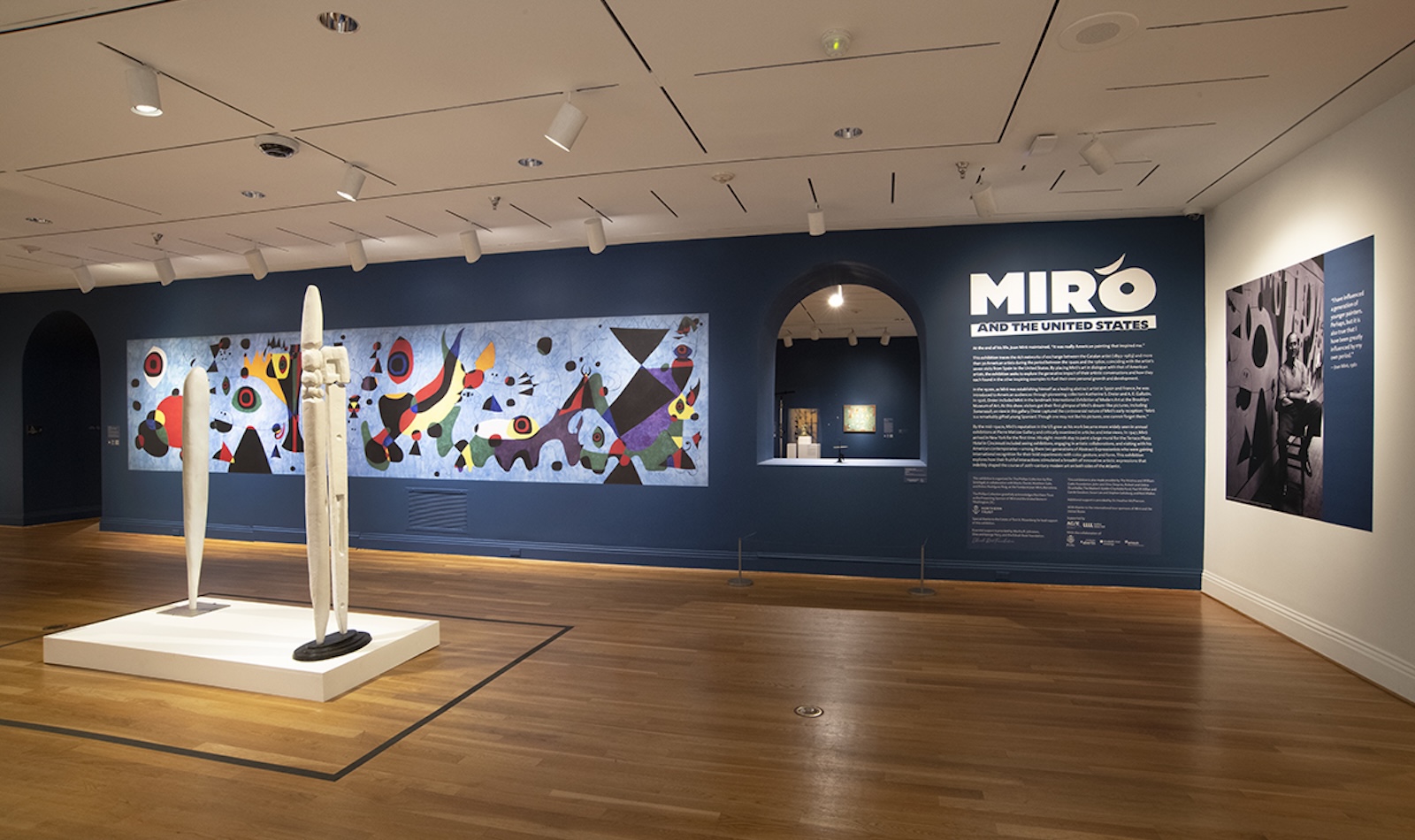
Phillips Collection’s new ‘Miró and the United States’ exhibit focuses on transatlantic cultural exchange rather than conflict
Tellingly, the newest exhibition at The Phillips Collection is titled Miró and the United States, rather than Miró vs. the United States.
The latter framing might be expected in Washington, where so much of public life is structured around opposition: court cases, political battles, and ideological showdowns.
The exhibition unfolds in the shadow of World War II. The transatlantic relationship had been shaped by the fight against European fascism and, soon after, would be altered by Cold War tensions.
A title like Miró vs. the United States might suggest a cultural clash between European modernism and an emerging American art scene.
But conflict is not the story this exhibition sets out to tell.
Instead, Miró and the United States offers another narrative: exchange. Across the fourth-floor galleries, the exhibition reveals a transatlantic dialogue among artists seeking a new visual language.
From the start, curator Elsa Smithgall places Joan Miró in dialogue with his American contemporaries, encouraging viewers to draw connections and find parallels with what they already know and have seen in Washington.
Walking in, visitors are greeted by a miniature Alexander Calder mobile. Locals may recognize it immediately because a monumental Calder hangs permanently in the National Gallery of Art’s East Building just across town. The gesture is deliberate. This exhibition is about kinship and the electric charge that passed between artists who understood and built on each other’s artistic vocabulary. Featuring 75 works by Miró and more than 30 other artists, the exhibit traces this artistic dialogue through a transformative mid-20th-century period of war and political turmoil.
The exhibition foregrounds artistic exchange but gives less attention to how that exchange shaped not just techniques but also political realities and activism: Miró working under a decades-long dictatorship in his native Spain, and his American counterparts shaped by a very different political and cultural environment.
In November 1941, as the United States stood on the brink of entering World War II, the Museum of Modern Art opened a retrospective of Miró’s work in New York. Within weeks, the bombing of Pearl Harbor would bring the United States into the war. Politically, both sides of the Atlantic Ocean were defined by conflict. Artistically, something else was happening. American and European artists were studying one another’s work, visiting studios and exchanging ideas about abstraction, symbolism, and the emotional possibilities of painting.
By the early 1940s, Miró had begun his famous Constellations series: 23 small, jewel-like paintings filled with stars, birds, ladders, and mysterious floating symbols. He painted them as Nazi forces advanced across Europe, and the works became his imaginative escape from war.
When the series was exhibited, artists in New York responded quickly. Rufino Tamayo’s Heavenly Bodies (1946) shares the same star-studded blue sky and the same sense of floating forms adrift in a vast cosmos. Tamayo likely saw Miró’s Constellations when they debuted at a New York gallery in 1945. The influence is quite visible. Zigzagging beams of white light suggest the pattern of a constellation, while a figure at the edge of the canvas tilts his head back, mouth open, as if in awe of the universe.
Miró’s work was very much grounded in the brutality of war, though the current exhibition shies away from the full range of his political outrage. One of the show’s most arresting works, Still Life with Old Shoe (1937), was painted while Miró lived in exile in Paris during the Spanish Civil War. The painting’s jagged forms and acidic colors convey the anguish he felt watching his home country descend into violence. Miró later described the painting as his own response to Picasso’s Guernica.
Armenian American artist Arshile Gorky admired Miró’s Still Life after seeing it in the 1941 MoMA retrospective and created his own interpretation, Garden in Sochi (1943). Where Miró’s composition unfolds against a dark sky, Gorky places his shapes against a luminous white background. While Miró’s imagery evokes the violence of war, Gorky’s forms draw from personal memories of his childhood. The worn shoe in Miró’s painting becomes Gorky’s reference to his father’s Armenian slippers. The bottle becomes his mother’s butter churn.
Miró took inspiration from Picasso and turned the horrors of war into a still life of symbolic objects. Gorky then absorbed Miró’s visual language and reshaped it into something autobiographical. Each artist extended the conversation across a politically fraught Atlantic.
When Miró arrived in New York in February 1947 on his first trip to the United States, he encountered a vibrant artistic community of painters, musicians, critics, collectors and museum leaders, and met many of the artists who would shape Abstract Expressionism.
In technique and expression, Miró’s exposure to American painting loosened his gestures and pushed him to experiment with new ways of applying paint. His 1948 painting The Red Sun, with its thick impasto, bold black drips, and cratered surfaces, reveals the influence of his American contemporaries.
What the exhibition does not mention is that many of those American artists had come of age during the New Deal, when the U.S. government treated art as a form of activism. Between 1933 and 1943, the Federal Art Project sponsored a decade of arts funding and launched the careers of then-unknown artists like Willem de Kooning, Lee Krasner, Jackson Pollock and Mark Rothko. That generation carried a vision of cultural democracy: art by the people, for the people. This context is largely absent from the exhibition.
The exhibition doesn’t ask how Miró used his art politically — not just as an escape but as a form of confrontation — or how his encounters with American democratic ideals may have shaped his political imagination. Was the collaboration between Miró and the United States limited only to art? The show presents the Constellations as an imaginative flight from war, which they were. But Miró also made explicitly political works: posters condemning Franco, prints supporting Catalan independence, and murals that refused to look away from violence. However, because the exhibition focuses primarily on works between 1947 and 1968, those artworks are largely absent.
This omission is a missed opportunity. The exhibition does a great job tracing artistic exchange, but stops short of asking a broader question: How does that exchange shape transatlantic relationships beyond the gallery, particularly in public life? Sports diplomacy is well understood. Arts diplomacy is no less significant.
The exchange between Miró and America was not just about techniques and textures. It was also about a Catalan artist encountering a democratic society after years of war and dictatorship, and American artists encountering a European modernism that encouraged an artistic vocabulary of biomorphic forms, symbols, and dreamlike imagery. That two-way conversation helped redefine what art could be, and why it mattered, on both sides of the Atlantic. A clearer acknowledgment of that political dimension would have made the exhibition’s story not just beautiful, but urgent.
Miró’s Terrace Plaza Hotel mural, which he created during his 1947 visit to America, still exists in Cincinnati, as does his much later civic sculpture in Chicago’s Brunswick Plaza. And until the attacks of Sept. 11, 2001, a monumental Miró tapestry hung in the World Trade Center’s South Tower. Its destruction underscores how, even after Miró’s death, his work remained entangled with histories of war and violence.
Nevertheless, walking through the blue-walled galleries, surrounded by stars, birds, ladders and floating forms, what emerges from Miró and the United States is not a story of conflict but of exchange: artists responding to one another across oceans and decades.
Not vs., but and.
Miró and the United States opened on March 21 and continues through July 5. The Phillips Collection is located at 1600 21st St. NW.
Comments are closed.