


Education, affordable housing emerge as key themes during 2019 inauguration
Bowser, Racine and DC Council members re-elected in November kick off new term
Affordable housing, DC statehood, homelessness, education reform and reducing violent crime were key issues for many District officials during Wednesday’s swearing-in ceremony at the Walter E. Washington Convention Center.
Mayor Muriel Bowser, Attorney General Karl Racine and several DC Council members took oaths amid the partial federal government shutdown and one day prior to the swearing-in ceremony for the 116th Congress. The Jan. 2 event provided ample fodder for city officials to criticize President Donald Trump and the formerly Republican-controlled Congress.
Officials previewed their agendas for the coming term, and incumbents summarized their previous accomplishments in speeches following their oaths. Racine, who has gained national prominence of late, highlighted several priorities for the attorney general’s office: reducing violent crime, fighting elder abuse, addressing the opioid epidemic and continuing to pursue the emoluments lawsuit against President Donald Trump that Racine filed in 2017.
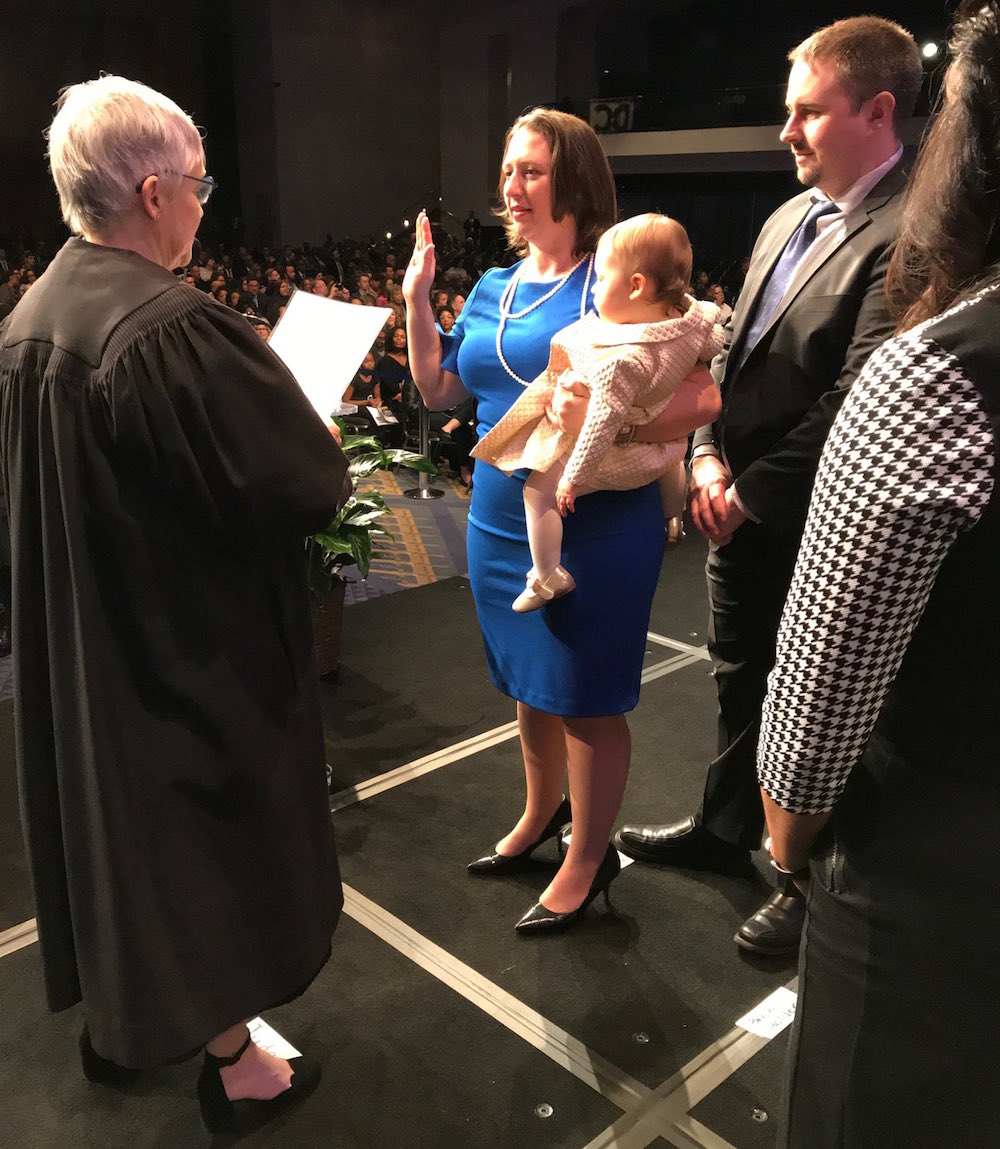
“In the next four years, the Office of the Attorney General will double down on our efforts to protect District residents and defend our laws. In the coming weeks and months, you’ll see efforts from our office to fight elder abuse, to protect children from sex trafficking and to defend our civil rights,” Racine said. He also vowed to fight “bad federal policies” around immigrants, health care and the environment.
Incumbent DC Council members Charles Allen (Ward 6), Anita Bonds (at-large), Mary Cheh (Ward 3), Kenyan McDuffie (Ward 5), Brianne Nadeau (Ward 1) and Elissa Silverman (at-large) were also sworn in Wednesday, as was Council Chairman Phil Mendelson. Each touched on issues affecting their neighborhoods while stressing the need for collaboration across the District.
Cheh began by reiterating her support for DC statehood and sharply criticizing the government shutdown.
“They can’t even keep the lights on, keep the doors open, and yet representatives from around the country can tell us what laws we can have,” she said. “This is wrong.”
Cheh highlighted the District’s financial health, including an AAA bond rating from Moody’s, the highest possible credit rating. Then she mapped out several upcoming areas of focus.
“We are the envy of jurisdictions around the country because of our economy. We have balanced our budgets; our economy is very strong; we have [AAA] bond ratings. And yet, we also have our struggles,” she said. “There are too many murders, too much carnage on our streets. We are crushing people with high fees, fines and charges. We’re suffocating our businesses with lengthy procedures and burdens of bureaucracy.”
McDuffie, who has served on the council since 2012, concentrated on education reform, closing the achievement gap between black and white students, and addressing gentrification in the District.
“I can’t point to a single public school located east of the Anacostia River that has a waiting list full of students living west of Rock Creek Park,” McDuffie said. “A true measure of our success for our city, as it should be for any city, is how we educate our people.”
Nadeau, representing the District’s most diverse ward, acknowledged her white privilege during her speech, emphasizing the need to fight homelessness and build more affordable housing. Since she was first elected in 2015, Nadeau has spearheaded the development of more than 800 affordable housing units in Ward 1.
“Now, more than ever, there are residents saying, ‘Yes, in my backyard,” Nadeau said, noting the contrast from “not in my backyard” cliches or “NIMBY-ism.”
She added, “I hear you, longtime residents, when you say, ‘We don’t recognize our neighborhoods anymore; all the new things being built are not being built for us.’ Even newcomers are saying, ‘Do not let our presence wipe away the vibrant culture that first attracted us to the District.’”
Silverman reiterated McDuffie’s call to close the gap between black and white students, and also emphasized the need for more effective DC government.
“It shouldn’t be a fight to fund effective adult education programs that put moms and dads to work, or to have specialty healthcare located throughout our city, or to put money toward evidence-based restorative justice programs that can make sure a 10-year-old buying an ice cream or a social worker coming home from work doesn’t become a victim of gun violence,” she said.
Mendelson noted that the 2018 election was the first since 2002 in which every council incumbent on the ballot was re-elected, but said that doesn’t mean voters are entirely satisfied with the District’s governance.
“To say that citizens are comfortable with the direction we’re going in is only a half-truth,” he said. “The feedback I took from last year’s election was that citizens aren’t comfortable with the city’s direction on important issues like education and affordability.”
Public schools, Mendelson said, are supposed to be “the great equalizer” and “the solution to social justice ills.” He said the District desperately needs a long-term strategy that ought to include ending social promotion in order to ensure that students have the skills they need to succeed in upper grades.
Bowser, who begins her second term this year, took her oath last. She stressed the importance of unity and concern for all wards in the District.
“We are only as strong as a city as the ward the struggles the most. You cannot represent the District of Columbia as a whole and not reflect that in your words, actions and budget decisions,” Bowser said during her speech. “When I campaigned in 2014 as an ‘all eight wards’ candidate, I meant it and I’ve done it.”
She also recalled the first couple weeks of her first term in 2015, when a snowstorm hit the District and a woman died after a Metro car filled with smoke. The Washington Post’s Outlook section gave Bowser the dubious distinction of “the worst week in Washington.”
“Those first two weeks, what I so desperately wanted to be the start of our ‘fresh start’ was actually a slow start. I remember being bestowed the not-so-great honor of the ‘worst week in Washington’ by our friends at The Post,” Bowser said. “The lesson I took from it was that the mayor must be the one who admits what went wrong, explains what steps she can take to fix it, and establish what needs to be done so it never happens again.”
Ongoing efforts by the Bowser administration include the East End hospital project, maintaining the financial health of the District, developing affordable housing and raising the minimum wage. Despite the District’s financial health and high credit rating, Bowser said that the city must spend carefully in anticipation of a potential recession.
“We are not financial tsunami-proof,” she said. “We must resist writing checks now that we cannot cash in recessionary times.”
Later that day, the State Board of Education held a swearing-in ceremony for Emily Gasoi (Ward 1), Ruth Wattenberg (Ward 3), Zachary Parker (Ward 5) and Jessica Sutter (Ward 6). The board members’ concerns about education reform echoed those of Bowser and several council members: reading and literacy scores are too low; student trauma is not being addressed sufficiently; students are graduating despite inadequate performance; and there remains a significant achievement gap between black and white students.
“It is the best of times if you live in certain sections of our city — often more affluent and whiter, where your kid is guaranteed a seat in one of our better schools,” Parker said, referencing the opening line in Charles Dickens’ A Tale of Two Cities. “It is the worst of times if you live in other sections of the city: often less affluent and blacker, where you were just told that your neighborhood school is only worth one out of five stars.”
The afternoon ceremony also featured the two members of DC’s statehood delegation re-elected in November: Sen. Michael Brown and Rep. Franklin Garcia. DC Council members also took turns at the podium administering the oath of office to advisory neighborhood commissioners in their respective wards.
This post has been updated to correct a misspelling of State Board of Education member Jessica Sutter’s name.
Comments are closed.