

jonetta rose barras: Everyone can vote in the special election on June 16, regardless of party or nonparty
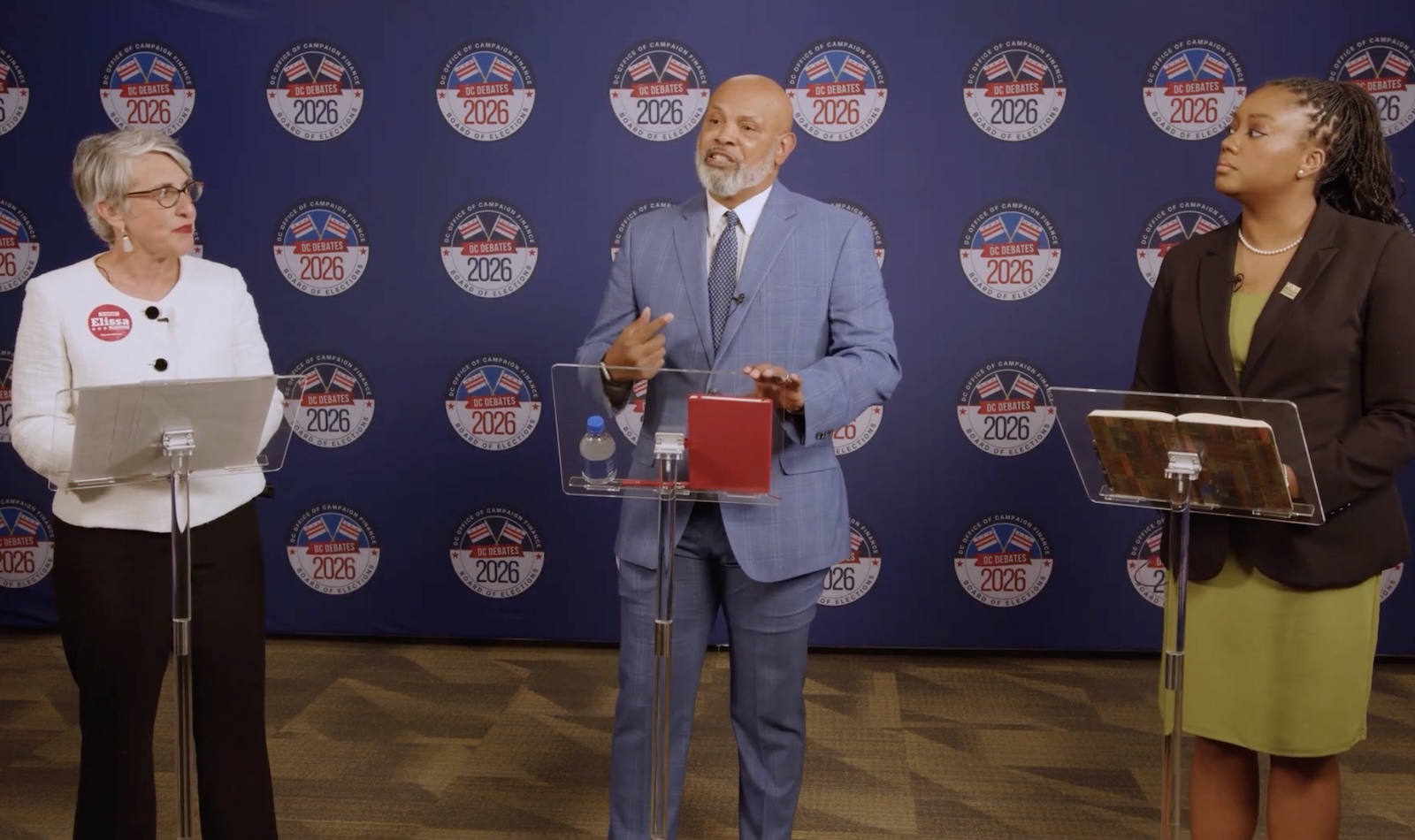
“It’s nice to see everyone so willing to work together,” journalist Michael Brice-Saddler quipped while moderating the recent debate sponsored by the DC Office of Campaign Finance principally for candidates certified under the Fair Elections Program running in the at-large DC Council special election.
Interim at-large Councilmember Doni Crawford, DC State Board of Education President Jacque Patterson and former two-term at-large Councilmember Elissa Silverman are each running to fill the final months of Kenyan McDuffie’s term, which runs through January 2027 but became vacant when he resigned earlier this year to run for mayor as a Democrat.
The special election is being held on June 16, the same day as party primaries. Voters registered as independents shouldn’t be confused when receiving a ballot in the mail. It’s not a mistake — although we know how prone to mistakes the DC Board of Elections has been over the years.
In this case, take the ballot. Everyone, regardless of party status, can vote in the special at-large council election. For members of a political party, take note: It’s at the very end of the ballot, on the last page.

The kumbaya moment that drew Brice-Saddler’s praise midway through last month’s debate arrived after Silverman asked her opponents, “How can we work together?”
That seemed an odd question from a pol who served in the legislature between 2015–2023 and who made tons of enemies along the way. Equally baffling was Silverman’s calm demeanor, which contrasted with her former, more fiery self.
Crawford didn’t comment on the apparent conversion. She accepted the peace offer hidden in the Rodney King-esque question. “I’m always willing to work with anyone to push the agenda for DC.”
Crawford is not without her own controversy. When McDuffie resigned, the council had to appoint an interim replacement. The 13-member legislature selected her — although she lacked the experience of some of the seasoned politicians on the list of 40 who were under consideration, which ironically included Silverman and Patterson.
Patterson has known Silverman since she was a journalist at Washington City Paper in the early 2000s, when she endorsed his run for Ward 8 councilmember as the Loose Lips columnist. “I don’t think we would have a problem working on issues we truly care about,” he replied to her query. “I look forward to helping anyone in this seat. I want it to be me, of course.”
For this column, I watched or attended forums and read questionnaires prepared by various local groups. I also requested and conducted one-on-one interviews with Crawford and Silverman; Patterson did not reply to my email.
Given the power and influence of the mayor — the marquee item on this year’s local ballot — a short-term special election may seem like a consolation prize. It isn’t.
Consider that in DC, the council approves all appropriations — not the mayor.
Being a member of the legislative branch is no hand-me-down.
In regular at-large contests, the law permits voters to choose two individuals for the vacant seats in the November election. The Democratic Party primary winner has traditionally won the most votes.
The second winner must be a person from a minority party or no party. Once upon a time, Republicans could push their way inside. That was before some Democrats began hedging their bets and changing their party affiliation to independent.
All three special election candidates were once active members of the Democratic Party. Call this a game of masquerade, if you wish.
In this case, the candidate who prevails in the special election will have to run in November if they want a full term in the seat. That could set up a rematch among the same three contenders in a race that would feature any other independents who decide to run, plus nominees from the Democratic, Republican and DC Statehood Green parties — all vying for one of the two at-large seats at stake in the general election.
The prospect of a second election before claiming a full term has not dissuaded Silverman, Patterson or Crawford. And don’t let that let’s-all-get-along give the impression there hasn’t been tension and elbow action in the race.
At one point in the debate, Patterson asked Silverman why she was trying to get back in the legislature after her election loss in 2022: “People said they didn’t want you. What did you learn from that defeat?”
Let’s go to the clips: In 2022, Silverman seemed poised for reelection. McDuffie, then the Ward 5 councilmember, decided to run in the Democratic primary for DC attorney general. However, responding to a challenge by an opponent, the DC Board of Elections ruled that he did not meet the statutory qualifications regarding his status as an active lawyer.
McDuffie quickly pivoted, deciding to run for the at-large council seat in the general election, which required him to discard his Democratic Party membership and register as an independent.
Silverman suddenly had a formidable opponent she hadn’t expected. She lost her bid, receiving 63,471 votes to McDuffie’s 71,924 votes. The Democrat in the race, incumbent Anita Bonds, was the top vote-getter with 103,991 ballots marked for her.
Now, four years later, Silverman faces the woman who served as staff director for McDuffie’s Committee on Business and Economic Development during his most recent term.
Silverman didn’t flinch at the sharpness of Patterson’s query. “When difficult things happen, you can either keep repeating them or you can change.
“I’ve chosen to change,” she added.
A banner on her current campaign website reads: “Re-elect Elissa Silverman” as if there had been no defeat, no break in her political career.
Last week, Patterson and Crawford announced their cross-endorsement of each other. With the arrival of ranked choice voting this election season, candidates have resorted to a new form of hedging.
Like some candidates in the Ward 1 race, Patterson and Crawford are encouraging their own supporters to rank them No. 1 and the other No. 2 on the special election ballot.
“I think Elissa has the advantage because of name recognition. I think Elissa is going to get 50%,” said John Capozzi, a Ward 7 resident and longtime political activist.
“Jacque looks like he lands on third place,” Capozzi told me earlier this month in a telephone interview.
From that vantage Crawford would be relegated to second place. This week, however, DC Council Chair Phil Mendelson endorsed Crawford — an endorsement that could well elicit varied reactions among voters, but one that is likely to shake up the race in some fashion.
“I have the money and resources to win,” Crawford told me during our recent interview.
“I think it’s Jacque’s race to lose,” said Ambrose Lane Jr., another Ward 7 resident and chair of the Health Alliance Network. “Jacque ran citywide; he is known citywide,” he added, referring to Patterson winning the at-large seat on the State Board of Education in 2020 and again in 2024.
During the OCF debate, Patterson said he was running because “we need a fresh face on the council. … We need to move the city forward. We need new ideas and new ways of doing things.”
The Abbott and Costello-style “Who’s on First” routine in DC politics has always been entertaining. However, determining who’s actually likely to score top place involves analyzing a candidate’s position on issues as well as understanding the impact of identity politics.
The latter was a factor in Silverman’s defeat. It may affect this year’s outcome as well.
Earlier this month, a group calling itself the Black Power Breakfast Club distributed an open letter that argued, “Elissa Silverman should not be running for at-large council right now.” The writers, describing themselves as Black women organizers and community leaders, indicated that her “record reflects a consistent failure to demonstrate respect, accountability, and care toward Black women and femmes in this city — especially those who are poor and working-class.”
Among the “evidence” cited, the group mentioned her comments about Black Lives Matter DC and subsequent apology, as well as a purported failure to address their concerns that the campaign for the city’s paid family leave law “used images of Black families while centering transient white professionals and failing to build authentic relationships with Black communities.”
When I asked Silverman about this complaint during my interview with her, she said, “I called some of the women on that letter and said let’s get together. Let’s hit reset.
“I apologized,” continued Silverman. “We need to work together.”
Lane said he has been working with the Million Man Vote, a predominantly Black male group that has interviewed at least a dozen political candidates. He said they have presented their agenda, which among other things advocates for financial freedom and economic security through guaranteed jobs for Black men; an end to police brutality and racial profiling; guaranteed affordable housing and support for homeownership; a Marshall Plan for rebuilding Black communities; reparations; and full human rights and equality.
“I can tell you many have agreed to our plan,” said Lane. He declined to say who the group had interviewed, but it’s worth noting that Patterson was an advisory member of the group prior to launching his council campaign.
Based on forum responses and my conversations with the candidates, they approximate each other on the major issues that have animated this year’s elections — public safety, the economy, and the city’s fiscal health and affordability, chiefly housing.
Silverman has said she is running to deal with President Donald Trump. “We need clarity for our residents and our businesses” about DC’s posture. She said that, just as the council conducts a fiscal analysis of public policies under review, “there needs to be a Trump analysis” to predict how he is likely to react.
She said the DC government should make better spending decisions. Silverman said she heard a common refrain from residents who urged her to run: “We need your voice on fiscal responsibility, on accountability. We need your journalistic instincts.”
Silverman called truancy a “house on fire issue. Our present and our future depend on addressing it.”
Crawford agreed that addressing the needs of youth ranks as a top priority. She stepped in during the curfew discussion in the council, offering several amendments that were critical to creating support for a permanent law; an emergency bill still has not passed.
The council’s resistance to an expanded youth curfew apparently doesn’t reflect public sentiment. City Cast DC conducted a poll in mid-May on that subject and others ahead of DC’s election and found that 72% of voters support an expanded teen curfew.
Crawford believes there should be more programming for youth in their neighborhoods, greater collaboration among agencies, and more mental health services, especially since Mayor Muriel Bowser cut funding in the fiscal year 2027 budget to pay in-school clinicians. “I plan to fight for that program going forward.”
On the debate stage, Crawford acknowledged that there is “still the perception and reality” that people are not safe. She argued for better use of violence interrupters, among other things.
“Every single year we see the same thing and that’s because we have not invested in policing, community policing,” said Patterson, advocating for reconstituting “our reserve officers as a way of driving down overspending.”
He also argued for “stronger investment in mental health” and summer programs.
“We need people to feel safe. We [also] need to follow evidence-based best practices,” said Silverman. After the murder of George Floyd by Minneapolis police, the council put together a commission to examine DC public safety policies and make recommendations for improvements; that report should be implemented, she added.
The three candidates also agreed that the government should push for speedy production of affordable housing. “I think we have to move faster,” said Patterson, noting that his daughter, who is a teacher, “could not buy the home she was raised in because of the price and what she makes.” He said he supports denser construction like what is happening at Barry Farm and mentioned that during the Williams administration the government used Hope VI funding to “build more housing and create greater opportunity.”
“We need to build more,” said Silverman. But she added that DC has hundreds of vacant units owned by the DC Housing Authority “just sitting there. We need to do both. [That] is our land; we can redevelop our public housing to be a real asset.”
She and Patterson support providing a greater subsidy for office-to-residential conversions. “That is one of the changes in my thinking,” Silverman said during the OCF debate.
Crawford told me that when she meets with groups like Empower DC, which works with public housing residents, “They want repairs and maintenance. Further, the city can’t solve the public housing problem with the mere $60 million that is set aside in the capital budget,” she added, disputing the effectiveness of Silverman’s proposed priority.
There also wasn’t consensus on the notion of waiving affordability requirements in order to encourage more office-to-residential conversions downtown or providing greater subsidies in the hope that lower-income residents share in the benefits of such projects. During my interview, Crawford told me she favored “fast-tracking” certain permits and licenses for affordable housing development citywide — not just downtown. She also called for changes to the city’s Home Purchase Assistance Program to make it accessible to more people while introducing credit for on-time rental housing payments.
The commonality of their policy proposals may be indicative of their place on the political spectrum. Each leans left of center, although Silverman could be considered the person farthest left. During our conversation, she defined herself as a “liberal,” however. Her endorsements generally align with those of mayoral contender Janeese Lewis George; many of the same unions are backing Silverman, including Unite Here Local 25, AFGE Local 2725 and the Metropolitan Washington Council AFL-CIO.
“I don’t like labeling. I am a very independent thinker,” Crawford demurred. “I think people like my honesty.”
Notably, Crawford worked for several years at the left-leaning DC Fiscal Policy Institute before taking a staff position with McDuffie, generally seen as more moderate. In the special election, she has been endorsed by the Greater Capital Area Association of Realtors, the Restaurant Association of Metropolitan Washington, DC Charter School Action, the DC Association of Realtors, the Washington Parking Association and Opportunity DC, among others.
No endorsers were listed on Patterson’s campaign website. However, ElectED DC, a group that describes itself as organizing residents east of the Anacostia River to build political power, has endorsed him.
Here are two key questions for special election voters: Who among the trio is truly an independent? Who has the best skill set to help the council navigate the District’s current and future challenges — fiscal and political?
jonetta rose barras is an author and DC-based freelance journalist, covering national and local issues. She can be reached at thebarrasreport@gmail.com.
Comments are closed.