

jonetta rose barras: Who among DC’s mayoral candidates can help the city fulfill its potential? (Part 2)
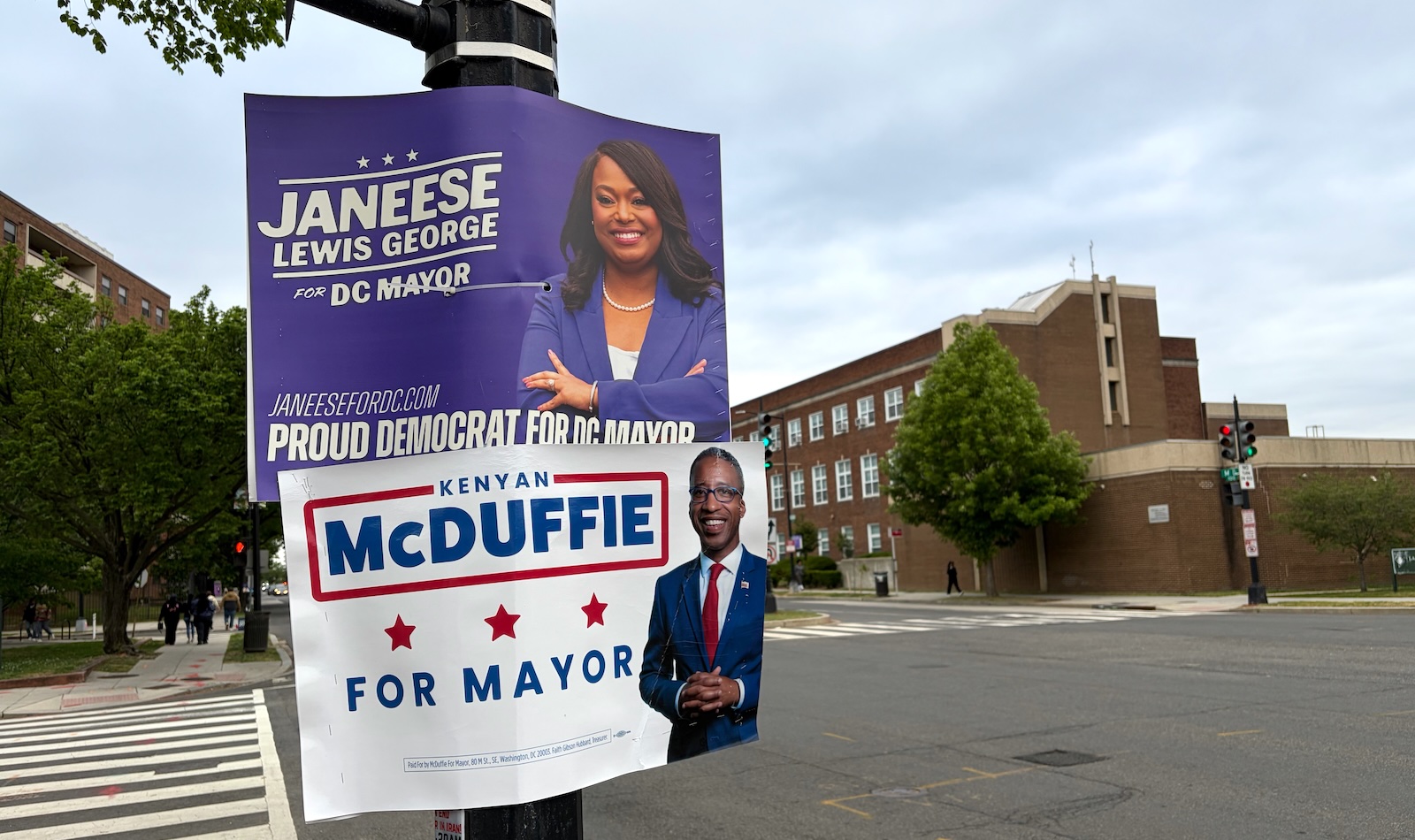
At a recent mayoral forum, moderator Dwayne Lawson-Brown asked the candidates to use three words to describe their political style. “Principled. Resilient. Effective,” said Ward 4 DC Councilmember Janeese Lewis George. “Bold. Compassionate. Committed,” replied former at-large Councilmember Kenyan McDuffie.
That parsing of personalities and motivations belies the similarity of their origin stories: McDuffie and Lewis George — widely considered the two leading contenders in the Democratic primary for mayor — are both African American and are both native Washingtonians. They attended traditional DC Public Schools and hail from working-class families.
Interestingly, there was a time when McDuffie was a mail carrier; Lewis George’s mother also worked for the U.S. Postal Service. Due to a scarcity of economic opportunities, the postal service around the country was striver-haven for many Black people.
Oddly, that financial stability subsequently led each to law school. Prior to holding elected office, the two candidates had careers as prosecutors — she in Philadelphia and later with the DC Office of the Attorney General; he with the U.S. Department of Justice’s Civil Rights Division.

Not to be too flippant, it’s like one of those pictures when two people have worn the same outfit. The question that naturally pops up: Who wore it better?
In this case, the question for DC voters is: Who is better suited and better prepared to step into the mayoral suite in the John A. Wilson Building and guide the District into the second quarter of this 21st century? Is it one of the candidates who has never held a political office in DC? Is it someone who has been in the legislature for five years? Or is it the person who has been there for 13 years and served as chair pro tempore?
Initially, there were nine Democrats seeking to get onto the ballot for the office being vacated by the District’s three-term mayor, Muriel Bowser. After the ballot qualifying process, only seven were left standing: Gary Goodweather, Ernest Johnson, Vincent Orange, Rini Sampath and Hope Solomon, along with Lewis George and McDuffie.
In my reporting for this two-part series on the mayoral race, I have relied on select forums, published questionnaires and one-on-one interviews, specifically with Goodweather, Orange and McDuffie, to gain insight into candidates — their political, governing and management philosophies, their take on critical issues, and their vision for DC’s future. (Part 1 focused in large part on the candidacies of Goodweather, Orange and Sampath.)
This final installment of the series comes without Lewis Geoge’s direct engagement with me. Her campaign did not respond to my multiple requests for an interview. Consequently, the microphone belongs largely — though not exclusively — to McDuffie.
This is not an endorsement column, however.
The perception of Lewis George-McDuffie twinness among some voters is underscored by the issues on which they have campaigned. “On 75% of the issues, Janeese and Kenyan probably are the same,” Chuck Thies, a longtime national and local political consultant, said during an interview with me last month.
As an example of the similarities, a prime plank in Lewis George’s People-First platform is “Childcare for All.” She has said she would increase the supply of childcare programs by relying on “underutilized schools,” and she has committed to a goal of no family having to spend more than 7% of its annual income on childcare. She also has pledged to help increase the Early Childhood Educator Pay Equity Fund.
Most mayoral candidates, including McDuffie, want to improve childcare. His “Every Child, Every Step” plan would also seek to lower the cost of childcare for families and “repurpose DC-owned space.” His proposal extends through age 18, however. For older children and youth, he has said he would look to expand partnerships with schools, recreation centers, libraries and community organizations. He has suggested introducing “rites of passage” programs, arts hubs and establishing “Future DC Jobs” fellowships. (Lewis George has a separate “Excellent Schools for All” plank with some similar proposals.)
The fundamental difference between their childcare efforts, however, is funding. She has talked about using a “business activity tax.” He has suggested expanding the child tax credit.
“It’s that 25% where they are diametrically opposed,” said Thies, citing public safety, housing and financial management as areas of dramatic differences.
A self-described democratic socialist, Lewis George has marqueed herself as the affordability pol who will look out for DC’s working families. At this stage does that moniker still have currency?
District residents, like those around the country, have been traumatized by multiple and continuous assaults — high grocery prices, loss of health insurance, wars, confrontations with masked agents from Immigration and Customs Enforcement (ICE), and battles for democratic freedoms. Unsurprisingly, people have become weary and skeptical about what is possible when the economy is crumbling and the city’s independence — political and governance — seems to be deteriorating.
Lewis George has tried to glue McDuffie to Trump or Bowser, making him part of the chaos and problem. In a recent fundraising letter, Lewis George wrote that in her first televised debate she confronted McDuffie “about having the financial backing of big Trump donors.”
“Just this year, 17 people who have given a total of $85,205 to Trump political committees also donated to Kenyan McDuffie,” Lewis George wrote in that correspondence dated May 4. She said she “asked Mr. McDuffie to return those donations and he refused to say he would.”
That correspondence seems to deliberately conflate donations to the two campaigns . Some have called the framing an unethical smear.
McDuffie understandably took offense. He declared that he would not allow anyone to falsely define him or label him. He also asserted that when he arrived on the council in 2013, among his first legislative actions was authoring “the most comprehensive campaign finance reform and ethics reform” in a decade.
Perhaps a more salient point is this: Lewis George and McDuffie are both participating in the city’s Fair Elections Program, which dictates how much money they can accept and from whom. Individual donations to a participating DC mayoral candidate cannot exceed $200 — meaning that donations from any 17 people would total no more than $3,400.
McDuffie has received $1.9 million in grants and matching funds from the public financing program. Lewis George has received just over $2 million.
Last month, the DC Office of Campaign Finance received a complaint from Kevin Sobkoviak requesting a review of Lewis George’s relationship with several unions and the union-backed independent expenditure committee, Safe & Affordable DC.
The OCF subsequently opened an investigation, as I wrote about last week. Lewis George has dismissed the complaint as “baseless.” Finance officials have said they have 90 days to complete their probe.
Lewis George has been endorsed by a slew of unions as well as several council colleagues — at-large member Robert White, Ward 6 representative Charles Allen and retiring Ward 1 representative Brianne Nadeau. Former Attorney General Karl Racine and former Ward 7 Councilmember Yvette Alexander have also backed Lewis George. Former Ward 6 Councilmember Tommy Wells serves as her campaign chair.
McDuffie’s notable endorsers include DMV New Liberals, former Mayor Sharon Pratt, former Council Chair Linda Cropp, former Ward 3 Councilmember Mary Cheh, former Ward 4 Councilmember Charlene Drew Jarvis, Maryland Sen. Angela Alsobrooks and Prince George’s County Executive Aisha Braveboy. In what may be seen as a real coup, McDuffie received the endorsement this week of former Mayor Anthony Williams, who rescued the city as its first independent chief financial officer in the 1990s and was subsequently drafted by citizens to run for mayor. He ultimately won the Democratic primary with 50% of the vote while defeating three sitting councilmembers. Williams went on to sculpt DC into an engine of economic success for two terms; his legacy continued until the COVID 19 pandemic.
Many of the unions lined up behind Lewis George were there in 2020 when she first ran for council. The backstory this year is that they are working especially hard to flex their muscle nationally, said one political operative who requested anonymity, noting union involvement in key elections like those in New Jersey and New York City.
After Zohran Mamdani, another democratic socialist supported by the Working Families Party, won the New York mayoralty, Lewis George was dubbed DC’s version and perceived by some to be on the fast train to victory.
McDuffie has pushed back, declaring that his erstwhile council colleague is no Mamdani and DC is no New York.
Some people I spoke with for this series dismissed McDuffie as a Bowser acolyte and overly pragmatic. Looking at his record, that kind of quick labeling seems misleading.
Who is pragmatic? Who is progressive? Who is not?
Embracing the Obama-era Centers for Disease Control and Prevention’s assertion that urban crime was a public health crisis, McDuffie pushed through the Neighborhood Engagement Achieves Results (NEAR) Act. Adopted unanimously by the council, the 2016 law not only established violence interrupters but also required trauma services for victims of violence while dictating that mental health professionals accompany police on certain emergency calls. Over the years, he and the law’s most ardent supporters have often complained about the Bowser administration not fully implementing the legislation.
McDuffie is behind the creation of the council’s Office of Racial Equity and a similar agency in the executive branch. He persuaded the council to pass legislation creating a trust fund, known as Baby Bonds, for low-income children that would provide up to $1,000 a year from the time of their birth. As chair of the Committee on Business and Economic Development, he championed Ward 2 Councilmember Brooke Pinto’s legislation that made it easier to do business by eliminating or consolidating dozens of licenses and permits.
On affordable housing, he persuaded the council to mandate proceeds from the sale of city land to be invested in the Housing Production Trust Fund. He ushered through legislation that required housing construction on surplus city property to include a set-aside of deeply affordable units. When Ward 3 residents and other advocates wanted Bowser’s administration to purchase the Marriott Wardman Hotel, he wrote a letter supporting their push for a mixed-use development that would include 3- and 5-bedroom family-sized apartment units located near the Woodley Park Metro station.
McDuffie has promised that he would issue an executive order preventing DC police officers from working with ICE, although many activists say he did little to address the issue as a councilmember. He has vowed to establish an expenditure committee within the first 100 days of his administration; its responsibility would be to track agency spending in an attempt to control costs. He also promised to create a publicly accessible dashboard tracking the performance of city agencies to improve management and transparency. And McDuffie has pledged to build 12,000 new units of affordable housing.
The latter is one of the chief gaps between the two candidates, according to Thies. Lewis George has established 72,000 new homes in five years as her goal, supersizing the one set by Bowser of 35,000 new and preserved units.
During Lewis George’s council tenure, she has been one of the strongest voices for tenants, pushing for more vouchers and anti-eviction protections and proposing the Green New Deal for Housing Act, although there’s been no movement on the latter proposal.
In her campaign, she has said that addressing the city’s housing needs requires bold actions, such as encouraging transit-oriented development via high-density, mixed-use buildings near Metrorail and bus stops; legalizing small apartment buildings up to six units citywide, with less stringent setback requirements; and ending parking requirements citywide.
“As mayor, I’ll make sure our next era of growth is more productive, and more fair, than our last,” she wrote in an opinion piece for Greater Greater Washington outlining her plan.
McDuffie has challenged the feasibility of Lewis George’s platform, particularly given the several years of fiscal challenges projected by the District’s chief financial officer.
“I’m not promising big-ticket false promises that once you start to govern after you win the campaign, you get hit with economic realities,” McDuffie told me.
“We see that happening in New York right now — with a mayor who made a lot of promises and now is committed to raising taxes and going to Albany and asking for a bailout on policies around freezing the rent and other things.”
Then there is the issue of public safety. McDuffie has promised to hire 1,000 new police officers to increase the force to 4,000 — a pledge that would require reversing the attrition patterns and recruiting challenges that have thus far stymied the Metropolitan Police Department’s efforts to boost the number of officers. One way he has suggested addressing that problem is by increasing the recruitment bonus, a solution with its own hurdles.
While Lewis George has moderated the “defund the police” stance she took when she first came onto the council, she has fought against efforts to strengthen laws that deal more strongly with crime and those engaged in criminal activities in the city. This week, she once again voted against the permanent juvenile curfew law, even after it had been watered down with various amendments.
Something that McDuffie and Lewis George have in common in the view of some observers: “Neither has the [necessary] depth of experiences. Neither has managed a large business,” said another political operative. “Can DC afford to subject itself to untested leadership? DC is fragile right now.”
When I asked McDuffie about that, he told me he will be ready on Day 1, pointing to his 13 years on the council versus Lewis George’s five years.
“As chair of the Committee on the Judiciary and Public Safety, I tackled complicated issues around criminal justice reform, juvenile justice reform, thinking about new ways to ensure accountability and enforcement of our laws to hold people accountable when they commit crimes,” McDuffie said, “but also ushering in opportunity into communities that have been largely plagued by crime.”
He said his role as chair of the Committee on Business and Economic Development — a post he had for nine years — gave him insight into the city’s finances and allowed him to work directly with DC’s chief financial officer. “I’ve been to Wall Street. … I understand the implications of having a lower bond rating and the cost that it brings to the District of Columbia in terms of our ability to borrow and do the things that we need in terms of capital expenditures, renovating schools, having cash.
“I bring all of that to bear,” added McDuffie.
That’s just one of the assessments that Democrats will have to gauge before casting their primary ballots.
jonetta rose barras is an author and DC-based freelance journalist, covering national and local issues. She can be reached at thebarrasreport@gmail.com.
Comments are closed.