

jonetta rose barras: Has Janeese Lewis George’s mayoral campaign violated DC election finance laws?
Earlier this week, Wesley Williams, operations and policy officer for the DC Office of Campaign Finance, confirmed that his agency has opened an investigation into whether the relationship between Janeese Lewis George’s mayoral campaign, the union-created Safe & Affordable DC independent expenditure committee, and several unions — particularly Unite Here Local 25, its New York City headquarters, and SEIU 32BJ — have violated local campaign finance laws. The investigation follows the agency’s receipt of a complaint filed by Kevin Sobkoviak.
“The investigation was opened on Friday, April 24, 2026,” Williams wrote in an email to me. “All matters related to the investigation are confidential until the investigation is complete and an Order has been issued by the Director of the Office of Campaign Finance. The D.C. Official Code and Regulations allow for 90 days for completion of an investigation.
“However, the Office conducts all investigations as thoroughly and expeditiously as possible,” Williams added in his correspondence.

Among the issues Sobkoviak raised in his complaint were specific concerns about the Lewis George campaign having “concealed” the names of individuals working for her campaign by listing those payments as expenditures to Gusto, a payroll company similar to ADP. While some names were later revealed in amendments to the reports, Sobkoviak argued that, “Today, we still do not know who is being paid through reimbursement to Local 25 and SEIU 32BJ.”
He also noted that Safe & Affordable DC, the independent expenditure committee, is housed in the same offices as Unite Here: 901 K St. NW. Some payments from Lewis George’s campaign for “rental, staff reimbursements” went to this same address, suggesting the possibility of coordination and collusion, a violation of DC campaign finance laws, he wrote in the complaint.
“The public policy behind these laws is to prevent actual and apparent corruption in our candidates and our elected officials, who must serve the public trust,” Sobkoviak wrote.
Lewis George’s campaign did not reply to my request for comment about the complaint.
However, in a statement to other journalists, she called it a “baseless complaint.” Her campaign also said she has followed the advice of her lawyers.
Payments to Trister, Ross, Schadler & Gold PLLC are listed as expenditures in the campaign’s Jan. 31 and April 10 reports filed with OCF.
On its website, Trister, Ross, Schadler & Gold touts that its lawyers have “advised hundreds of organizations about how to contribute and make independent expenditures in federal and state elections, and advised dozens of federal and state candidates on all aspects of their campaigns.”
It also notes that the firm’s lawyers have “helped organizations navigate campaign finance, lobbying, corporate or voter registration laws in all 50 states and the District of Columbia.”
In a response to an email query from me, Jessica Robinson, a spokesperson for Trister, Ross, Schadler & Gold, confirmed that it “is counsel to Janeese for DC. In accordance with the firm’s policy, we will not publicly comment on or communicate with the press about this, or any other client of the firm.”
In a written statement, Joslyn Williams, head of Safe & Affordable DC and former president of the Metro Washington Council, AFL-CIO, expressed confidence that the “baseless complaint” would not distract voters. “We and our many supporters have been vigilant in following DC campaign finance law and look forward to submitting our response.
“This complaint is not serious,” he added.
The allegations in Sobkoviak’s complaint align with questions and concerns I raised publicly through my X account and privately with OCF through written correspondence as early as April 15.
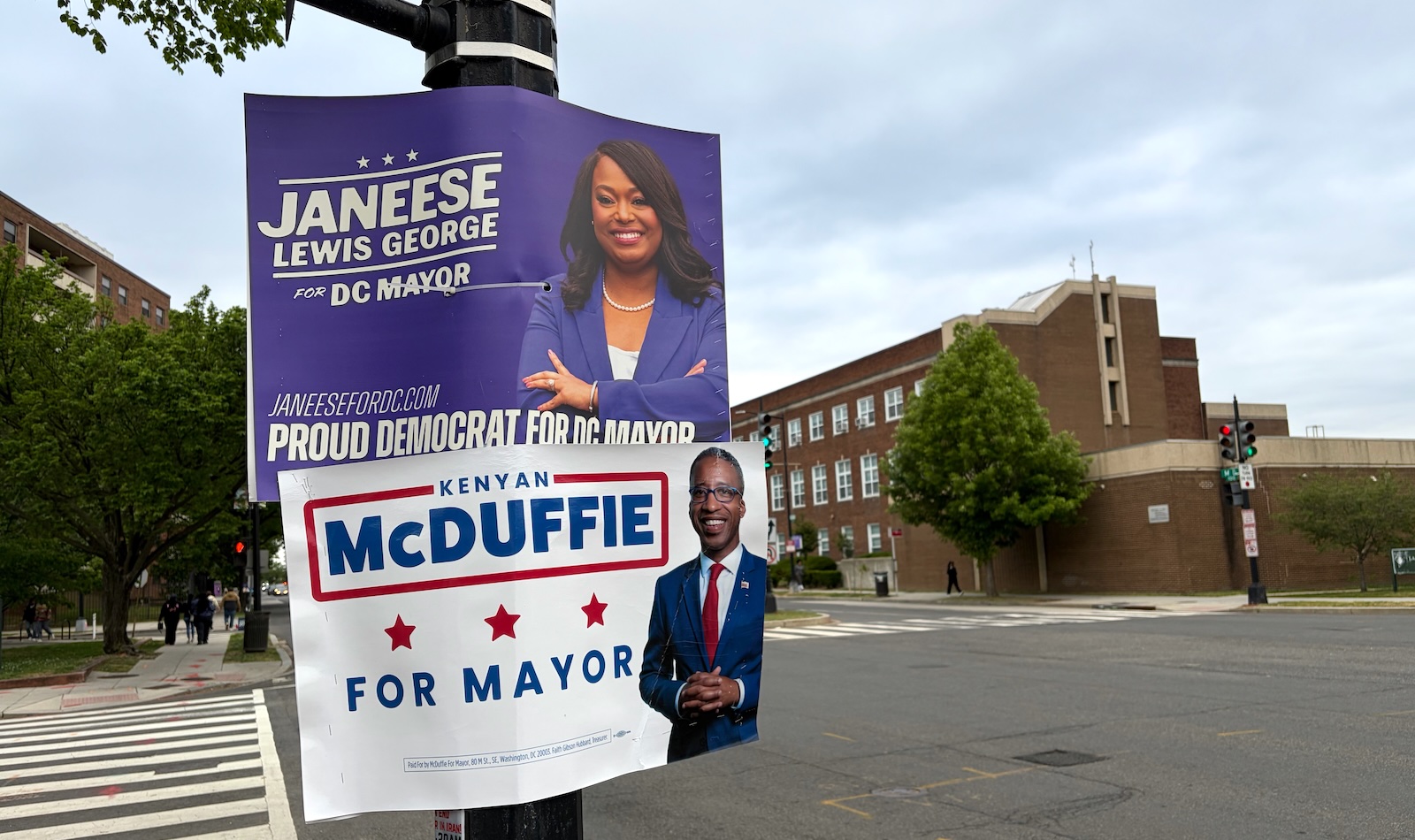
Around that time, in preparation for a planned series of articles, I began reviewing financial reports filed with the OCF by mayoral candidates. After all, the DC Council appropriated $12 million in fiscal year 2026 for the Fair Elections Program, which provides grants and matching funds to certified political candidates who meet fundraising criteria. Only three mayoral candidates have been certified thus far. Together, they have received $4,159,042.20. Gary Goodweather has received $364,725.10. Kenyan McDuffie has received $1,820,715.55.
The largest amount that has been paid out to date has gone to Lewis George; her campaign has received $1,973,601.55, according to OCF’s website.
To some, payments made to unions may seem small, considering the total payout to her campaign. However, it’s critical to me that when public money is being spent for any reason, individuals who are in receipt of those funds or managing those funds are engaged in the highest ethical behavior and that the letter and the spirit of the law are being followed. After seeing the reported payments to unions in the Lewis George campaign’s filings, I reached out to OCF.
Williams told me back then that the agency has been in “ongoing communication” with the Lewis George committee and had sent three letters “requesting supporting documentation on expenditures reported by the committee including the matters that you raised.”
“Some of the requested information we have received and is currently under review,” Williams added in an email to me dated April 15.
A week later, Williams denied my request for copies of the letters OCF had sent to Lewis George. “We have not commenced an investigation,” he said in an email dated April 22. “However, there are matters currently under review by this Office and subject to the investigative process. The [documents] you requested are considered work papers and therefore cannot be made available to you at this time.”
Between Dec. 15 and April 10, Lewis George’s campaign disbursed more than $150,000 to Unite Here’s national office, its Local 25 affiliate, and SEIU 32BJ for “rental hours” and reimbursement of salaries to workers who apparently remained on the union’s payroll even as they performed high-level duties in Lewis George’s campaign. One of the individuals serves as deputy campaign manager and another as communications director.
Experts I spoke with have said this arrangement is highly unusual. Williams told me that “In general, a person may volunteer a portion of or all their time to or on behalf of a candidate they support. One may also take a leave of absence from their place of employment while working for a campaign.”
He made no mention, however, of having a campaign pay an employer to place its workers in that campaign; at minimum that appears to be what Lewis George has been doing since the launch of her campaign in December.
The campaign’s Jan. 31 finance report has been amended four times, according to documents on the OCF website — including as recently as April 24, the same day the agency opened its investigation. It appears some of the changes may have been in response to concerns raised by the OCF during the reviews Williams mentioned it had been conducting.
Unite Here received various payments, including several that evolved from “rental” to “staff salary reimbursement.” One payment of $24,739.65 referenced “staff hours reimbursement” and used the initials “AG” and “AY” — matching two campaign staffers, Amanda Michelle Gomez and Adam Yalowitz, for whom the union was receiving salary reimbursements.
Another expenditure, $19,737, was noted in the original report and in Amendment 1 as “rental,” but by Amendment 4 became Unite Here Local 25 “staff salary reimbursement.” A third payment of $21,558.18, initially specified as a rental, by Amendment 4 appears to be divided into two “staff salary reimbursement” payments of $10,965 and $10,593.18, one made to Local 25 and the other to its New York City office.
In her April 10 report, Lewis George reports paying SEIU 32BJ $10,901.33 for “staff salary reimbursement.” Unite Here received two more payments, both for “reimbursement of salaries and staff”: $31,399.87 was paid to the local union office in DC located at 901 K St. NW, and $41,936.57 went to the New York City office.
While the OCF will determine the legality of those arrangements, they sparked a number of questions for me — and, obviously, for others who read the financial reports. Were the union workers in Lewis George’s campaign sharing information with the independent committee formed by their bosses? If that occurred at any time, it would likely constitute a violation of campaign finance laws that prohibit coordination or collusion between campaigns and an independent PAC.
Further, since the unions had endorsed Lewis George, did the reimbursement payments, which reportedly covered salaries and benefits, constitute a quid pro quo for the endorsement?
We’ll have to wait for the OCF to complete its probe.
Meanwhile, another potential controversy surrounding Lewis George’s supporters may be percolating. The chair of DC for Democracy, a political action committee that played a major role in Lewis George gaining a foothold in local politics and winning her seat as Ward 4 representative on the DC Council, sent out an email asking its members and supporters to make contributions to the Sierra Club DC PAC.
“I’m reaching out to ask for your financial support for an important opportunity to shape the outcomes of DC’s 2026 primary election,” Tiffani Nichole Johnson wrote. “Our partner, Sierra Club DC PAC, is working to support many of the candidates DC4D endorsed, including Janeese Lewis George for Mayor.”
In the email, Johnson claimed that Sierra Club PAC had “raised a substantial amount [of money] with grassroots DC support,” but was working to unlock a 1:1 match. She noted the PAC had “already launched a mail program to show McDuffie’s complicity in utility rate hikes and elevate Janeese Lewis George’s support for a healthier and more sustainable DC.”
“They have fact-checked McDuffie,” continued Johnson, noting that Sierra Club PAC would be launching a “digital program to continue to reach every voter with the facts and stakes of this election.”
In a telephone conversation earlier this week, Johnson told me the letter request “as far as I’m concerned” was one-time and “that’s it.”
She said what the Sierra Club PAC funds with the money “has no bearing whatsoever on DC for Democracy. We’re just the disseminator.”
Johnson rejected my characterization of the arrangement being interpreted as the Sierra Club PAC and DC for Democracy acting together as an “independent expenditure committee.”
“We will be providing documentation for that one expenditure,” Johnson added.
When I asked Williams about the legality of such activity, he told me via email that “PACs are different from Independent Expenditure Committees in that they are allowed to make contributions to candidates (in the traditional program) and other PACs. They are also allowed to make independent expenditures.”
If DC for Democracy and Sierra Club DC engage in such behavior, they are required “to create a separate account which is called a non-contribution account,” he added.
“Non-contribution account means a financial account of a political action committee that is segregated from other accounts of the political action committee and is used for the sole purpose of making independent expenditures.
“All the contributions to this account must specifically be ear-marked for that purpose,” noted Williams, adding the next report is due June 10.
Stay tuned.
jonetta rose barras is an author and DC-based freelance journalist, covering national and local issues. She can be reached at thebarrasreport@gmail.com.
Comments are closed.