

Clinique Chapman: The next mayor can get public safety right. Here’s how.
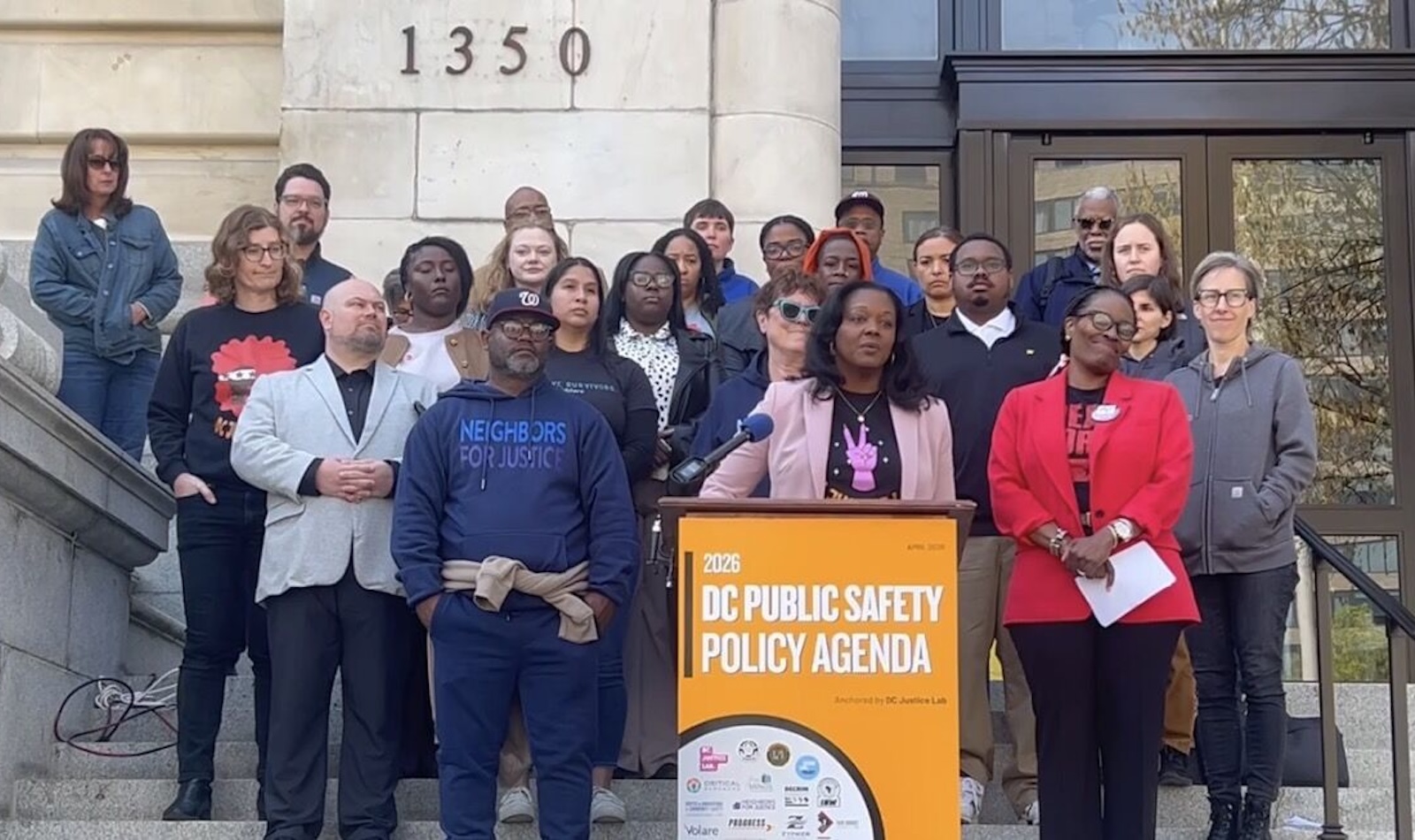
Last month, DC Justice Lab convened nearly 30 organizations to stand together on the steps of the Wilson Building and release the 2026 DC Public Safety Policy Agenda, a set of recommendations developed by policy experts, individuals working directly with young people, survivors of violence, former law enforcement officials, returning citizens, and families navigating the system every day.
The agenda’s community-informed framework seeks to rectify the fact that public safety in DC has been defined too narrowly for too long. The conversation still centers on policing — how many officers we have, how quickly we can hire more — while ignoring the strategies, policies and programs that actually drive safety outcomes.

A new mayor will take office in January, and together with a new congressional delegate and DC Council will shape the city’s next chapter. That creates an opportunity, but only if leaders are willing to move beyond the same narratives and failed policies that have driven the approach to public safety for years.
Over the past year, the District has been subjected to a steady stream of federal attacks on its public safety policies, with decisions being made devoid of meaningful input from the people who live here. Congress has repeatedly advanced legislation that expands surveillance, increases enforcement powers and undermines local control. These policies are disconnected from what actually makes communities safer, and they disproportionately harm Black and brown residents and reflect a deeply racialized approach to public safety. None of it reflects what DC residents are asking for or what the data shows is effective.
Instead, the District has been used as a political proving ground. Those decisions carry real consequences, and they fall most heavily on Black communities that are already over-policed and under-resourced. Black residents make up less than half of DC’s population but account for more than 90% of searches that result in no warning, ticket or arrest. These are the same communities that experience the highest levels of trauma, violence and enforcement.
Violent crime in DC dropped significantly over the last two years, even as the police force remained below historic staffing levels. Nationally, homicides declined in the vast majority of major cities, many of which are also facing staffing shortages. The evidence does not support the idea that investment in increasing the officer headcount drives safety.
What actually works is investment in communities.
The co-created policy agenda prioritizes scaling up community violence intervention and establishing clear standards and accountability. It calls for expanding non-police responses to behavioral health crises so that people in need of care are not met instead with enforcement. It pushes for sustained investment in housing, employment and trauma recovery, conditions that are consistently linked to reductions in violence.
The agenda also addresses the ways current policies continue to produce harm. Practices like jump-out searches (DC’s version of stop-and-frisk) disproportionately target Black residents with little evidence of effectiveness. Surveillance tools continue to expand without meaningful oversight, with data shared across federal agencies and little transparency to the public. And people returning from incarceration are often set up to fail, with nearly 1 in 3 people on supervision in DC ending up back in custody — most often for violations, not new crimes. When city leaders continue to rely on and implement failed policies, Black families and communities pay the price.
The same is true for how the city treats young people. Youth, particularly Black youth, are pulled deeper into a system that punishes behaviors instead of addressing unmet needs. Any serious public safety strategy has to start from the premise that young people are children and that policies and programs should be designed to support them, not criminalize them. The agenda calls for investments in prevention, education, and community-based supports that keep young people out of the system in the first place. It prioritizes age- and developmentally appropriate responses, diversion, and resources that address root causes rather than relying on punishment as a default. We cannot hold children to a higher standard of accountability while willfully ignoring the flawed and inequitable systems they are born into.
The agenda also confronts a basic mismatch in how the city responds to harm. Too often, behavioral health needs are treated as public safety threats, and the default response is law enforcement — an approach that has ended in tragic and preventable harm, particularly among Black residents of the District. The city needs to expand our behavioral health infrastructure and scale up alternative response programs so that mental health crises, substance use and other nonviolent incidents are met with the needed trained professionals, not armed officers. Cities across the country have shown that these models reduce unnecessary police contact and improve outcomes for residents in crisis. DC should be doing the same.
Alongside the agenda’s public release, we shared the proposals with all mayoral candidates. This was an intentional, nonpartisan choice to ensure that, regardless of who becomes mayor, no future administration can lead on public safety without having access to a concrete, community-informed set of priorities.
DC needs leadership that is willing to follow the evidence and invest in approaches that are already showing results. That includes recognizing that public safety policy imposed from outside the District, without accountability to residents, will not produce better outcomes.
DC residents understand what safety requires. The organizations that worked together to create this agenda are already doing that work every day, often with limited resources and inconsistent support.
The next mayor and council will decide whether DC continues to follow an ineffective model that has produced harm and inequity, or invests in a public safety framework that is evidence-driven, community-rooted, and built to last. The stakes are too high to get this wrong.
Clinique Chapman is chief executive officer of DC Justice Lab.
About commentaries
The DC Line welcomes commentaries representing various viewpoints on local issues of concern, but the opinions expressed do not represent those of The DC Line. Submissions of up to 850 words may be sent to editor Chris Kain at chriskain@thedcline.org.
Comments are closed.