

Amid recent violence, District puts an additional $6 million toward violence prevention and jobs training program
District leaders doubled down this week on the idea of a two-pronged approach to stemming the tide of violence across the city: Target illegal guns and expand social services.
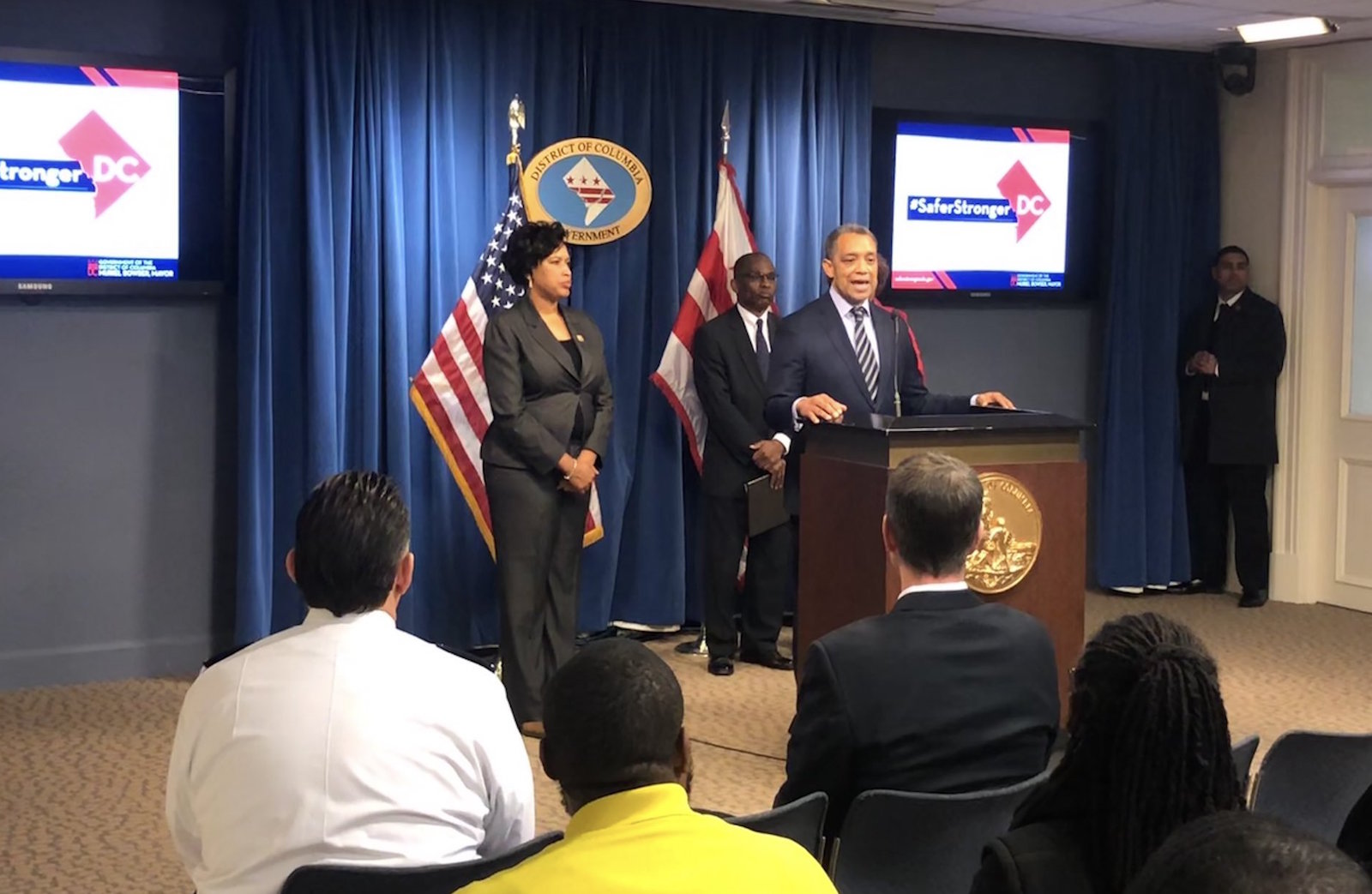
Amid a spike in murders, Mayor Muriel Bowser and Attorney General Karl Racine on Friday announced a $6 million investment in violence interruption and job training programs for hard-to-employ residents.
The additional money came from a settlement with Washington Gas, its parent company and AltaGas that Racine’s office negotiated last year in connection with their proposed merger. The DC Infrastructure Academy will get a $4 million boost for its workforce development training. The rest of the money will go toward a violence prevention program run out of Racine’s office, assuring funding through July 2020.
The Infrastructure Academy is run by the Department of Employment Services to prepare residents for work in energy, transportation, information technology, and other industries. “When we connect people to good-paying jobs, we can steer them away from crimes of opportunity or economic crimes, because they’re gainfully employed,” Bowser said.
The attorney general’s initiative, known as “Cure the Streets,” employs “violence interrupters” to prevent the escalation of disputes and to offer support services to individuals at risk of committing crimes. It began operating in two “high-violence” zones in wards 5 and 8 in June 2018.
Racine said the program has led to zero homicides in those two areas: a section of Trinidad, and a portion of the Congress Heights and Washington Highlands neighborhoods. In that time, five and eight nonfatal shootings have occurred in the zones, respectively. (The $2 million from the settlement is the same funding that Racine two weeks ago referred to at a community meeting as a donation from the private sector.)
The mayor’s office has a similar program that relies upon community nonprofits to prevent disputes from escalating into violence. According to Kevin Donahue, the deputy mayor for public safety and justice, the city plans this year to “intensify” its funding for the program, which is part of the Office of Neighborhood Safety and Engagement.
“Reducing violence in our city requires an approach that includes police involvement, human services involvement, and the community,” Bowser said on Friday.
Earlier in the week, Bowser outlined her administration’s plans to reducing violence at a breakfast meeting on Tuesday with D.C. Council members and Racine present. Leaders there agreed with Bowser that in addition to hiring more police to patrol on foot and bicycle, the city should expand its “public health approach” to crime prevention.
Bowser officials said the rise in homicides can be attributed to many factors, such as an increase in close-range shootings and a rise in daytime gun violence. Donahue said these trends have made shootings more likely to turn deadly. “There’s not a single magic program, or solution, or investment that’s going to solve this,” he said at the Tuesday meeting.
Officials note violent crime has slightly decreased overall in recent years, and the number of shootings has generally remained the same. But the 19 homicides so far this year represents a 73 percent rise compared to the same period in 2018 — a year that ended with 160 homicides, a marked increase from 2017’s total of 116.
In line with successful models in other jurisdictions that have focused on public health as a way to reduce violence, Donahue said the District signed a contract “a couple of months ago” to train more social workers to treat victims of trauma.
Speaking Friday, Racine said there was a consensus at the mayor-council breakfast “around a holistic approach to reducing crime, recognizing that we can’t just rely on the police.”
Bowser administration officials also referred to the concurrent need for investments in “traditional policing.” Donahue said on Tuesday that he wants a “significant collaboration” with federal partners to reduce the number of illegal firearms. The mayor wants a police force of 4,200 officers, Donahue said, but “it also has to be done in a way that’s respectful to the community.”
Bowser also said her administration will ask the DC Council to renew a financial incentive program for detectives reaching retirement to stay on the force.
The Bowser administration also plans to begin conducting surveys on a “rolling basis” about police-community relations. The Metropolitan Police Department and the deputy mayor’s office are still determining the frequency and cost of the surveys, which will be conducted by an outside organization.
The Criminal Justice Coordinating Council has completed its own survey on police-community relations, and its results are due in the spring, according to Donahue’s office. The concept is modeled on successful programs in Los Angeles and Chicago, Donahue said. “We can have really data-informed discussions” on the impact of new policing measures once survey results are available, he said.
At the Tuesday meeting, Ward 8 Council member Trayon White added an emotional plea to the policy-oriented conversation, forcefully emphasizing the urgency of gun violence. All too often, he hears gunshots when he’s at home, he said.
“We have to declare that we are in an emergency when it comes to crime and violence,” White said, calling for hiring at least 100 more “outreach workers” to help prevent violence between feuding crews. “If we don’t do that, we’re just spinning our wheels,” he said.
Racine briefly mentioned his office is weighing legal action against gun dealers whose firearms end up trafficked illegally into the District, saying that “just 10 percent of dealers” are responsible for most of the weapons used in homicides. “More lax gun laws [in Virginia and Maryland] export the guns essentially here,” he said.
This post has been updated to provide additional details about the planned surveys about police-community relations, and to clarify that the Criminal Justice Coordinating Council has completed its own survey on police-community relations but will not oversee the initiative.
Comments are closed.