


For Sgt. Ryan and his cadaver dog Kylie, an ‘epic game of hide-and-seek’ comes with high stakes
Everyone knows Lassie, the heroic collie from novels, movies and TV who repeatedly saves her human from near-death experiences. But in DC, there’s a real-life canine hero, whose companion rescued her from a shelter and trained her to perform an invaluable task.
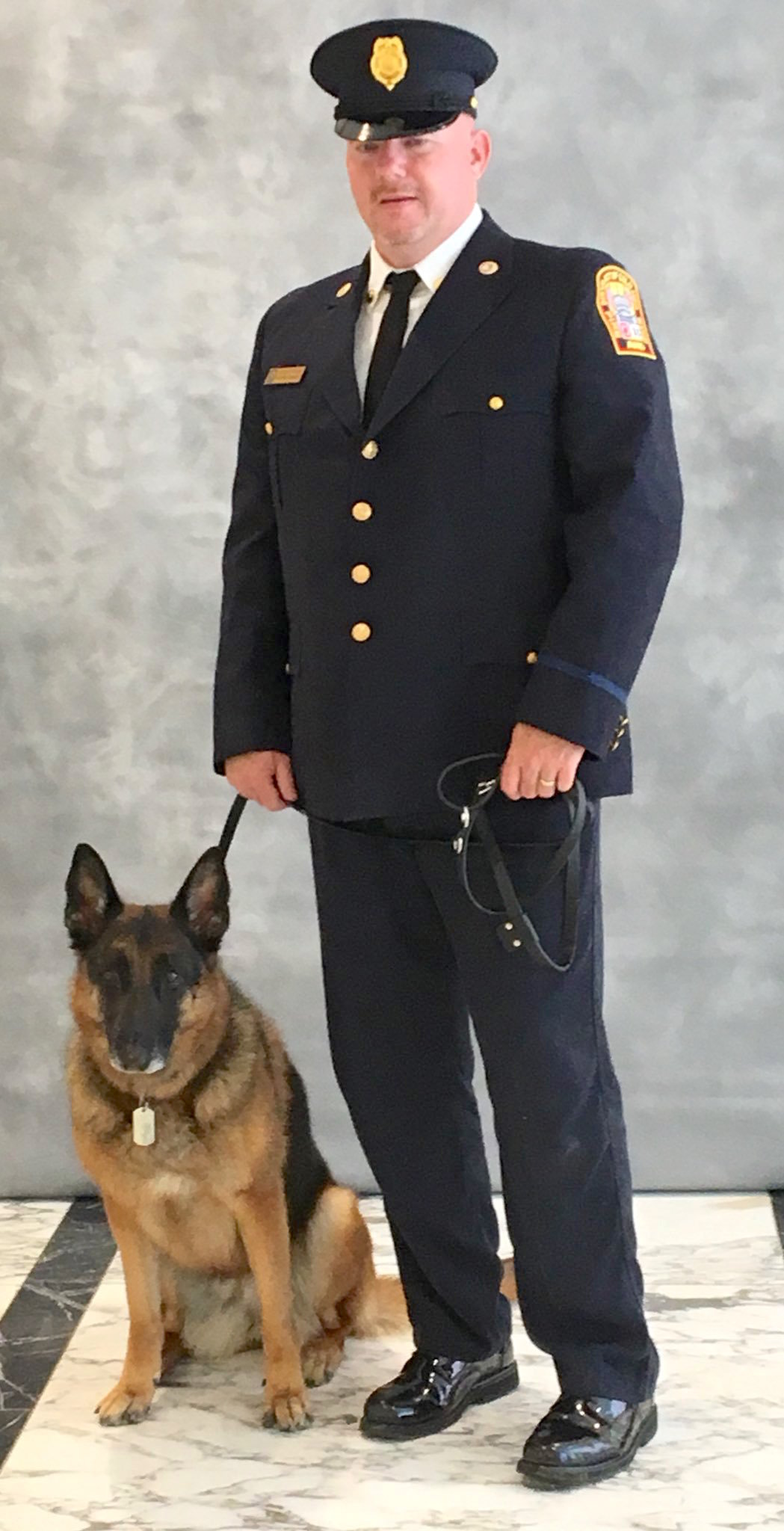
Kylie is a 6-year-old German Shepherd/Belgian Malinois mix, and Gene Ryan is a sergeant paramedic for the DC Fire and Emergency Medical Services Department.
“Her nickname is ‘Girlfriend’ because she never leaves my side,” Ryan said with a laugh.
Kylie is the District’s only cadaver dog, specially trained to smell decomposition. She can locate bones, tissue, body parts, hair and blood. In the past two years, she has found more than 28 missing bodies.
“She will not find live people,” said John Sollers, deputy fire chief of the department’s special operations division. “So for a Metro crash, you can use a ‘live find dog’ — and then if the dog doesn’t find anything but the cadaver dog does, that’s a really good indication that we can stop our search and rescue, which makes it safer for our search and rescue team.”

It can be dangerous work for Ryan and his partner, however. On July 16, Kylie sustained severe injuries while helping the U.S. Park Police search for possible bones in the area of Four Mile Run and George Washington Parkway in Virginia. Her brachial artery and a few veins were severed in a front paw, and there was extensive swelling in her rear leg. She was taken by helicopter to the Friendship Hospital for Animals in Northwest DC, where she underwent surgery. Ryan was able to take her home two days later.
On Sunday, Ryan confirmed she had a follow-up appointment on Friday and her cast was removed.
“They performed another procedure using a laser to help repair some of the tissue damage,” Ryan wrote in an email. “The plan is to hopefully have her back to work in 6-8 weeks, but we are just happy that she is going to be ok.”
The injuries drew extensive media coverage, and Ryan expressed his tremendous gratitude to the community and country for the “outpouring of support.” He said there’s talk of a future fundraiser to help offset the cost of Kylie’s medical bills, although details aren’t yet set.
Kylie wouldn’t be alive today if Ryan hadn’t saved her back in 2013. Ryan had spent a year driving around the country, searching humane shelters for “the craziest dog,” because as he says, “those are dogs that are just looking for a job.” When he finally found Kylie in Maryland, the shelter she was in was planning to euthanize her because of a genetic defect that left her with no teeth, making it difficult to feed her.
“I didn’t need her to have teeth,” Ryan said. “I gave her a smell test and she passed.”
Kylie later received titanium teeth, thanks to Ryan and his wife, Susan, paying thousands of dollars out-of-pocket for the procedure.
Adopting Kylie was just one step as Ryan went about building the cadaver dog program from scratch, as none existed when he joined the department in 2009. After dealing with a loss of his own, Ryan felt it was important that families were afforded a way to find the remains of their loved ones.
“I was in New York City in 2001 during 9/11 when the buildings fell, and my partner was killed as the building fell on him,” said Ryan, a former paramedic for the New York City Fire Department. “Everyday I watched for weeks as people suffered not knowing where bodies were and I thought, ‘We need to do better.’”
It was more than four months before his partner’s body was recovered. In the aftermath of the terrorist attacks, Ryan realized he couldn’t bear to remain in New York City because “they build buildings too high.” He decided to relocate to DC, and although it pains him to speak of it, Ryan says having seen the suffering from 9/11 up close drove him to start the cadaver dog program in DC. He faced one roadblock, however: the means necessary to make it happen. Ryan knew the best chance he had to start this program was by getting the public to rally behind it.
“I realized we needed the support from community members, so I started talking to the community and this one member wrote me a check for $40,000,” Ryan said. Because city regulations prohibited Ryan from using the money to buy canine equipment, he decided to start a nonprofit: Disaster Preparedness DC.
“I became the CEO,” Ryan said, chuckling.
With the start-up of the nonprofit, Ryan was able to use the $40,000 — along with an additional $40,000 in donations he received within a couple of months — to purchase dog crates, training supplies and other specialized equipment so that the department’s emergency medical service vehicles could transport dogs. He trained Kylie himself, teaching her to respond to certain smells and ignore others.
Department officials credit Ryan for building support for the cadaver dog unit and getting it off the ground. “Gene Ryan is the epitome of knowing when and under what circumstances it’s time to play ball,” said DC Fire and EMS chief communications officer Douglas Buchanan. Cadaver dogs aren’t common across the United States, and Kylie has more training than most of those that are doing the work, Buchanan said.
The Metropolitan Police Department and the U.S. Park Police are among the public safety agencies that have enlisted the services of Ryan and Kylie, who have been instrumental in a number of prominent cases since they first started working together. One that sticks out in Ryan’s mind was last September’s fire at the Arthur Capper Senior Public Housing complex in the Navy Yard neighborhood, where dangerous conditions faced the fire department’s search and rescue team.
“This man couldn’t find his wife’s urn,” Ryan said. “Kylie had never been trained to find cremated remains but soon enough she’s on top of this pile and she finds it 30 feet down.”
Kylie is not just a partner to Ryan, but also a member of his family. And it seems others on the DC Fire and EMS team are also fond of their canine colleague.
“There’s a lot of love and respect between both [canine and handler],” Sollers said. “Without the dog, you are nothing but another human with a crappy sense of smell.”
Ryan’s hard work and compassion have not gone unnoticed. Last month he received a Morris & Gwendolyn Cafritz Foundation Award for outstanding public service, which came with a $7,500 cash award. Ryan credited his team for his success, but above all, thanked Kylie and his wife, Susan, who allowed him to “chase [his] dreams.”
Buchanan has nothing but respect for the work Ryan does, and for the effort it took him to get where he is today.
“He knows his job is to provide DC Fire and EMS with some end-of-a-story,” Buchanan said. “When I think of myself and others leaving such a scene, I wouldn’t be able to sleep. But he walks away with the positives — whether it’s closure for a family or an answer to law enforcement.”
Despite the incredible amount of sorrow Ryan witnesses daily, he still has a sparkle in his eyes and a good sense of humor. Ryan summed up his work with Kylie in a heartfelt acceptance speech at the Cafritz awards ceremony.
“She’s the world champ in an epic game of hide-and-seek,” he said.
This is the second installment of The DC Line’s spotlight series on this year’s Cafritz Award winners. Read about the MPD language access officer who strives to ensure all are heard. You can also learn about last year’s honorees in our 2018 profiles.
So… this is from JULY!! Why don’t we hear of any updates?? What’s the latest.