

Boiler operator Jose Santos keeps Columbia Heights campus tuned up and energy efficient
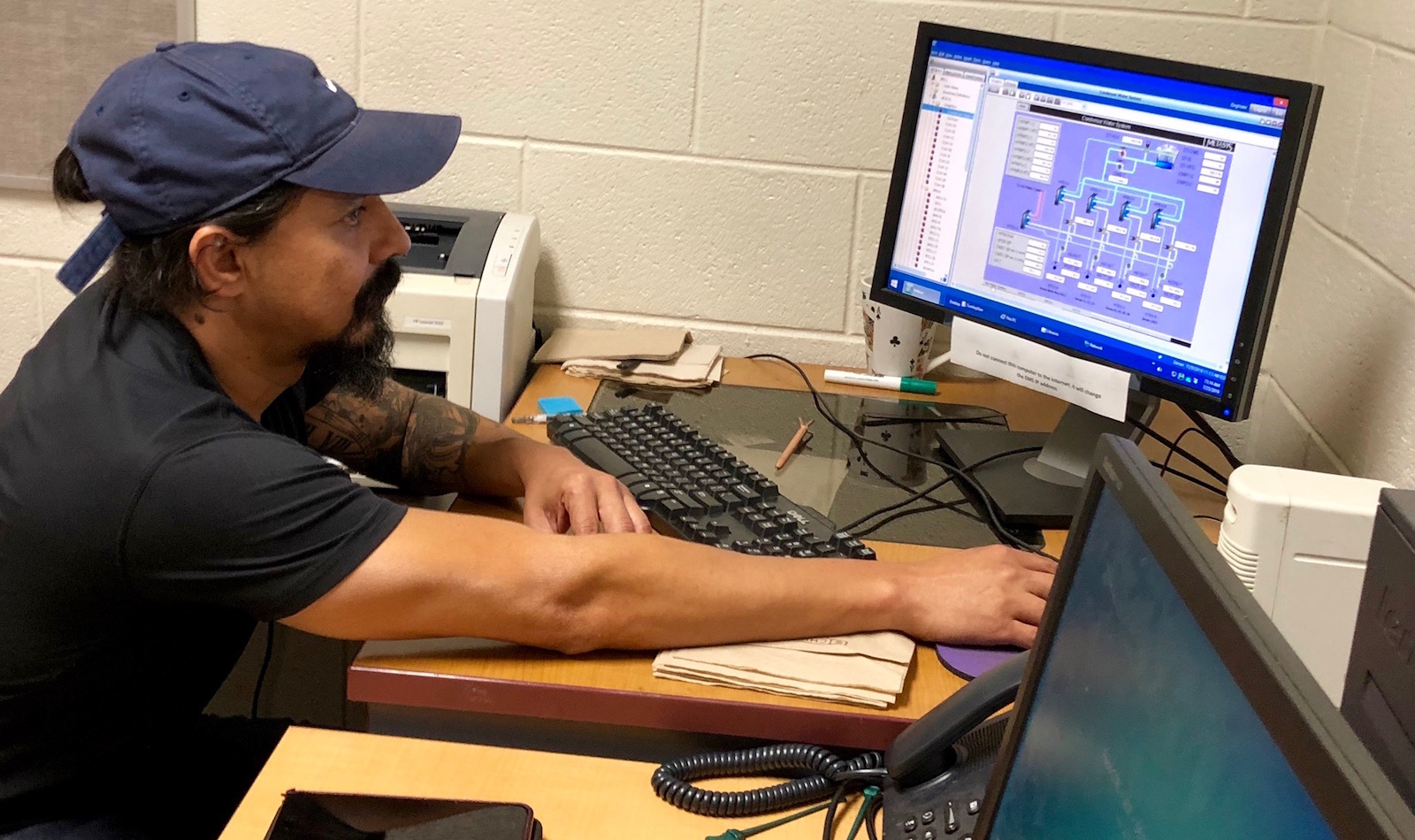
It’s early morning, and Jose Santos peers at the computer monitor in his basement office at the Columbia Heights Educational Campus on 16th Street NW. On the screen, a blue-and-green diagram corresponds to the water pumps, boilers and air conditioners that heat and cool the four-story school building.
A few minutes later, Santos takes the elevator up to the third-floor mechanical room, where the pumps whir loudly and two large burners, which have been removed from the building’s boilers, sit on the floor. Inspected and ready to be put back, they’re part of Santos’ checklist as he gets the school building ready for the start of classes on Aug. 26.
All is well in his building and that’s just the way Santos likes it. As a boiler plant operator for the DC Department of General Services (DGS), Santos is responsible for keeping the heating and air conditioning running and the building comfortable for the students, faculty and staff who use it. But, for Santos, it’s not enough to simply keep the systems going. He prides himself on keeping the building “tuned up” so it operates efficiently and saves the city money.
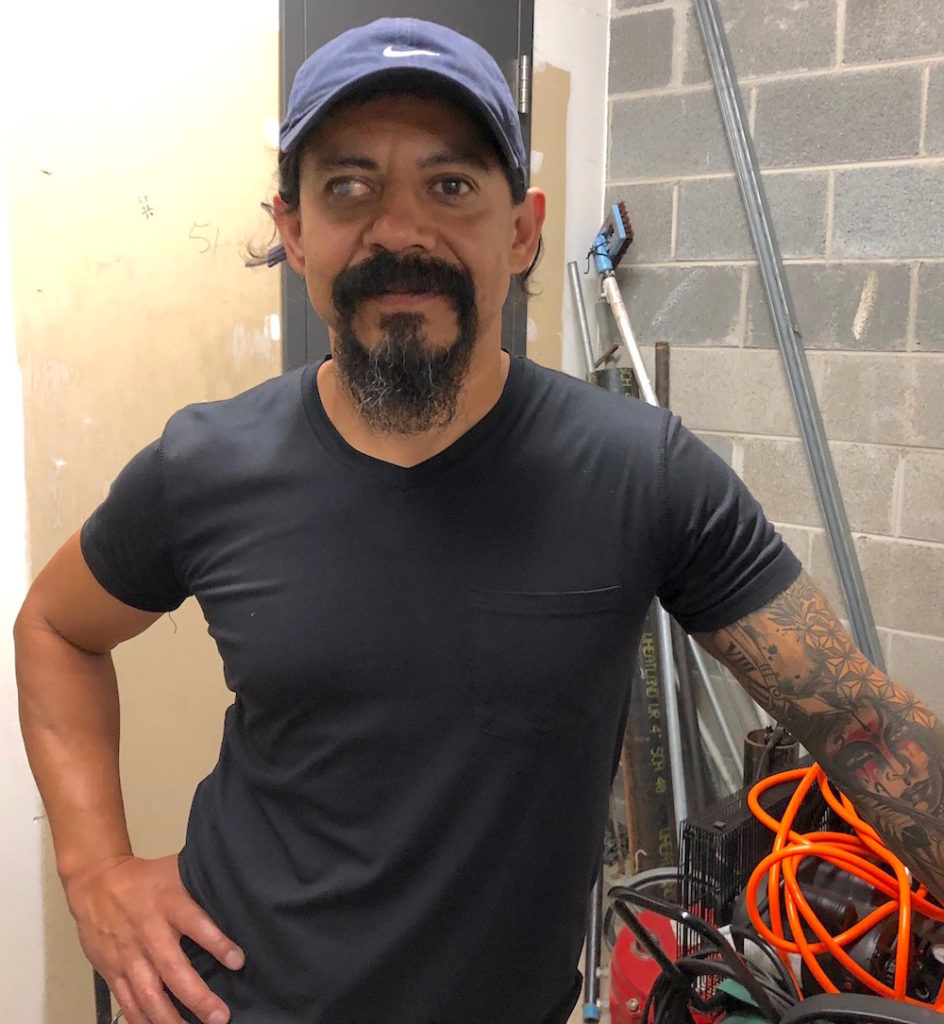
Santos started working for the department in 2013. Since then, he’s put in countless extra hours not only at Columbia Heights but also Woodrow Wilson High School and Alice Deal Middle School to improve their HVAC systems, saving the District at least $900,000 a year in heating and cooling costs, according to the department. For his efforts, Santos received an award in June from the Morris & Gwendolyn Cafritz Foundation and a $7,500 prize, honored as a public servant who makes life better for the people of DC.
Santos’ love of machinery stems from his days growing up on Guatemala’s Pacific Ocean coast in the small city of Puerto San Josė, where he started tinkering with motorcycles as a teenager. In the 1970s and ’80s, while he was growing up, Guatemala was mired in civil war. When he was 17, the country’s teachers were on strike for nine months; schools were closed. With little else to do, Santos and his friends spent their days surfing. His father, a schoolteacher, and his mother, a homemaker, fretted about his future. Santos decided to move to the United States.
He made his way to Los Angeles, where he lived for a year and a half doing home repairs. With the help of a friend, Santos then moved to Davenport, Iowa, landing a job in a vegetable-packing plant. He worked there for almost nine years, learning to operate and fix the machines. During that time, he met his future wife. When the plant closed, he enrolled in refrigeration courses and got a job at the University of Iowa power plant.
In 2009, when his wife, a flutist, joined the United States Marine Band, the couple moved to the DC area. Santos got a job as a contractor at the U.S. General Services Administration power plant at 13th and C streets SW.
Now 49, Santos is a wiry man with a ponytail and a salt-and-pepper goatee who lives on Capitol Hill and still works part-time for the GSA in addition to his job with DC. He laughs and describes himself as a workaholic who “wants to have the best building in the District.”
His supervisor, Alfred Pitts — who shared a table with Santos and his family at the Cafritz awards ceremony — calls him “Tos” for short and describes him as “a great employee, a very positive person and a quick learner.” Pitts, a utility systems operator supervisor who’s been with the Department of General Services for six years and worked for the DC Housing Authority for 18 years before that, says Santos “is a good role model” who readily shares his expertise with co-workers.
Not long after being hired as a roving boiler operator, Santos was dispatched to Wilson in Tenleytown. Despite extensive renovations of the high school in 2010 and 2011, significant problems remained with the building’s systems.
Santos diagnosed and managed the correction of major equipment-programming flaws and ordered repairs for machinery that wasn’t working properly, according to the Cafritz Foundation. Within a year, the building was more comfortable and Wilson teachers, staff and students were happier. The improvements were saving enough energy that the high school received the U.S. Environmental Protection Agency’s Energy Star certification, which has only been awarded to three of the 400 city-owned buildings.
The Cafritz Foundation notes that Santos “took on the building’s improvement as a personal challenge, as part of his mission to optimize equipment performance, reduce costs, and lower environmental impacts, which goes well beyond his official job duties to operate and maintain boilers and auxiliary equipment.”
When DGS administrators learned about Santos’ success, they asked him in 2015 to tackle the Columbia Heights campus, which serves students in grades six through 12. One of the biggest users of electricity among District-owned buildings, the campus was struggling with an HVAC system that produced room temperatures either too hot or too cold. One winter two heating units on the roof froze, causing pipes to burst and water to leak inside the building. Tiles fell off the ceiling. Buckets were placed around the building to catch the dripping water.
The project proved to be even more challenging than the work at Wilson, requiring Santos to put in long hours, including from home, to monitor equipment and guide contractors through repairs. But his work paid off, and the school’s energy bills were cut by 30 percent. In recognition of his efforts, the administration of the Columbia Heights campus awarded Santos a certificate of appreciation.
In January 2018, Santos’ department asked him to help the boiler plant operator at Alice Deal in Tenleytown to fix problems there. After inspecting the building’s equipment and the computer program that was running it, Santos says, he realized that solving the issues at Deal was not going to be a quick fix. It reminded him of an expression his mother sometimes uses referring to a stop-gap measure: Quieres cubrir el sol con un dedo. (You want to cover the sun with one finger.)
“I don’t like to put out fires,” says Santos. So, he worked extra hours, repairing equipment and teaching himself how to fix computer programming errors. Deal’s electricity bill was reduced by $350,000 that year.
On a typical workday, Santos starts his shift at 5 a.m., but before then he logs into his home computer, which is equipped with the same software he has on his office computer. He checks the HVAC system and then he goes to work in Columbia Heights.
Once there, he’s on the computer again, looking at the pump and piping icons that make up the diagram of the building’s system. After that, he usually walks around the building, checking temperatures. On the third floor he checks for any leaks in the system. The mechanical room is spotless. “I do the cleaning, too,” he says. “If the work area is dirty, you don’t notice a change that might be a problem.”
Over the past year and a half, Santos has convinced teachers, staff and students at the school to keep doors to offices and classrooms closed as a way to save energy. By 9 p.m. all systems in the building are off — another energy saver for the District.
“People say to me, ‘Jose, you’re only concerned about saving energy,’” says Santos. “But I say I’m concerned about not using energy that we don’t need to use. Little things make a big difference. When we keep the doors closed, we might save $100 a day — and $100 a day over a whole year is a lot of money.”
This is the third installment of The DC Line’s spotlight series on this year’s Cafritz Award winners. Read about the MPD language access officer who strives to ensure all are heard, and the sergeant paramedic who set up the DC Fire and Emergency Medical Services Department’s cadaver dog program. You can also learn about last year’s honorees in our 2018 profiles.
Comments are closed.