

Jack McCarthy: Life-changing charter schools lack facilities
At the heart of the District’s approach to education lies a gaping contradiction. On the one hand, Mayor Muriel Bowser states a belief in “education reforms that guarantee every child a quality seat … regardless of ZIP code.” On the other hand, District schools with the potential for turning around the life prospects of the rising generation of children struggle to access school space. Meanwhile, the city sits on 1.4 million square feet of vacant or underutilized classroom space, including 10 schoolhouses that could be used to educate District public school students.

Nearly half of those students are educated at public charter schools. These unique public schools provide a free education while operating independently of the traditional public school system and being held accountable for improved student performance. Unlike schools controlled by DC Public Schools, chartered public schools aren’t entitled to a building, but must instead find suitable facilities in which to educate their students.
From firsthand experience, I can assure you that the necessity of finding space is complex enough in this costly real estate market with limited funds and ability to access loans. But the city’s continued flouting of District law makes matters much worse.
DC law requires surplus school buildings to be offered to charter schools before private developers can bid for them. Tragically, however, successive administrations have frequently circumvented this requirement. Scores of school properties have found their way into the hands of private developers while the needs of public charter school students who could have benefited from adherence to the law are overlooked. Other buildings were simply left to decay rather than being renovated and used as schools.
The government’s priorities are so skewed that a shocking nine of 10 currently vacated buildings are located in the city’s three highest-poverty wards.
This deficiency comes at a time when some 12,000 students sit on waitlists for public charter schools unable to accommodate them. It comes at a time when the government itself has stated the need to add nearly 40,000 more high-quality seats to the District’s public education offering, mostly in underserved neighborhoods. And it comes at a time when the city spends three times as much on DCPS facilities as it does for charter facilities.
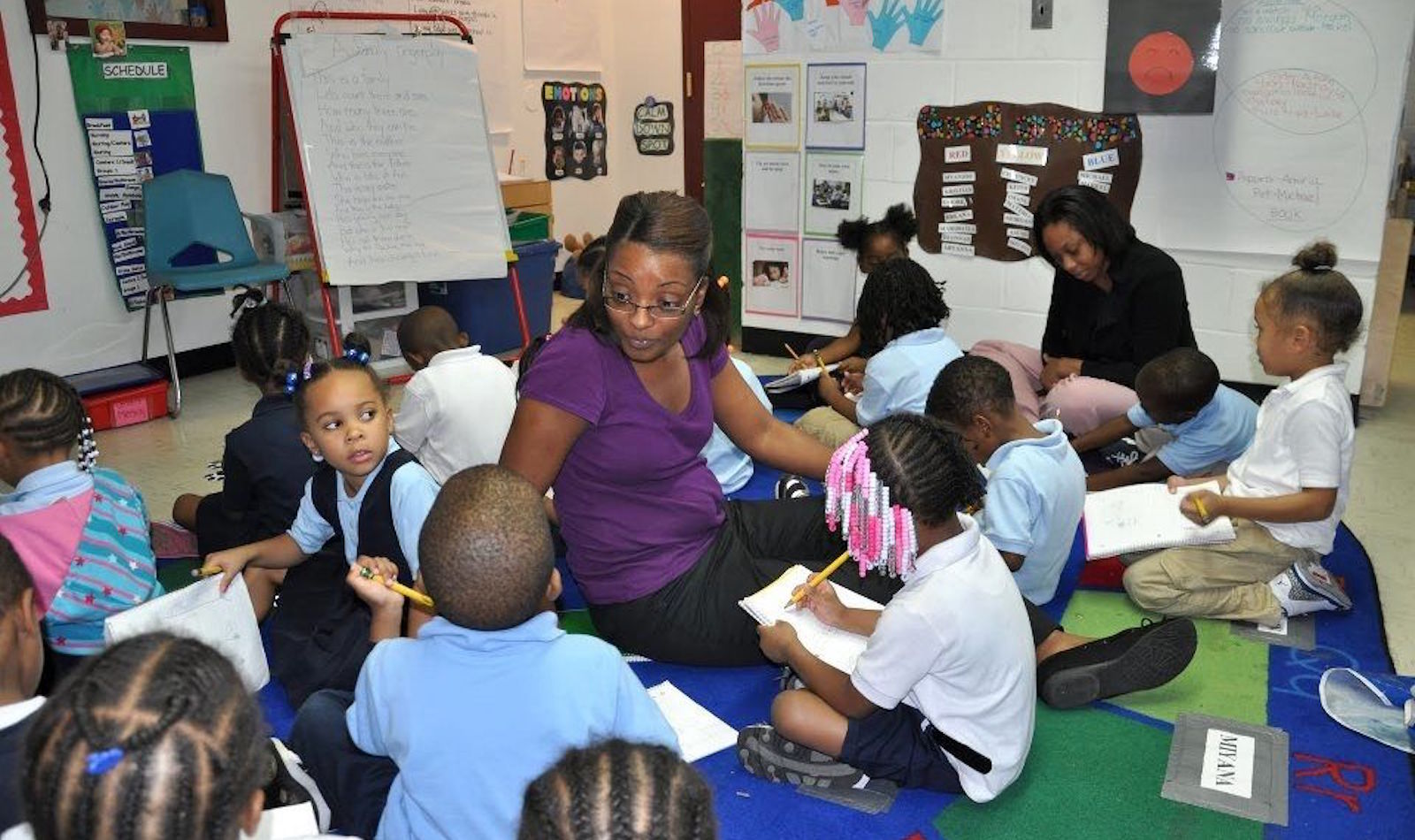
As the board chair of a District public charter school, I recently experienced this mismatch between government rhetoric and reality. AppleTree Early Learning Public Charter School provides a preschool program ranked Tier 1 by the DC Public Charter School Board. We serve 1,300 3- to 4-year-olds at 10 District campuses, one of which was forced to close due to lack of suitable school space. Previously, the Southwest campus had operated in portable classrooms we set up on former tennis courts at Jefferson Middle School Academy, a DCPS campus. This temporary arrangement was far from ideal but symptomatic of charters’ difficulties in acquiring usable facilities. When the city said it needed the space vacated, officials did not propose any of the city’s many underused or vacant buildings as an alternative.
When no appropriate space could be found, the campus had to close for the entirety of the 2019-20 school year — space having been acquired only for the following year. (Next fall, AppleTree’s Southwest campus will reopen in an office building at 475 School St. SW near L’Enfant Plaza.) About 108 mostly economically disadvantaged and minority students were enrolled at that campus in a program designed to close the notorious achievement gap. Research reveals that this gap begins before kindergarten and, left unaddressed, continues through formal schooling and life. Although we were able to find places at other AppleTree campuses for some children, many had to shift into other schools.
Sadly, this represents yet another inconsistency between government pronouncements and actual decisions. The mayor proclaims a commitment to early childhood learning — but this doesn’t extend to providing city-owned space for use by an effective early learning program offered by a public charter school. Instead, by default, this program is discontinued for a year with all of the disruption that entails for the children enrolled and their families. Somehow this terrible outcome is deemed preferable to yielding a tiny share of available city-owned school space even in return for rent.
Making surplus school facilities available to children from some of the District’s most vulnerable communities is ethically and legally the right thing to do. In this particular case, the government is getting in the way of something it says it wants — closing the achievement gap between disadvantaged children and their peers.
While these children are clearly the biggest losers from how the government currently conducts its business, they are not the only ones. Others paying the price include the city and its taxpayers, who could tap the charter schools’ facilities allowance for revenue in return for releasing surplus space and the thousands of children on waitlists for effective charter programs. By doing the right thing, everyone would win.
Jack McCarthy is the board chair of AppleTree Early Learning Public Charter School.
About commentaries
The DC Line welcomes commentaries representing various viewpoints on local issues of concern, but the opinions expressed do not represent those of The DC Line. Submissions of up to 850 words may be sent to editor Chris Kain at chriskain@thedcline.org.
Comments are closed.