


Keshini Ladduwahetty: Wanted — a budget that aims boldly for justice
Last week DC Mayor Muriel Bowser unveiled a budget that promises continuity. By using prior surpluses, local reserves and federal relief funds, she has avoided the cruel budget cuts being made by many other jurisdictions. But continuity is the wrong approach in a time of pandemic in a city-state with glaring inequalities. Rather, we need a budget that aims boldly for justice, funded by the wealthiest DC residents and federal government relief funds.
The District of Columbia suffers from long-standing disparities in health, education, housing, income and wealth — disparities that cried out for policy responses long before the pandemic, but are now gravely exacerbated. The ordinary risks of homelessness are more lethal because of COVID-19. Access to food, health care and basic services are more limited due to reduced public transit. Students without internet access at home are cut off from education. Voters are ensnared by obstacles and delays in mail-in voting.
While Mayor Bowser has done better than most governors in responding to the public health emergency, her response still falls far short of the massive human need we have here. And while she has spoken eloquently of the disparate effects of COVID-19 on black communities due to historic structural inequities, her budget makes only timid gestures at addressing them — and in some areas, even cuts funding. In the absence of bold legislation that furthers equity, we will emerge from the pandemic tragically less equal than ever.
This status-quo budget, which proposes denying obligated cost-of-living increases to DC government workers, is a slap in the face to those who deliver vitally needed public services and the unions that represent them. Workers in the Department of Employment Services and the Board of Elections are straining under higher workloads and upended work routines. DC Fire and Emergency Medical Services Department personnel and Department of Public Works trash collectors risk their lives daily, while other workers distribute free meals at DC public schools or provide free COVID-19 testing. Yet these workers are asked to forgo cost-of-living increases in the name of “shared sacrifice,” when the sacrifices are anything but equally distributed.
A budget that boldly aims for justice would address critical short-term human needs created by the pandemic by:
- providing safe private spaces (think empty hotels and college dorms) for the homeless;
- assisting child care providers who are critically needed for the recovery;
- providing home internet access to all low-income families, including public housing residents, so they can access critical services and voting rights;
- offering assistance for the approximately 30,000 undocumented workers and other workers who are denied federal assistance;
- expanding investments in violence interruption programs; and
- providing clean, private spaces and adequate protective equipment for incarcerated people.
Those steps are essential but by no means sufficient. A budget that boldly aims for justice would also address the underlying inequities that made COVID-19 so unequally lethal for black and brown communities. Needed provisions include:
- providing contractually obligated cost-of-living increases for DC government workers;
- ending homelessness by adopting the recommendations of the Fair Budget Coalition;
- prioritizing the repair and renovation of public housing as a first step toward building new non-market housing on a major scale (i.e., public housing, social housing, community land trusts and co-ops);
- fully funding the Birth-to-Three for All DC Act (which provides subsidies for private child care) as a step toward free universal child care as a public benefit; and
- fully funding pay-to-play reform as a major step toward dismantling the systemic corruption that allows the wealthy and well-connected to dominate public policy.
How to pay for such a bold, justice-centered budget? Any untapped federal relief funds should go toward critical short-term needs, and the District should continue to push for equal treatment with the states — including the $700 million it was shortchanged in the CARES Act drafted by the Senate. In her budget presentation earlier this month, the mayor reported using $252 million — less than half of the $725 million available directly to the DC government through the Coronavirus Relief Fund and other federal sources — to help balance the 2020 and 2021 budgets. It would be hard for DC to justify getting more federal aid if we do not fully use the funds that have already been allocated.
The bold investments that address underlying inequities should be funded with taxes on the wealthiest DC residents. The concentration of wealth in DC can be hard to wrap one’s head around. In 2017, the richest 2% of households took in $8.5 billion in income, while the bottom 76% got $9.8 billion, according to Internal Revenue Service data. Despite this inequality, the richest households pay a smaller share of their income in DC taxes than middle-income families. Income inequality was made even more cringeworthy by the Trump tax cuts, in which the wealthiest 5% of DC residents got the lion’s share of the benefits — a whopping $564 million in 2019 alone.
The pandemic has revealed that it is the much-maligned public sector — not the vaunted “free market” — that undergirds our social and economic life. Even the local business titans (“DC2021”) are now begging for government aid. We can turn the mayor’s status-quo budget into one that boldly aims for justice by tapping the vast resources available to build a robust public sector. All we need are DC Council members with the moral clarity to see past and present wrongs and build a more just future.
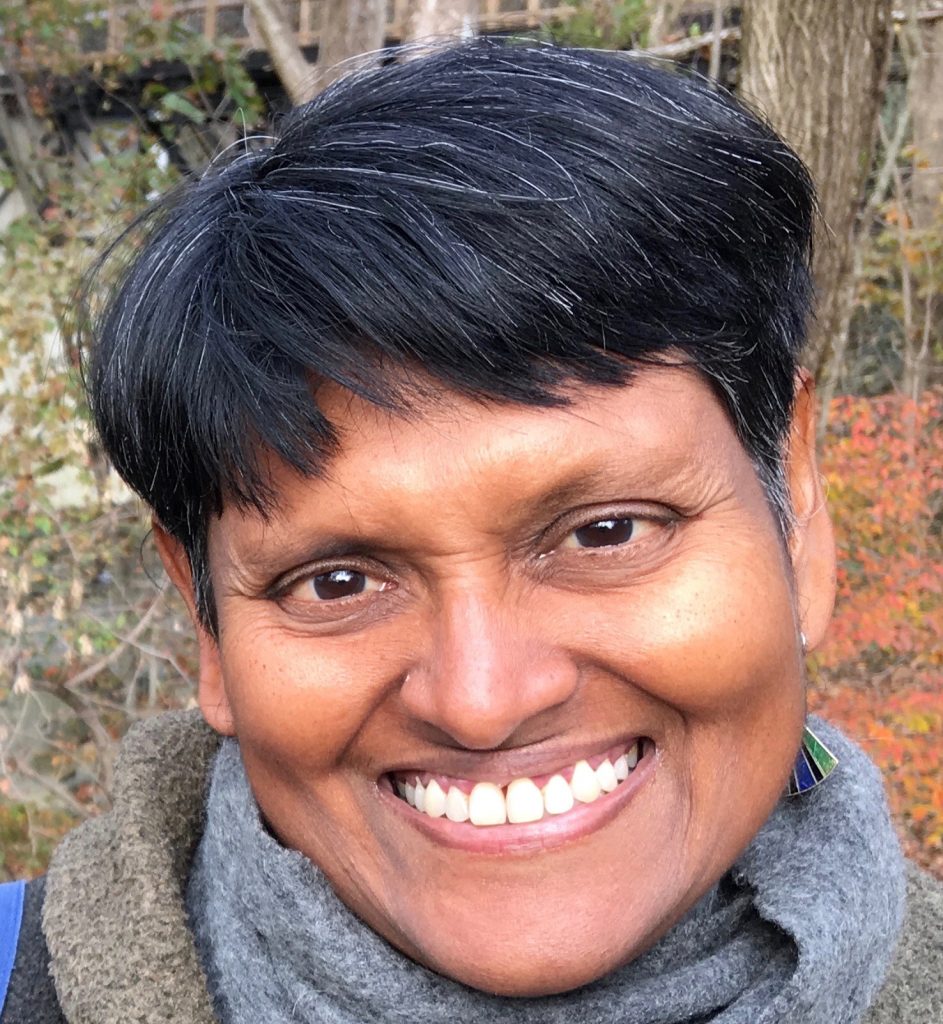
Keshini Ladduwahetty is former chair of DC for Democracy (DC4D) and a member of the group’s steering committee.
About commentaries
The DC Line welcomes commentaries representing various viewpoints on local issues of concern, but the opinions expressed do not represent those of The DC Line. Submissions of up to 850 words may be sent to editor Chris Kain at chriskain@thedcline.org.
Excellent piece. Important for the fairness and growth in justice in our greater community.