

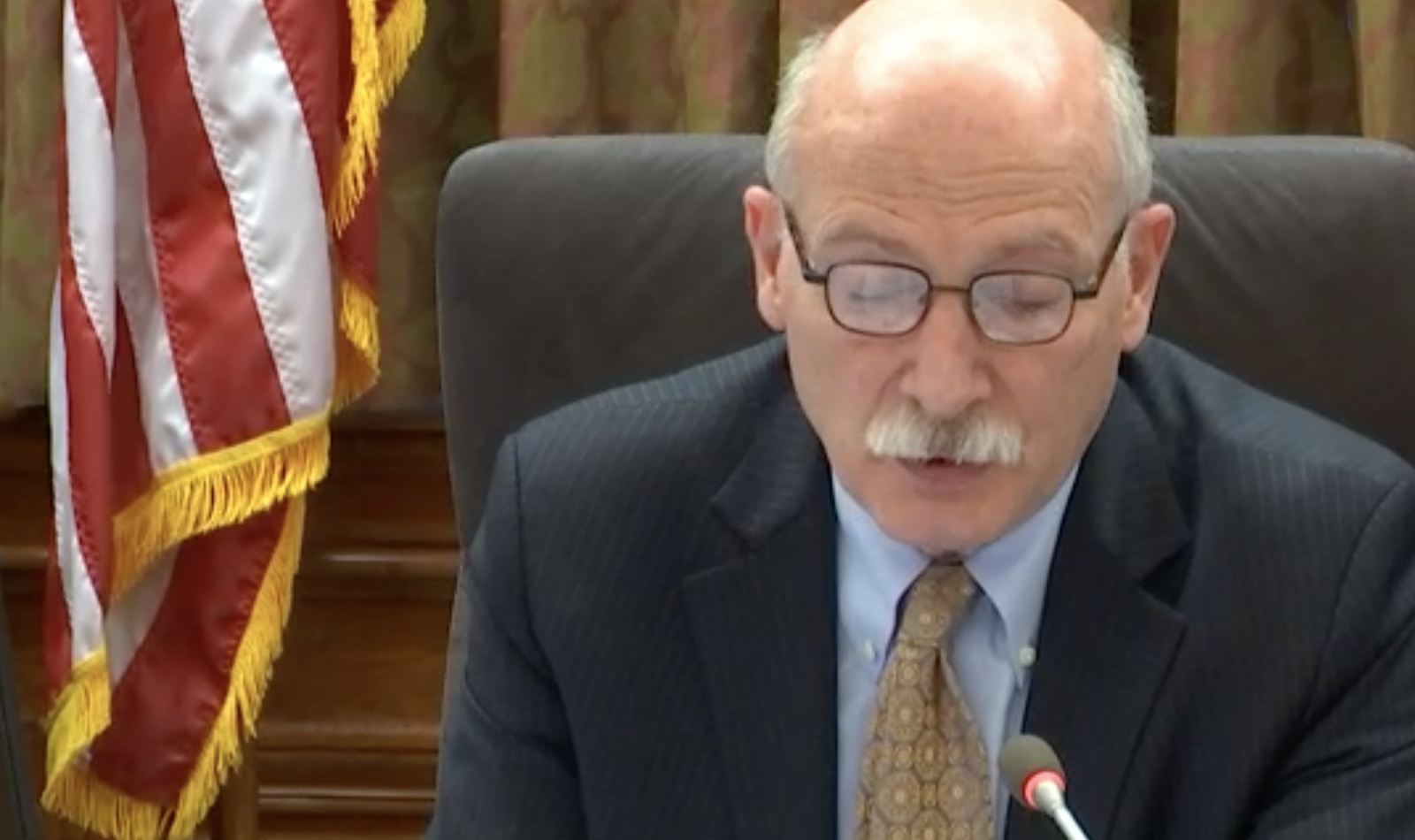
jonetta rose barras: The DC Council chair’s visionless vision
A few weeks ago, before I received an email from DC Council Chair Phil Mendelson with the subject line “My Vision for D.C.’s Future,” I had conversations with several DC residents during which they lamented the fact that neither Mayor Muriel Bowser nor he had stated plainly their agendas for the next four years. I thought the arrival of his email was fortuitous: Now I could provide answers for those concerned citizens.
After clicking open the document, I realized I was wrong. Mendelson’s email was a public policy grab bag. He said his focus on the council would be public education, public safety, affordable housing, and, oddly, the operation of the new Department of Buildings, which he established via legislation two years ago.
That’s it? Really? A rehash of the past.
I sought clarity but Mendelson did not respond to my email request for comment.
DC is struggling economically in many respects, despite the upwardly revised revenue estimates of DC Chief Financial Officer Glen Lee. Some of the city’s popular restaurants and retail shops have closed or have announced upcoming closure. Tourism, a key local industry, has not yet returned to its pre-pandemic level. Nevertheless, Mendelson made no mention of any of that in his vision thing. It’s as if the city has its own money-printing machine and doesn’t have to depend on the business community as a key partner in financing all those programs the council wants to fund and on which many advocates and their nonprofit organizations rely for their survival.
Mendelson has been on the council since 1998, when he was first elected as an at-large member. He became chair in 2012, winning a special election. Still, he seems to have repeated the mistake of novice politicians who act as if the council is nothing more than a policymaking machine. It is much more than that — at least when it’s functioning properly. It’s hard to argue that’s the case right now, since the past four years have shown again and again that the council does not understand the totality of its responsibilities.
If Mendelson’s recent email is all that he sees for the council’s next term, then he is suffering a severe case of myopia.
“There have been so many findings about what’s going wrong,” said Alexander Padro, the head of Shaw Main Streets and an advisory neighborhood commission candidate who is on the general election ballot. As an example, he mentioned the scathing assessment of the city’s public housing authority that was conducted by the federal Department of Housing and Urban Development.
“I am surprised he didn’t deal with that,” said Padro.
Bernard Demczuk, a longtime political player in the District and an adjunct professor at the University of the District of Columbia, said he agrees with most of the issues Mendelson laid out. However, Demczuk argued the list of priorities should include economic development, particularly in depressed and neglected parts of the city, and a “better way to mitigate gentrification.”
“Black people built this city and they do not deserve to be pushed out of their own creation,” he added.
Mendelson may want to consider creating what Demczuk called “A Blueprint for Our Nation’s Capital” that would identify the “ultimate goal” of the council in concert with the mayor and District residents. The idea harkens back to what happened during Anthony Williams’ mayoral administration. The citizen summits helped drive his administration’s policy and budget priorities.
It’s true that politicians typically set and announce their agendas after their elections. They establish transition committees whose members help to outline the future, including identifying potential key personnel to implement their plan.
However, Mendelson — not unlike the mayor — appears to have an unencumbered path to victory at this point, without any major challengers on the ballot. The question isn’t whether he will win the November general election. Rather the mystery is the number of votes he will receive: How many voters will fully embrace his return? And how many, demonstrating dissatisfaction, will decide not to mark their ballots for chair?
Is there a mandate or a middle finger?
As of Nov. 3, the DC Board of Elections has reported receipt of 71,341 ballots: 6,740 cast in-person at early voting centers; 25,270 via election drop boxes; and 39,331 via the U.S. Postal Service. Election observers have concluded the city is on a trajectory to duplicate or outpace its June 21 primary turnout.
Whether it’s despite the surety of reelection or because of it, Mendelson has been mostly opaque, only spouting the same policy priorities. That we keep concentrating on the same areas, spending more and more money, signals the government’s failure — in approach and delivery. This factor alone, in my view, ought to instigate a moment of true reflection and analysis about the way forward.
That need was amplified by the HUD assessments as well as other reports issued recently by the DC auditor, like the one related to the fact that offending police officers have been allowed to return to the Metropolitan Police Department on appeal after having been fired. Additionally, several key agencies are without their own directors and are being led by senior managers with multiple portfolios — for instance, the deputy mayor for health and human services is also director of the Department of Health Care Finance, while the director of the Department of Parks and Recreation also runs the Office of Neighborhood Safety and Engagement. That this continues is not just an operational failure but also indication of lax oversight.
The District’s chief executive, like that of any corporation — and the DC government is a $19 billion corporation — is charged with the daily management and administration. However, the legislature, comparable to a board of directors, is responsible for ensuring the CEO is effectively managing the business, including every division and affiliate, guaranteeing shareholders a good product and the proper return on their investments.
If the mayor has fallen short of her duty — and she has — the council’s performance hasn’t been any better. The long-range impact of legislative proposals frequently is not considered or fully understood. Legislators are assigned oversight roles for which they have no expertise or background; it’s all about fueling individual desires and personal fiefdoms rather than pursuing the optimal path for growing and improving the city.
“Subject-matter experts would be invaluable for reinvigorating the council’s oversight roles,” said Padro, citing the model on Capitol Hill, where each committee has staff with specific skills, talents and experience related to its area of focus, which can improve committee performance.
The absence of those voices and insufficient contributions from local or national experts — who could add weight and sharpness to the discussion — has meant public hearings often become unfocused. It also means that the legislature often relies heavily on outside groups and individuals to craft proposed bills; these third-party crafters are often working to advance their own agendas, which may not necessarily align with the interests of DC residents.
Further, financial reviews and analyses sometimes are incomplete; when they are conducted, they frequently are available during deliberations only to council members, not the taxpaying public who are footing the bill for bloated programs and policy debacles. Collectively, these issues have resulted in a low- or poor-performing legislature that has been unable to effectively hold the executive accountable. Strong oversight should extend beyond getting the Department of Buildings up and running.
Demzcuk suggested the council consider conducting a retreat — or “an ‘advance’ as former Mayor Marion Barry would describe them” — in January 2023, soon after the swearing-in ceremony for new and returning members. He suggested a citywide summit in the spring to ascertain citizens’ concerns. The results could be combined to set a four-year plan for District policymakers.
There are organizations that could help facilitate such efforts to ensure their success.
“The National Conference of State Legislatures is a resource the council could make use of,” DC Auditor Kathy Patterson told me earlier this week during a telephone interview about how best to enhance the legislative branch’s performance.
Interestingly, the National Conference of State Legislatures, at the request of then-council Chair Linda Cropp, conducted a study in 1999 of the legislative branch’s operation. That same year DC Appleseed issued its report titled “Operational Reform of the DC Council: A Fix-it-Yourself Manual.”
Unsurprisingly, each group made the same assessment. It appears that a few of the recommendations were implemented but not to the full extent suggested.
For example, the council established a limited centralized staff. Aside from the budget office, however, none of that staff is focused on research and analysis. The legislature’s general counsel reviews the drafts of some legislative proposals, but mostly for legal sufficiency.
A prime concern remains unaddressed — even after 23 years. DC Appleseed said this back then: The “fundamental conclusion is that inadequacies in the council’s current staffing structure [are] at the heart of many of the council’s operational problems.”
“The decentralized nature of the staffing structures in which most staff members are hired by, report to and serve at the pleasure of individual members favors the creation of 13 different power centers—each with its own agenda as opposed to a work program designed to fulfill the council’s legislative responsibilities.”
Breaking down any power center is no easy feat. A structure as intimate as the council’s exacerbates the difficulty, particularly given the ideological shifts among its membership over the past five years or so. Still, there is no reason to avoid the structural needs, including creation of a more logical committee system, introduction of subject-matter experts into the staffing pattern and expansion of a central management operation.
“DC Appleseed believes that unless the council changes its staff structure to focus on the institutional needs of the legislative body, its operations problems will persist,” the report authors added.
That prediction has proved quite accurate.
Mendelson is not your average council member. He is the leader of the legislative branch and, arguably, the second most consequential elected official in the city. He needs to act like he understands his role.
He can’t afford to cling to an antiquated, narrow vision. If he needs help adjusting his lens, perhaps Appleseed can update its study.
One thing is certain: The council can’t continue its poor performance. It has to step up its game, if the quality of life for District residents is to significantly improve.
This post has been updated to correct the name of the National Conference of State Legislatures.
jonetta rose barras is an author and freelance journalist, covering national and local issues including politics, childhood trauma, public education, economic development and urban public policies. She can be reached at thebarrasreport@gmail.com.
The focus on the Department of Buildings is absolutely critical. The agency appears to have gone entirely rogue… They are just not showing up for inspection appointments at all, and not offering any explanation. All across the city, people have been waiting in many cases for months for them to do their jobs. Something major needs to be done there. It is basically just a new logo slapped on the same old DCRA and doesn’t appear to have improved. That isn’t the kind of agency we can let just cease functioning since all development, and even maintenance, of the city depends on its acting. Just building a garage now requires SEVEN inspections, and each one takes weeks or months of fighting them just to get somebody to show up. Building a garage most places takes a week. Here it takes 7-12 months, entirely because of the abject lack of professionalism in the DOB/DCRA.
Considering that the Department of Buildings was established on October 1, 2022 it is impossible for them to have missed months of inspections, but your rant sounds good. It just cant be factual because the facts dont add up.
Further the establishment of DOB is a waste of money because the major issue at DCRA has been a shortage of staff as the last several DCRA directors have all stated. So instead of actually making the investment of additional money to hite staff, we decided to create two new agencies and zpend more than $20 Million to fo so as opposed to hiring the additional staff required. Yeah, this is the answer for those privileged intellectual masters such as Mendelson, Cheh, Allen, Silverman, Gray and you.