

Capital Projections: Immigrant experience edition
Capital Projections is The DC Line’s selective and subjective guide to some of the most interesting arthouse and repertory screenings in the coming week.
JOHN WICK: CHAPTER 3 – PARABELLUM
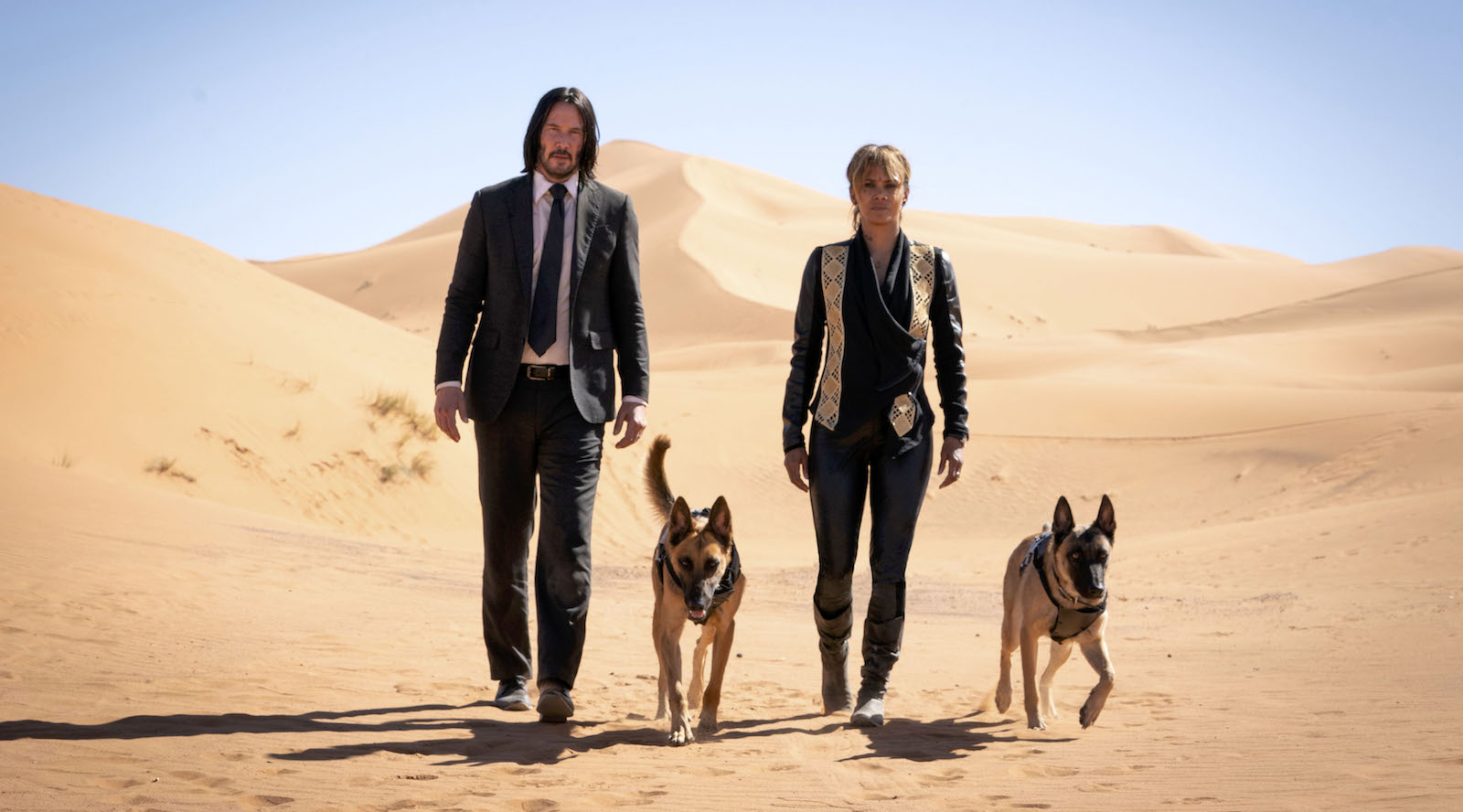
An ultra-violent Hollywood franchise would seem to fall outside this column’s primarily indie-movie scope. Yet, with gorgeous lighting that would perfectly suit the arthouse, John Wick: Chapter 3 uses blockbuster methods to tell a story common to much smaller movies: that of immigrant alienation. Keanu Reeves returns as the seemingly indestructible killer who, as John Wick 2 came to a close, had an hour’s head start to evade the assassins who would soon attempt to claim the $14 million bounty placed on his head. Wick thus spends much of this chapter on the run, careening from one brutal, stylishly choreographed set piece to another. He often fends off attackers alone, as in a Chinatown antique store battle that’s timed like slapstick comedy; other times he does so with help, as in a side trip to Casablanca where he teams with fellow outlaw Sofia (Halle Berry) and a pair of Malinois attack dogs. (Fans of the first film will be relieved to know that no dogs are killed this time.)
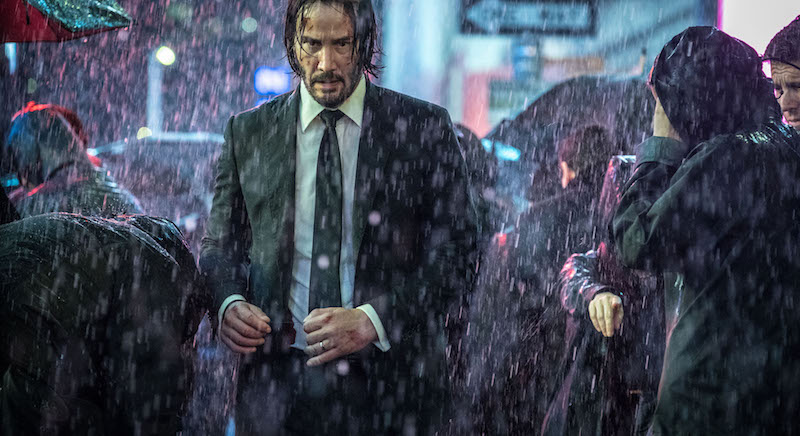
It’s a lot of killing, and viewers might feel exhausted by the end of it all. Fortunately, the movie offers more than just murder; it has an aesthetic unique among action thrillers. Like all of the films in the series, Parabellum takes place in a modern world that still holds onto old-fashioned trappings like rotary telephones, typewriters and honor among thieves. And in an unusual twist, Wick visits a Russian ballet school (headed by Anjelica Huston), where we learn of his surprising origins: It turns out he’s a Belarussian orphan who developed his fighting skills while training in dance and wrestling. As relentless as a 131-minute WWE match but with better cinematography, Chapter 3 may be the weakest in the franchise, but it’s still a wild, visceral thrill.
Watch the trailer.
Opens Friday, May 17, at area theaters.
THE SUN IS ALSO A STAR
Jamaican-born Natasha (Yara Shahidi of Grown-ish) is a cynical 17-year-old who’s interested in astronomy but doesn’t accord the stars any mystical significance. Daniel (Charles Melton of Riverdale) is a romantic Korean American teen who writes poetry, which doesn’t fit in with his father’s dream of sending him to medical school. They meet cute (to use the rom-com shorthand), and while Natasha resists, Daniel asks for just one day to make her fall in love with him. The problem is that Natasha and her undocumented immigrant family are about to be deported the next day. Adapted from Nicole Yoon’s 2016 young adult novel of the same name, this adolescent romance looks terribly saccharine on paper, but as I wrote in my Washington Post review, “director Ry Russo-Young (Before I Fall) somehow manages to sell this madness, aided by the convincing visual flair of cinematographer Autumn Durald, whose bird’s-eye views of Manhattan convey the delirium of young love. Her camera catches the scope of the big city, a hugeness that not only overwhelms the concerns of these two not-yet fully-formed adults but also thrills them with a sense of possibility.”
Watch the trailer.
Opens Friday, May 17, at area theaters.
PHOTOGRAPH
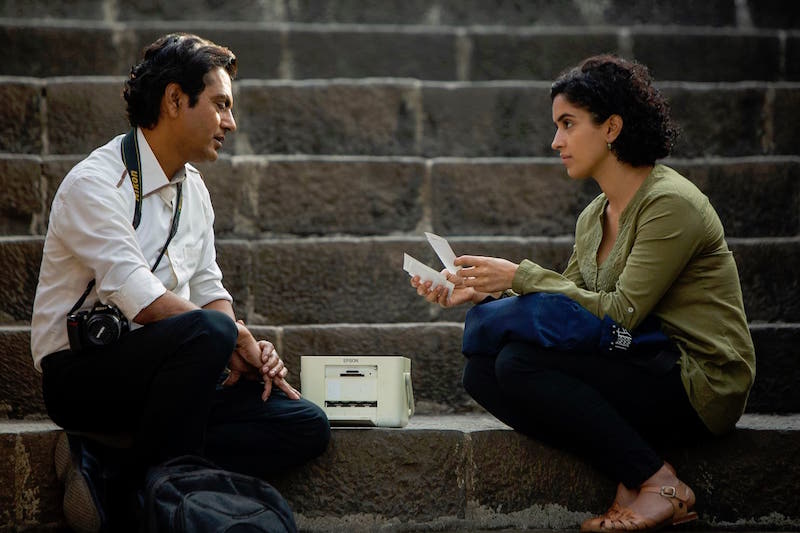
This low-key film from director Ritesh Batra (The Lunchbox) depicts a Mumbai love story via patient observation. But there’s little in the way of sparks. Rafi (Nawazuddin Siddiqui) makes his living taking photos of tourists at the Gateway of India. When he meets Miloni (Sanya Malhotra), a shy, pretty visitor, Rafi persuades her to meet his grandmother (Farrukh Jaffar), who has been pressuring him to get married. Batra maintains a subdued tone as he depicts modest characters who seem resigned to their fates. The director approaches each setting with loving detail, from the busy tourist traps where Rafi plies his wares to a somber cafe where the would-be lovers try to have a conversation. The film’s reticence perhaps suits Rafi’s pitch to customers: Take a photo, or else the moment will be gone forever. But while Photograph aims to capture the elusive and make it permanent, the film doesn’t quite produce a lasting memory.
Watch the trailer.
Opens Friday, May 17, at Landmark E Street Cinema and Landmark Bethesda Row. $12.50.
HIT & STAY: A HISTORY OF FAITH AND RESISTANCE
On May 21, 1969, three young men were arrested after they entered U.S. Selective Service offices in Silver Spring, Maryland, and poured blood and black paint on draft files. Commemorating the 50th anniversary of the incident, the AFI Silver Theatre and Cultural Center presents this documentary from local filmmakers Joe Tropea and Skizz Cyzyk, who chronicle Vietnam War protests inspired by the efforts of Catholic activists. The divine spark, as it were, happened in 1968 in Catonsville, Maryland, where nine Catholics (including Father Daniel Berrigan) used homemade napalm to destroy draft records, then prayed and awaited the consequences, which included time in prison. Known as the Catonsville Nine, their faith-based efforts inspired acts of civil disobedience around the nation. Activist Les Bayless will join the directors for a Q&A after the screening.
Watch the trailer.
Wednesday, May 22, at 7:15 p.m. at the AFI Silver Theatre and Cultural Center. $13.

THE IMAGE BOOK
Iconoclastic French director Jean-Luc Godard has been the unlikely champion of Hollywood crowd-pleasers such as Nicholas Ray’s over-the-top 1954 Western Johnny Guitar and the slapstick comedies of Jerry Lewis. But Godard’s own films always follow their own unconventional path, averse to anything resembling commercial potential. His latest is as uncompromising as ever, a history of Arabic-language cinema in the form of a collage arranged, as its title suggests, like a book. The New Yorker’s Richard Brody wrote that the director’s “manipulations of archival footage in ‘The Image Book’ — with lurid shifts of color, dramatic heightening of contrast, analytical reframings; drastically lo-fi and analog-created videotape-based effects, and extreme, rhythmic, frame-by-frame slow motion — make everyone else’s use of archival clips seem tame, impersonal, pusillanimous, even parasitical.”
Watch the trailer.
Sunday, May 19, at 4:30 p.m. at the National Gallery of Art. Free.
DEEP RED
Director Dario Argento is the master of the gory Italian horror sub-genre known as giallo. But as is typical of the milieu, his dramatic visuals don’t always compensate for plotting that may generously be called dreamlike but is too often simply incoherent. Yet in this delirious thriller from 1975, Argento’s cinematic bloodlust achieves a narrative clarity, with vivid, highly saturated colors and a mystery that actually makes sense. David Hemmings (Blow Up) stars as a jazz pianist who witnesses a murder — or does he? Trying to solve the crime himself, he’s swept up in a nightmare that involves a terrifying ventriloquist dummy and buckets of blood. The AFI Silver Theatre and Cultural Center will screen a new 4K digital restoration with scenes that weren’t in the English-dubbed version released in the United States. Because some of the originally deleted elements only exist with Italian dialogue, the restoration features scenes in which characters shift from speaking English to Italian. It may seem incongruous, but it plays like another symptom of the auteur’s fevered brain.
Watch the trailer.
Friday, May 17, at 9:45 p.m.; Monday, May 20, at 10 p.m.; Wednesday, May 22, at 10 p.m.; and
Thursday, May 23, at 10 p.m. at the AFI Silver Theatre and Cultural Center. $13.
Comments are closed.