


jonetta rose barras: DC Council Chairman Phil Mendelson enters the rogues’ gallery
There are many labels that have been slapped on DC Council Chairman Phil Mendelson throughout his decades-long political career. He has been accused of suffering the all-trees-no-forest syndrome, of being a nitpicker, and of being a transactional-ist who is focused only on sealing a deal or sidestepping controversy.
Few people — even some of his most ardent critics — have raised serious questions about his integrity and ethics. That changed last week.

On Sept. 15 Mendelson sent a letter to Mayor Muriel Bowser offering to resolve the never-ending Medicaid managed care contract debacle and saga. The Washington Post’s Julie Zauzmer Weil first published a copy of that correspondence on her Twitter account on Sept. 16.
“I believe there is a solution to allow the continuation of services under the Medicaid and Alliance Programs,” Mendelson wrote in his letter. He proposed a series of slick, disingenuous maneuvers designed to assist the mayor in getting around both the letter and spirit of an order issued in December by the city’s Contract Appeals Board (CAB), an independent, quasi-judicial agency that is — by law — the final arbiter in contract disputes.
Following the 2020 procurement of the Medicaid managed care organization (MCO) contract, Amerigroup DC, which was then an existing MCO contractor, filed a protest with the CAB. Amerigroup accused the District of violating its own laws as well as the rules it set for the solicitation — and demonstrating bias in the process. The CAB agreed and ordered the Bowser administration to reevaluate the offers it received.
For the past nine months, the mayor and Deputy Mayor Wayne Turnage have consistently and systematically sought to circumvent that order. The Bowser administration has also attempted to steer a contract to MedStar, who it appears would have been eliminated from the competition if a reevaluation had occurred.
Mendelson and a majority of the council, albeit a slim majority, had pushed back against the executive’s lawlessness. However, with his Sept. 15 letter, Mendelson headed straight into the rogues’ gallery, taking a seat next to Bowser, Turnage and the executives at MedStar Health Services. In recent weeks, the health care giant engaged in street-style muscling, threatening to terminate services to other Medicaid MCOs if its affiliate, MedStar Family Choice Inc., didn’t retain its contract. MedStar statements may characterize this as a standard technique with a goal of renegotiating payment rates, but the rationale falls short when the health care of so many vulnerable DC residents is at stake.
Equally troublesome is the fact that nowhere in his letter does Mendelson mention Amerigroup’s legitimate grievances. Instead, he said he would be willing to introduce emergency contracting legislation that could result in the retention of the “status quo” with MedStar winning that bid.
Why have DC officials decided to discriminate against Amerigroup DC? Unlike MedStar, Amerigroup DC has had a history of cooperating with other contractors, following the rules set down by the DC government and generally serving its members well. As Turnage himself has acknowledged in the past, MedStar was — and apparently continues to be — “a bad actor.”
Mendelson, the mayor and Turnage have helped seal the perception that the DC government lacks integrity and ethics. They have sent the message that contracting and procurement have gone from bad to patently corrupt.
“If integrity has an opposite, perhaps it is corruption — the getting away with things we know to be wrong,” Yale law professor Stephen Carter wrote in his book “Integrity.”
Earlier this week, during an intense telephone interview, Mendelson took offense to my characterization of his actions as reflecting a lack of integrity. He asserted that the council has “no good option.”
He said there aren’t enough votes on the council to outright disapprove legislation the mayor introduced in conjunction with her Health Care Resources Emergency Order earlier this month that would extend for a year all three MCO contracts, including the one to MedStar. Without the disapproval vote, the contract legislation could automatically take effect in October.
“We’re stuck with doing nothing,” Mendelson said. And, responding to my question, he added that the council does not have legal standing to sue the executive branch over its violation of local laws. He suggested that I find a law firm or a group of citizens willing to file a pro bono lawsuit against Bowser.
I am not the leader of the legislative branch of the DC government. I do not make an annual salary of $210,000. The burden of leadership requires figuring out how to persuade people to follow you or provide needed resources. Further, it isn’t as if Bowser and Turnage did not telegraph, repeatedly, their intent to run out the clock and push the council into a corner where it had few options.
The council had myriad opportunities to demonstrate courage, standing up to an executive that is as much of a bully as is MedStar. It could have signed on to a civil rights complaint filed last week with the U.S. Department of Health and Human Services by the DC Health Alliance Network LLC, one of the city’s largest community-based health advocacy organizations. I first reported about the filing last week in my blog. John A. Wilson Building sources told me that the mayor’s senior executive assistant has called some people in that group, objecting to their actions and reminding them that they have received grants from the Bowser administration.
Ambrose Lane, the Alliance Network’s chair, said the council could also approve legislation that would mandate universal contracting, requiring all DC hospitals to sign agreements to provide services to members of all of the city’s MCOs.
When Turnage decided last year — in the middle of a pandemic — to open bids for a new MCO contract, he argued that the goal would be to introduce and implement universal contracting as a way to improve the health care provided to Medicaid recipients. When all the hospital operators, including MedStar, signed such an agreement, Turnage boasted to the media.
However, when MedStar reneged on that agreement, vowing to terminate services to existing MCOs by Nov. 21, Turnage took no punitive action. Lane asserted that having universal contracting become law would remove the possibility of MedStar or any other hospital holding the city, Medicaid recipients or Health Care Alliance members hostage in the future. He noted that Maryland has a similar law that sets mandates and compensation penalties for companies that fail to provide services.
But don’t expect the Mendelson council to be that aggressive or forward-thinking. It apparently has accepted that it is in a can’t-beat-them-so-join-them world.
In his letter, Mendelson called on Bowser to conduct the reevaluation — seemingly a disingenuous instruction. After all, he presumed the winners would be two of the existing contractors: AmeriHealth Caritas of DC and Carefirst BlueCross BlueShield Community Health Plan of DC. That means the fix is already in, especially since there isn’t any consideration that Amerigroup might, in fact, end up as one of the top two.
Sources told me this week that the Bowser administration has, in fact, already completed the reevaluation but is refusing to share the new scores. That can only mean they aren’t happy with the lineup of new winners.
Mendelson said that after extending the contract for two of the MCOs, the mayor could then conduct a new emergency procurement for the third contractor. He suggested the existing provider — MedStar Family Choice — would win that competition.
“This solution would leave the current three providers, and thus the status quo, in place within the timeframe you have indicated that a new comprehensive managed care program can be solicited and awarded,” he wrote in the letter to the mayor.
When I asked Mendelson if the mayor had accepted his offer, he said “no comment.” At the time I was writing this article, my sources told me she had not.
His letter to Bowser seems to contradict his Sept. 10 memorandum to council members that makes clear the mayor doesn’t have the authority to execute contract extensions in this situation. The council’s lawyer argued that absent that authority, legislators had no alternative but to disapprove them. In the memo, Mendelson also offered that the council could choose to overrule the CAB, adding that he was not making that recommendation.
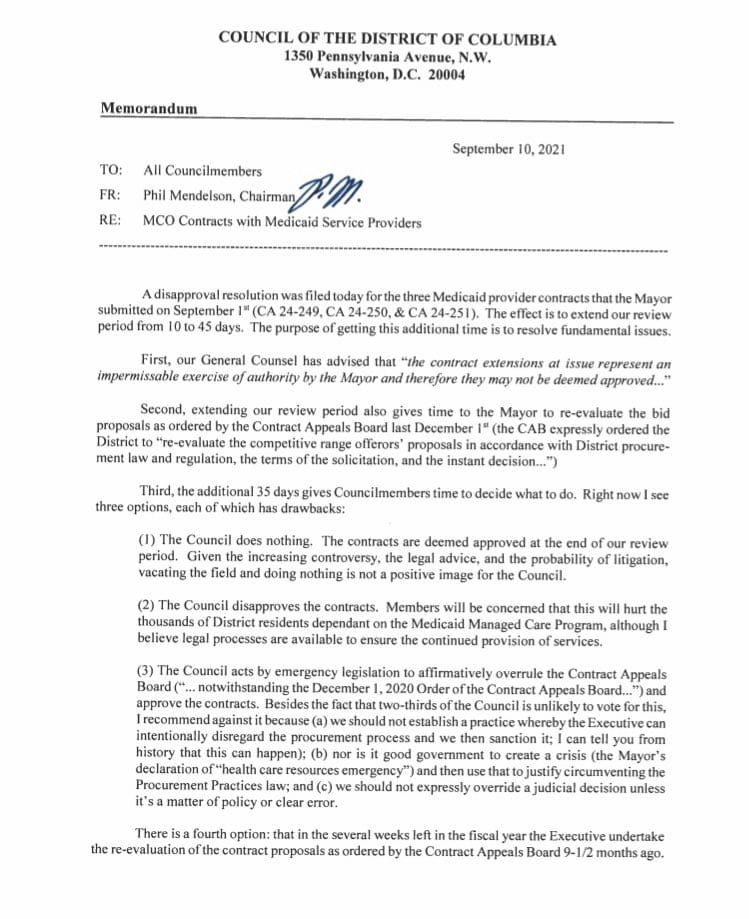
In my view, his Sept. 15 letter does just that. It is the legislature’s version of an end run around the CAB. Nevertheless, Mendelson may have enough votes to move forward if the mayor says yes.
In an interview earlier this week, at-large Council member Elissa Silverman embraced Mendelson’s analysis of the situation. “We’re in a bind, and we shouldn’t be playing games with people’s health care,” she told me.
“What the chairman proposes is trying to get us out of a legal bind. It doesn’t solve the problem that MedStar is using threats and bullying to get part of a $1.5 billion contract. I can’t condone MedStar’s behavior,” said Silverman, who joined with Ward 5 Council member Kenyan McDuffie to ask DC Attorney General Karl Racine to investigate MedStar’s actions. Specifically, they asked him to determine whether MedStar violated local or federal antitrust laws when it announced its termination of services to the city’s other MCOs, which serve two-thirds of Medicaid recipients and DC Health Care Alliance members.
Silverman said that, if she decides to support Mendelson’s proposal, she would want to ensure that more Medicaid recipients are vaccinated. In July, the mayor reported that only 1 out of 4 residents on Medicaid had received a COVID-19 vaccine. “If I voted for this, I would want MedStar to do everything in its power to get assigned patients vaccinated.
“I’ll take one more look at this,” Silverman continued, adding that in this instance she is “less concerned about the council’s integrity and more concerned about the integrity of our contracting and procurement process.”
In a statement provided through his spokesperson, McDuffie said: “It’s been nine months, yet the executive has refused to follow the CAB’s ruling, which will do nothing but cause harm to many of the [District’s] most vulnerable residents. I am currently exploring legislative solutions that will help protect the [District’s] Medicaid population.”
Bowser, Turnage and others have cast this controversy as about the health care of 200,000 low-income and working-class DC residents. The executive’s refusal to follow the law certainly could adversely affect them.
However, this is mostly about contracting and procurement. It’s about who gets one of the largest contracts in the city. It’s about whether District officials will follow local laws or toss myriad excuses and propaganda to get around them on behalf of favored contractors and friends.
It’s about whether DC’s elected officials will adhere to principles, to integrity, to the hallmarks of good government. Mendelson told me that standing on principle is too high a standard in this situation. “Principle is not going to get us anywhere.”
I leave him and other council members with these words from Carter: “We can never really know whether we are acting from deep and steadfast principles until those principles are tested.”
Test time.
jonetta rose barras is an author and freelance journalist, covering national and local issues including politics, childhood trauma, public education, economic development and urban public policies. She can be reached at thebarrasreport@gmail.com.
I read this article but do not understand. What is where is the rogue fallery.
Is Mendelson wrong because he is trying to uphold or cancel the medicaid contract?