


Keshini Ladduwahetty: Competing worldviews shaped the polarized debate over Initiative 77
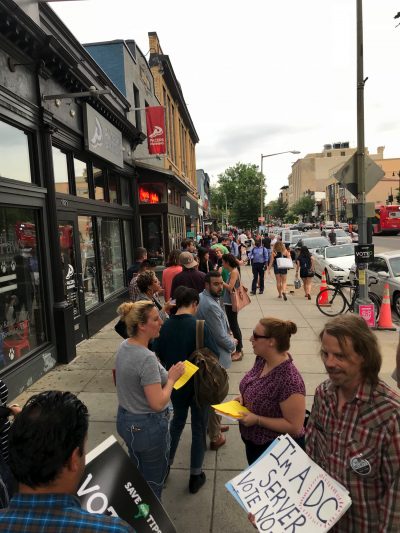
Months of contentious debate over One Fair Wage will end soon with the mayor’s expected signature on the DC Council bill repealing Initiative 77, which DC voters passed overwhelmingly in June. The controversy, which has raged since the primary campaign this spring, produced the most extensive media coverage and public discussion of any local issue that I can remember, with passionate arguments over the incomes of tipped workers, wage theft, sexual harassment and democracy. Glossed over in the debate were the contrasting worldviews of the opposing sides.
The hundreds of tipped servers and bartenders who vocally oppose I-77 believe that their interests are aligned with those of restaurant owners. These workers argued against I-77 because they worried that the new law would jeopardize their already ample incomes and the plentiful jobs driven by the rapid growth of the restaurant sector. The assumption seems to be that what is bad for business owners is bad for the employees. In the 1950s, this sentiment was captured in the dictum “What is good for General Motors is good for America,” a worldview apparently shared by Mayor Muriel Bowser, DC Council Chairman Phil Mendelson, the restaurant lobby, Republicans in Congress and The Washington Post’s editorial board.
 The handful of tipped workers who risked their jobs to publicly support I-77 have a very different view. These workers believe that owners have financial interests in exploiting workers, through low wages, wage theft, sexual harassment, and use of hiring and staffing policies to punish workers who air complaints. These workers believe that the self-interest of workers and owners clash significantly and in ways that are highly correlated with race and gender, a worldview that is shared by the residents, advocates, labor unions and others that support Initiative 77.
These contrasting viewpoints are also at play in the controversy over paid family leave, which is deeply interwoven with the charged race for the at-large seats on the DC Council. Paid family leave has emerged as the central policy dispute between two leading candidates: incumbent Elissa Silverman and challenger Dionne Reeder. The Washington Post’s endorsement of Reeder cited “profound policy disagreements with Ms. Silverman (notably her championing of unwieldy paid family leave legislation that punishes businesses that already provide the benefit).” Reeder has said she supports the general idea of paid family leave, but has vocally opposed the District’s law on the grounds that it could put her Ward 8 restaurant out of business and that the program covers non-DC residents who work in the District. These criticisms have centered the concerns of business owners, and imply an alignment of interests between business owners and workers.
In contrast, those who pushed for paid family leave, including Silverman, center the concerns of workers. The program is structured as a social insurance program available to all workers, including low-wage employees who are predominantly people of color and women. It is funded by a payroll tax paid by businesses and administered by neutral government agency, so workers would not have to rely on management for the benefit. This approach recognizes an inherent conflict of interest when a business has the power to administer a benefit that costs them money. The program also levels the playing field for small businesses, which can offer the benefit to their employees at a lower cost than if they were funding the program on their own.
These competing worldviews have major consequences for politics. The activists, citizens, organizations and elected officials that campaigned for DC Fair Elections (public financing of local elections) see wealthy business interests playing an outsized role in local affairs, to the detriment of the public interest. To further limit that influence, many of the same individuals and groups are now pushing for “pay-to-play” legislation that would prohibit businesses that benefit from government contracts or subsidies from contributing to political campaigns. Silverman’s campaign literature asserts her commitment to a “D.C. government that serves the needs of residents and local businesses — not one that caters to big-money special interests and the well-connected.” For many in this camp, politics is a means to equalize unequal power relations between groups with divergent interests, and ballot initiatives are an essential tool for voters to override powerful interests that block reform.
On the other side are Mayor Bowser and Dionne Reeder, who take offense at criticisms of the power of big-business interests. Reeder has characterized the pay-to play legislation as “divisive” and sees it as an attempt to “block local companies from the political process.” She has also taken offense at criticisms of real estate developers, saying “… we can’t just say that that’s a bad community, or that a particular developer is bad so all developers are bad.” In this view of the world, the issue is the morality or immorality of individuals, and the unequal distribution of power can serve as a useful check against democracy gone awry. Bowser explained that it is necessary to repeal a ballot initiative when the “voters get it wrong.”
With the mayoral and the ward council races all but assured, the contested at-large council race will be one measure of the relative strength of these differing worldviews in the minds of DC voters. With some Reeder supporters openly citing a desire for a second African-American woman on the DC Council, many are betting that the powerful pull of racial identity will trump competing interests at the ballot box this November. If they are right, the current occupant of the White House will be very pleased.
Keshini Ladduwahetty is chair of DC for Democracy (DC4D), which has endorsed Elissa Silverman for at-large council. The views expressed are her own.
About commentaries
The DC Line welcomes commentaries representing various viewpoints on local issues of concern, but the opinions expressed do not represent those of The DC Line. Submissions of up to 850 words may be sent to editor Chris Kain at chriskain@thedcline.org.
Comments are closed.