

jonetta rose barras: When will DC treat community violence like a public health emergency?
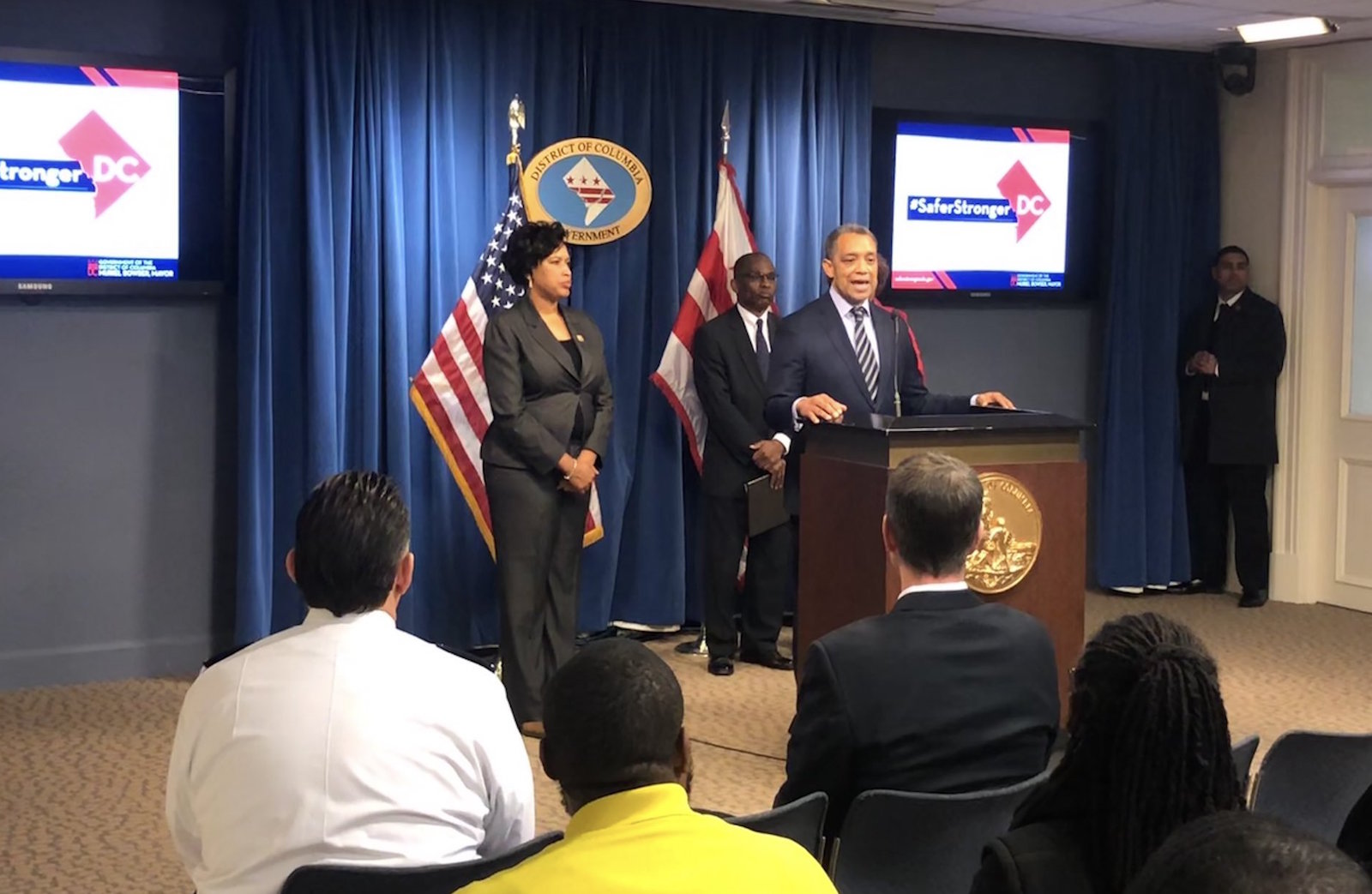
When DC Mayor Muriel Bowser, Deputy Mayor for Public Safety and Justice Kevin Donahue, and Attorney General Karl Racine announced earlier this month that they intended to treat the rise in community violence as a public health crisis, I was thrilled. The U.S. Centers for Disease Control and Prevention has made this link for decades, urging government officials to develop appropriate strategies. It appeared DC leaders were finally getting with the program.

In the past several months, I have come to understand more acutely the intersection between violence and childhood trauma. Trauma-inducing experiences can range from abuse and neglect, bullying, parental abandonment or incarceration, to living in a home where there is chronic unemployment, palpable poverty, substance abuse or domestic violence.
Trauma in the District has reached a crisis level, with nearly 50 percent of children having suffered two or more adverse childhood experiences, according to the 2016 National Survey of Children’s Health. Adults are also exhibiting signs of unresolved trauma.
Advocates have pushed for proactive solutions. “We have to move upstream and begin to stop some of these problems,” said Judith Sandalow, executive director of the Children’s Law Center in DC.
The mayor’s approach is not necessarily the answer advocates sought. Actually, it is the same ineffective prophylactic used for years by DC officials: increase the number of police on the beat, elevate streetwise civilians to the status of wizards, drop a ton of money on job training, and ramp up tough talk.
Bowser and Racine decided to use $6 million from a utility industry merger agreement on violence prevention — $4 million on an employment training program and $2 million for those streetwise civilians. “We know that breaking cycles of violence requires more than just law enforcement,” Bowser said at the time of the announcement. “We must stay focused on how we connect more Washingtonians to good-paying jobs and careers, how we prevent violence before it happens, and how we expand opportunity so that every person in our city feels a strong sense of hope, purpose, and dignity.”
Racine said the money will help continue Cure the Streets violence interruption sites, currently in wards 5 and 8, through July 2020. He said the “pilot program” has produced “promising early results.”
The two of them may have won friends and muzzled critics with those actions. However, they essentially have applied a dime-store Band-Aid to a gaping wound.
Behind the statistics
The government’s own statistics accentuate the insufficiency of its plan. Donahue said last week before the DC Council’s Committee on the Judiciary and Public Safety that 500 people were shot in 2018 — a number relatively constant with previous years. However, “the fatality rate increased — from 16 percent in 2017 to 23 percent in 2018,” he said.
There have been “more multiple gunshot wounds, more gunshots to the head, more daytime shootings, and more close-range shootings. … We saw an increase in intentional lethality in many of last year’s homicides,” continued Donahue. “Shootings largely stemmed from petty arguments, retaliation from ongoing disputes, robberies turned violent, domestic assault, and access to illegal guns.”
The underlying cause for all of that may be trauma. Researchers have found that individuals who have experienced trauma often become hypervigilant. The chemicals in their brains trigger a fight, flight or freeze reaction, which can translate to becoming the aggressor in situations where they perceive themselves in danger once again.
The 2017 Youth Behavioral Risk Survey offered supporting evidence: among DC middle-schoolers, 16.2 percent of African-Americans, 18.5 percent of Hispanics, 6.1 percent of whites and 11.5 percent of Asians said they missed school one or more days before completing the form because they said they felt unsafe.
How did that fear materialize? In 2017, 26.7 percent of the survey’s middle school respondents said they had carried a weapon to school, an increase from 23.1 percent in 2015.
Middle-schoolers become high-schoolers. High-schoolers become adults. Unresolved trauma can only become deadlier.
Rising to the challenge
During a phone conversation with me after his council appearance, Donahue acknowledged the importance of trauma. He asserted, however, “that addressing the root cause [of violence] is not mutually exclusive to addressing the immediate problem.”
“The root causes are so deep, the solution can’t be stretched across one good program,” he continued, explaining that multiple agencies must come to the table to determine how “we connect with individuals who are at one end or the other of gun violence.” He also said it is important to “look at the data and [be] willing to live by the evidence.”
Donahue admitted that efforts are often in place for only a set period, and frequently haven’t been thought through. “Coming to a community center in a neighborhood is not enough. Programs must be embedded in agencies to give us some permanency.”
That all sounds good — except apparently there aren’t enough people to do the work, according to Donahue. That’s why the Office of Victim Services and Justice Grants (OVSJG) has begun developing a “pro bono” trauma services bank.
The OVSJG is a grant-making agency that covers a wide swath of programs, including those serving returning citizens, assisting victims of domestic violence and sexual assaults, and pursuing juvenile justice reforms. “The common thread we see is trauma — high levels of trauma,” said executive director Michelle Garcia, adding that her agency is making a “concerted effort” to determine what the city’s response should be.
While DC has a Department of Behavioral Health, Garcia said trauma is somewhat of a “specialization.” She said her agency has reached out to Give An Hour, a national nonprofit that connects volunteers and professionals with victims of tragedies, to help establish the pro bono bank. In return for receiving trauma-specific training, clinicians would donate services to individuals and families at no cost.
Give An Hour also is expected to help map existing programs to determine gaps in the delivery system mostly offered through local nonprofits. It also will conduct a citywide trauma assessment, said Garcia, who added that there is already some information on children but “no comparable data for adults.”
Garcia said the mapping and the assessment are expected to be completed by Sept. 30, and the training will be ongoing. However, “nothing has launched yet,” she said. “We’re just in the development stage.”
Donahue called the trauma bank a “creative first step,” adding that “we can’t get to what we want to do in a single year.” He’s right — especially since the Bowser administration has budgeted only $430,000 toward this particular effort in the current fiscal year.
If taking a public health approach to violence prevention is more than a slogan, DC officials should increase funding for this critical foundational project being developed by Garcia and her team. It has the greatest potential for making the District safer and stronger.
jonetta rose barras is a DC-based freelance writer and host of The Barras Report television show. She can be reached at thebarrasreport@gmail.com.
Comments are closed.