

Gordon Chaffin: Young professionals who moved here need to step up
Longtime local DC journalist Tom Sherwood has this motto: “Local Washington is only as good as the people active in it.” My experience as a local reporter in the DMV corroborates that statement on a daily basis.
Our region faces a governance challenge stemming from the fact that too few people actively participate in that local Washington. Without strong voices from young residents — many of whom live in rental housing and don’t commute by car — decisions are made on big issues like education, transportation and housing that hamper our ability to evolve. That evolution should include more affordable housing, more public services for young families, and high-quality public schools with the resources to welcome greater enrollment.

The decision Montgomery County is now considering — literally banning new housing — is exactly the opposite of what would encourage more transplants to stay in the area. The measure comes because MoCo Public Schools, one of the best districts in the country, is facing over-capacity enrollment. MoCo has a long history of decisions that favor older, retired, car-traveling and home-owning residents. This “we’re full” mentality opposing new, more, different is omnipresent in local government meetings throughout the DMV. It’s the dominant opinion of elected and appointed decision-makers. It’s the resonant message of the majority of residents who show up to public meetings, almost always beginning their remarks with the decades or generations they’ve lived in that community.
The reality is that the District and surrounding communities in Virginia and Maryland have high portions of transient residents. Sabrina Sussman, senior manager of public partnerships and policy at Zipcar, expressed it well on Tuesday’s Kojo Nnamdi Show on WAMU about car-sharing and other transportation choices: “You have two distinct population groups — one that is native and local and very consistent … [who make] the city what it is. The other is a very transient population that often comes in waves of two, four, seven, even 10 years that’s often willing to change up their transportation mode is looking for the next big thing.” (The first category, of course, includes any number of people who came to DC years ago and stayed put.)
Transplants moved here from far away, are generally unfamiliar with the civic structures that mold their neighborhoods, and may not have an interest in getting involved. Some — like myself, up until now — keep their voter registration in their home state. They may anticipate moving soon to a new city as their careers take them across the country or world. Their ignorance and apathy for local civics create a glaring blind spot that shapes the weird local politics of the DMV.
When I described Tom Sherwood in the first paragraph, I wanted to say “DC reporter,” but that’s not precise enough in this town. DC reporter can mean he covers one or more of the three branches of federal government. Even to locals, describing a public servant in relation to DC is insufficient — “Department of Transportation,” for instance, can mean DDOT or U.S. DOT. Outside the Beltway, few have a conception of Washington, DC, as a place where generations of full-time residents live.
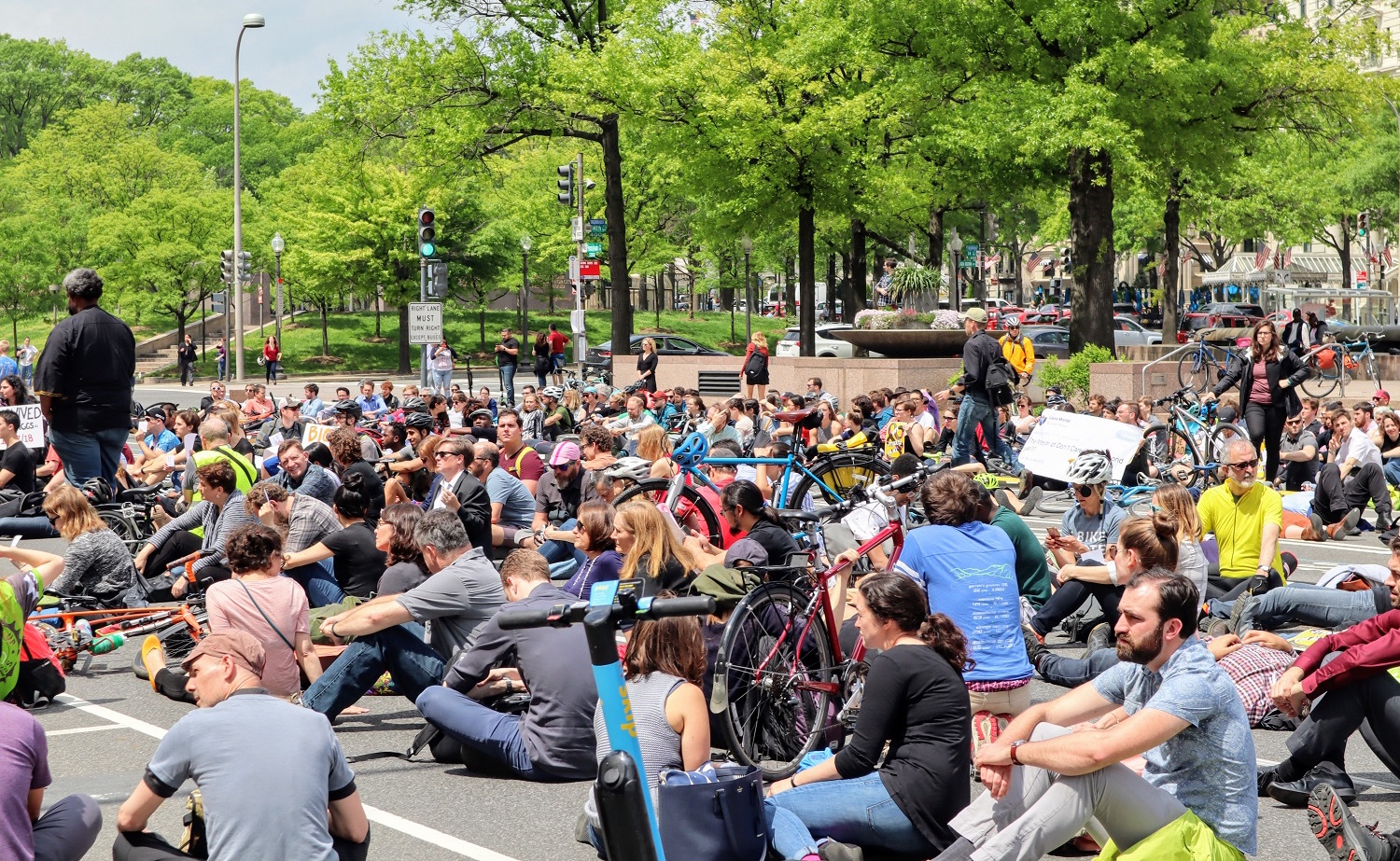
Most people here probably heard about #DontMuteDC or the death of road safety advocate Dave Salovesh. They’re in the top tier of local issues that’s able to penetrate the consciousness of DC transplant residents with regularity. Behind the scenes, local groups — ANCs (advisory neighborhood commissions), neighborhood associations and DC agencies are making calls on matters such as transportation and the use of public space.
Meanwhile — despite DC’s well-known lack of statehood — the DC Council functions similarly to a state legislature, with Mayor Muriel Bowser the equivalent of a governor. And though DC doesn’t have a vote on the floors of Congress, Del. Eleanor Holmes Norton votes in House committees and the Democratic Party’s conference. The members of DC shadow delegation — Sens. Michael Brown and Paul Struss and Rep. Franklin Garcia — also fight for local needs through their perch.
The organization of local governments in DC’s suburbs differs, but many share structures like neighborhood associations. Virginia and Maryland have county authorities while DC has its 40 ANCs, though the latter is wholly advisory.
Recent transplants to DC, please get involved. Find your local neighborhood association or ANC and go to its monthly meetings. These groups need your input if the DMV is to be considered a place worth staying past your current job or the current administration.
Another thing: Switch your voter registration to your current residence. That’s what I’m going to do — there’s too much at stake to forfeit our city council and mayoral votes.
Gordon Chaffin is a reporter for Street Justice, a daily email newsletter covering transportation and infrastructure throughout the Washington region.
Comments are closed.