


Gordon Chaffin: Mixed-use blocks like Monroe Street NE, not just commercial areas, need DDOT safety fixes
A problem common to many busy DC roads presents a pervasive danger in Brookland on the 600 and 700 blocks of Monroe Street NE: New or fairly new residential buildings attract multiple delivery vehicles and trucks per day, while retail spaces on the ground floor generate high volumes of ride-hailing cars. This kind of vehicle jam persists all day from steady vehicle arrivals, even though individual vehicles block bike lanes and no-parking zones only temporarily. That results in almost constant harm to street safety, with cyclists having to veer into car traffic and delivery vehicles making use of no-parking zones that were established precisely because vehicles parked there jeopardize public safety.
I live just off those 600 and 700 blocks of Monroe, and my advisory neighborhood commissioner — Nick Cheolas of ANC 5E01 — is active in working with DC agencies to make our streets safer. The road conflicts in this stretch have been going on since 2013, when Bozzuto finished the first Monroe Street Market buildings next to the Brookland-CUA Metrorail stop and opened several new retail and restaurant spaces, including a Busboys and Poets.
Here’s a series of recommendations the ANC and other local advocates should try pushing with the DC Department of Transportation (DDOT) to reconfigure Monroe in the high-activity area close to Catholic University — and a potential template that could prove effective in other troublesome areas across the city:
No-Parking Zones (shown in white on the map): The westernmost section of Monroe’s 600 block contains diagonally striped no-parking areas. However, they’re almost always filled by deliveries, idling passenger cars, ride-hailing pickups and even parked cars left unoccupied. They’re popular spaces to use for parking or standing because the legal parking spots nearby are often full.
In my Street Justice newsletter, I’ve reported that DC Department of Public Works enforcement personnel not only fail to enforce the no-parking zones but also encourage delivery vehicles to use the prohibited spaces. The drivers will never be cited for that civil infraction “just as long as they’re in-and-out,” according to one FedEx worker with whom I spoke. Because Monroe curves as it comes off Michigan Avenue, larger vehicles in no-parking zones along the turn radius almost always block the bike lanes. Occasionally, the backsides of large delivery trucks jut out into the lane cars are using to get around that corner.
In order for the city to enforce no-parking zones on the 600 and 700 blocks of Monroe, I recommend DDOT close off these no-parking zones with flexible white bollards.
Bike Lane Protection (shown in red): Once the popular no-parking zones are closed off, I predict deliveries and ride-hailing vehicles will use the adjacent bike lanes to park even more often than they already do, as depicted in a photo I took earlier this month. To prevent that illegal and unsafe behavior, I recommend DDOT use flexible bollards to protect the north and south bike lanes in the approaches to intersections with Michigan Avenue, 7th Street and 8th Street NE.
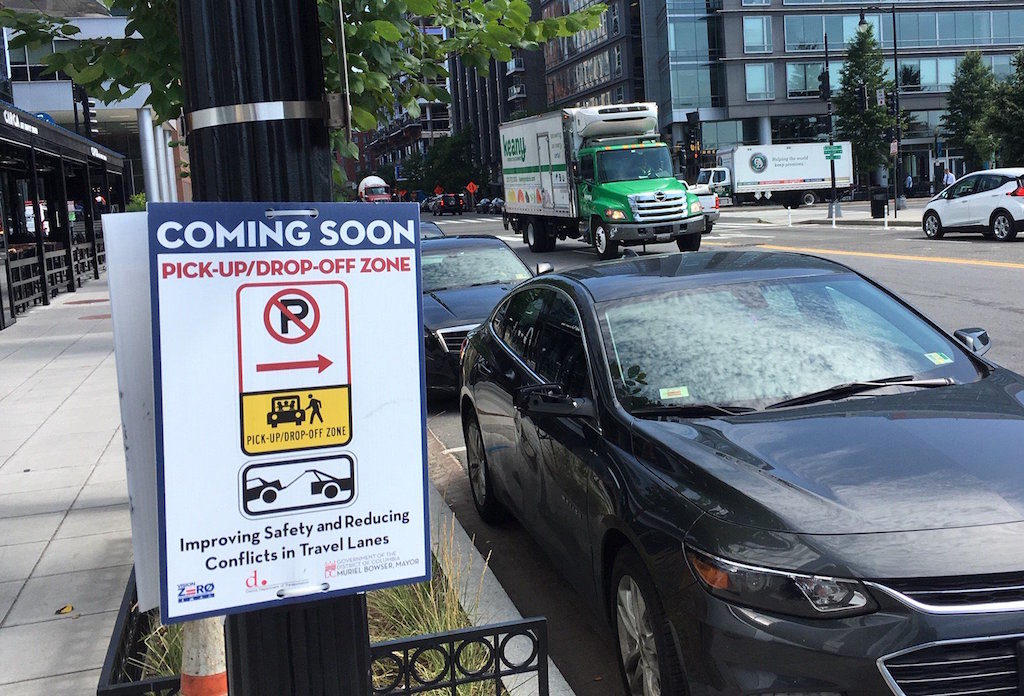
Pick-Up/Drop-Off (PUDO) Zones (shown in green): How’s My Driving, the crowdsourced app, has demonstrated that most safety conflicts with parking and bike lanes occur in corridors with high commercial and retail activity. DDOT is about to expand its pilot with PUDO zones, which essentially create taxi stands and short-term parking spots allocated to deliveries of packages, mail and commercial goods. DDOT’s 2018 batch of PUDO zones was primarily nightlife-related, such as Connecticut Avenue NW south of Dupont Circle. The new, 2019 batch of PUDO zones consists of nine problem spots where commercial deliveries block bike lanes almost constantly. That includes the 1200 block of 1st Street SE, a thriving block with brand-new residences, restaurants and offices near Nationals Park.
DDOT is introducing data-driven regulatory technology with 2019’s PUDO zones. The agency partnered with curb data management company curbFlow. The idea is that your Uber will automatically drop you off in that PUDO spot, even if you entered an address up the block, and your Lyft will pick you up there even if you’re a few hundred meters down the street.
I suspect few people know these blocks of Monroe are just as commercially active as the well-known spots in better-known neighborhoods. That activity corresponds to high ride-hailing traffic, short double-parking stops by private cars, and frequent truck deliveries. PUDO zones reduce the dangers caused by those road uses.
To mitigate these delivery conflicts and squelch harm from misuse of the bike lanes, I recommend DDOT take several parking spots in the 600 and 700 blocks of Monroe to create PUDO zones. This is also prudent given the future residential units under construction on the 700 block.
Turn Hardening (shown in yellow): This section of Monroe Street features high pedestrian traffic due to adjacent Catholic University, the Brookland Metro station, and existing retail — and it will only get busier with Bozzuto’s 2020 completion of Monroe Street Market’s fourth and final building, which will hopefully include a midsize grocery store. Meanwhile, a good deal of car traffic turns from Michigan Avenue onto Monroe — right where students and residents are walking.
To make pedestrians safer on Monroe, I recommend DDOT install the yellow “turn hardening” facilities they’ve placed at dozens of other intersections in DC. These semi-flexible plastic bollard structures force turning drivers to queue up and/or complete their turns in sharper angles. Drivers also have to slow down more at intersections, needing to complete a turn closer to 90 degrees. The greatest dangers come from motorists cutting their turns into shallower angles, endangering pedestrians on the parallel sidewalks.
X-Factor — Changes Coming to 700 block: The south side of Monroe’s 700 block is currently torn up as Bozzuto constructs its mixed-use residential building. The ground floor of that building has a large retail space and will probably need a PUDO zone with refreshed curbside design. Amid the disruption from the Bozzuto project, DDOT implemented a temporary lane shift on Monroe as it completes a reconstructed bridge over the Metro/CSX tracks.
Because those two projects won’t be complete until mid-2020 at the earliest, I recommend DDOT proceed now to install safety measures on the 600 block of Monroe and the north side of Monroe’s 700 block. At a later date — in conjunction with the completion of the bridge and the new residential building — DDOT should add similar PUDO, turn-hardening and protected bike lane designs to the south side of the 700 block.
I urge ANC 5E and the Brookland Neighborhood Civic Association to advocate for these safety improvements. These are low-cost facilities and should be completable in 2019. My neighbors and I deserve a safer street — and DC residents and visitors to benefit from lessons learned from the current situation on Monroe Street NE. Unlike most of the existing PUDOs, it’s not purely commercial, but there’s more than enough curbside conflict to create hazardous conditions. New designs, however, can mitigate these easily avoidable dangers.
Gordon Chaffin is a reporter for Street Justice, a daily email newsletter covering transportation and infrastructure throughout the Washington region.
Comments are closed.