

Gordon Chaffin: DC should abolish advisory neighborhood commissions or give them a lot more support
Right now, a large portion of DC’s elected officials are considering whether they should run for another term in office. Members of the District’s 40 advisory neighborhood commissions (ANCs) are discussing with loved ones the unpaid time investment, the public scrutiny, and the limited power they hold. For far too many, the community service they’ve delivered will have exhausted their passion and decayed their well-being. Some will call it quits in December when the current term expires — even if it’s their first two-year stint.

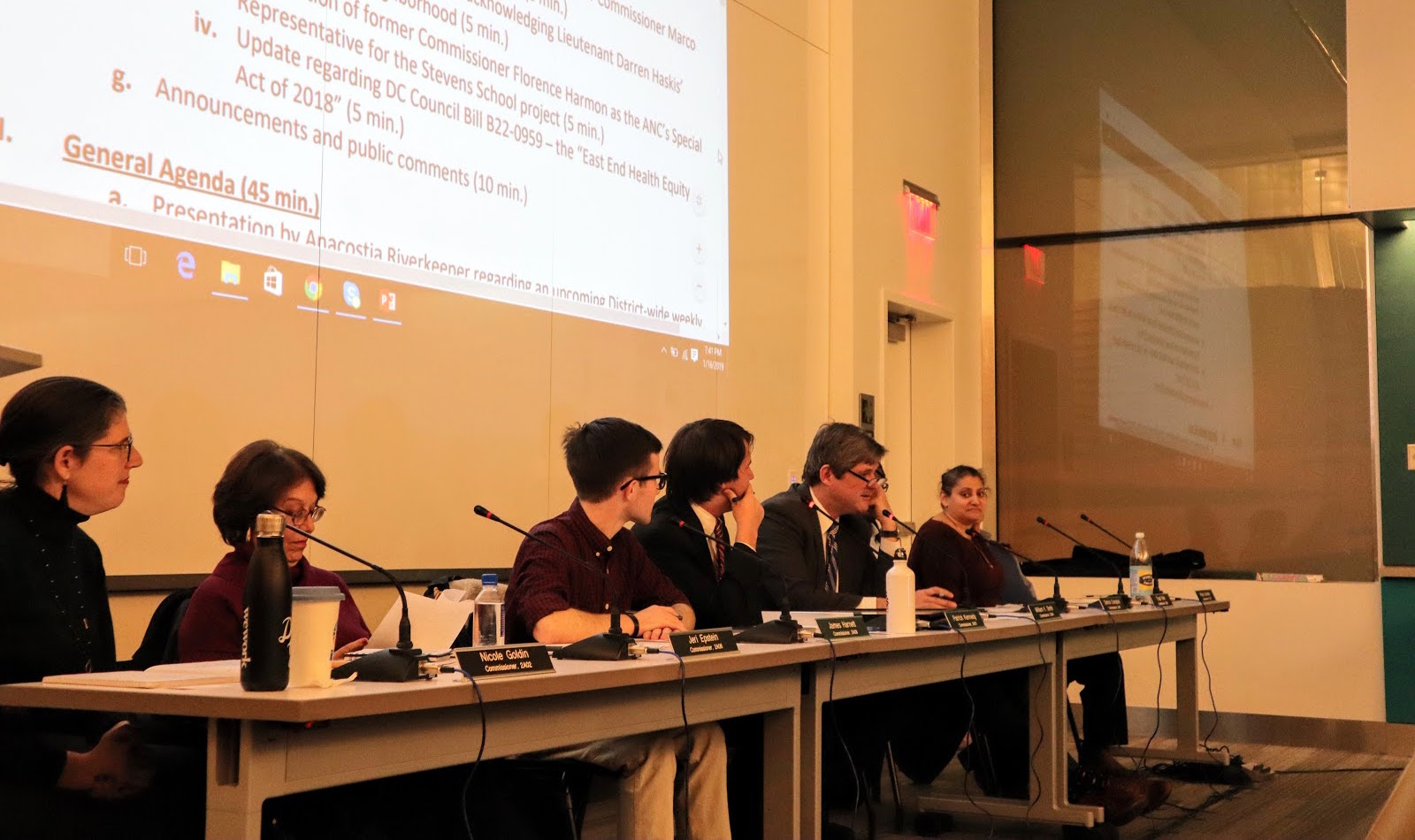
In my role as a local journalist, I cover several ANC meetings per week. I started my local news organization to do nuts-and-bolts reporting: covering local government meetings. The DC area has a lot of those and ANCs may be the best-known of them. Unfortunately, I’ve seen firsthand how inadequate support from DC’s Office of Advisory Neighborhood Commissions hampers the ability of ANCs to deliver on fundamentals like transparency and access. I see how vague and largely informal rules of deference give ANCs a confusing mandate for democratic representation: Nobody involved is quite sure how seriously to take resolutions passed and stern letters sent. “Great weight” given to ANCs can mean a great deal or very little depending on the whims of the DC Council or mayoral or independent agencies. That’s despite judicial guidance that sets the threshold as acknowledging and responding to specific points raised by ANCs — a standard that in practice leaves a lot up in the air.
I believe advisory neighborhood commissioners are set up to fail, and I’m calling on DC’s leaders to enact major reforms. In order to better represent the neighborhood-level concerns across the fast-growing District, DC should revise its legislative government structure to give ANCs much more formal power and resources — or abolish ANCs entirely and expand the DC Council as a unicameral legislature.
Last year, at-large Council member Robert White — whose committee oversees the ANCs — held four field hearings seeking testimony from the public and ANC commissioners, past and present. Many frustrations were tied to current events: ANCs have struggled to absorb the size and complexity of DC’s Comprehensive Plan, which includes three volumes, and several policy maps. To weigh in, ANCs needed to formulate suggested amendments and to pass consensus, non-binding comments during public meetings, and forward them to the DC Office of Planning. At the hearing, commissioners also communicated to White their struggles with the understaffed Office of ANCs, which — with just four full-time employees — is only able to provide minimal technical and administrative assistance to the 40 commissions.
It’s my job to know what’s going on in as many of those 40 ANCs as possible, and it is currently impossible to do so unless I show up in person to every meeting. Several ANCs with websites have let their registrations lapse in the past year — one day, there’s a confusing, minimally helpful website; then the next day, it’s gone. Few of the ANCs east of the Anacostia River even have online resources aside from the bare-bones listings maintained by the Office of ANCs. The ANCs in wards 1, 2, 3 and 6, in contrast, all have sufficient websites — 1B, 2A, 3B and 6B have four of the best. There’s little to no consistency, however, in what is posted and how it’s presented. And even the workable ones have outdated information — as I’m writing this, ANC 2E’s home page has Jack Evans still in office as the Ward 2 council member; ANC 4A hasn’t posted new minutes since December 2017.
Few ANCs record high-quality video or audio of their proceedings, and if they do, it’s rarely uploaded to their websites. ANC 6E uses a cheap camcorder, then uploads the video to an unaffiliated YouTube account in several segments with confusing titles. Some ANC meetings are livestreamed, but that’s often the result of an engaged citizen using their phone and a cheap tripod, logging onto DC Public Library WiFi, and sending video to a closed platform like Facebook. I produce high-quality livestreams on YouTube for ANC 1C, but the Adams Morgan commission is a rare case.
Financial issues are also extremely common for ANCs. I reported last year that Cleveland Park’s ANC lost $25,000 in a check fraud scheme and did little to get it back. That’s an atypical example, but all 40 commissions have to run their own finances and the treasurer isn’t necessarily someone with financial expertise. The DC government distributes funds to each ANC on a quarterly basis, but those allocations are delayed or halted when commissions exhibit financial irresponsibility as judged by the Office of ANCs.
In sum, ANC financial stewardship requires fiduciary vigilance every term from unpaid non-experts. In many cases this term, the current commissions are having to clean up the mess left by their predecessors. A surprisingly high number of ANCs — I’d estimate around half — don’t offer community benefit grants and therefore develop five- or six-figure account balances. For context, ANCs rarely spend more than five figures annually for their entire operations, which may or may not include a part-time staffer. ANC 5D, which represents Union Market and Trinidad, just put out a call for grant applications after their predecessors amassed a huge surplus.
After a year of intensive reporting on ANCs, I’m struck that new commissioners have to reinvent the wheel every single term. The staff of four at the Office of ANCs simply doesn’t have the bandwidth to provide centralized resources or procurement for vendor services like A/V. So, commissioners have to figure out finances, communications and public outreach, and acquire enough topic knowledge to manage neighborhood input on a multitude of issues. The city’s almost 300 commissioners are asked to weigh in monthly on wide-ranging topics such as housing, transportation, liquor licenses, public safety and public health. By the time any given set of commissioners has hit their stride, it’s election time again.
It’s clear to me that DC should expand the Office of ANCs to five or 10 times its current size. Day-to-day administration like booking meeting rooms should be taken care of by full-time staff. An expanded Office of ANCs should lead and manage vendor services for website design, maintenance and open government cornerstones like livestreaming. I also believe ANC commissioners should be paid a stipend commensurate with their five- to 15-hour-per-week time investment — a sum at least the rate of DC’s minimum wage.
While this would enable more people to serve in the role, I recognize that it would create a barrier for others. Commissioners are now clear of many conflicts of interest because their service is unpaid, voluntary, and not considered employment. Compensating ANC commissioners may make them part-time or contract employees, blocking some people from holding the position. Many commissioners serve in federal and DC government jobs that forbid outside employment, and the current system allows their service as volunteers. Many private-sector jobs also come with conditions or prohibition on outside employment.
But the benefit of greater ANC resources and professionalizing commissioner roles far outweighs this cost: Newly elected commissioners could spend their time considering issues, speaking to neighbors, and raising awareness about local government among transient and disadvantaged residents. This should be a substantial part of their responsibilities, yet many ANC members are bogged down with administrative matters. What’s more, they don’t receive any door-knocker cards or other ready-made materials for internet or in-person outreach. Without stipends, many commissioners I’ve spoken with do minimal outreach and focus only on what’s been done in the past: posting notices on neighborhood email lists and maybe on social media accounts.
Another important reason to give the Office of ANCs more staff and beef up its support structure for commissioners is to fix its terrible Freedom of Information Act request procedures. The FOIA process in DC isn’t ideal, but most of it is handled through a portal where the public can submit requests, get updates, and eventually receive documents. In contrast, FOIAs to ANCs are simply emailed to the Office of ANCs executive director, Gottlieb Simon, and the relevant ANC chair.
In the last 12 months, I have filed nine FOIA requests to ANCs. So far, I’ve received only one substantive response. For a few others, I received confirmation of the request followed by radio silence. In other instances, I’ve won administrative appeals after initial rejections — only to receive nothing more. In most cases, I never heard anything from anyone. According to my conversations with present and former commissioners, the FOIA response process depends entirely on the commission. Mr. Simon is almost universally well-liked by commissioners, so I blame his office’s dereliction of duty on way too much work for too few people. The Office of ANCs is the official point of contact, but the way each of the 40 ANCs handles FOIA response internally depends on its chair. In my experience, ANC chairs sometimes ignore requests or misrepresent how thoroughly their commissions have searched for documents.
A further concern is that the ANC status quo yields an unrepresentative, unfair mix of unpaid public servants advocating in an environment where the best people don’t last long and a permanent class of financially privileged, retired and home-owning volunteers skew civic decisions in a fast-changing “superstar city.” In January 2019, a recently elected Ward 5 commissioner shared a generalization about the two types of commissioners they observed: the good ones who skew young and burn out quickly or have family or professional responsibilities that arise; and the retirees or part-time workers who skew older, amass experience, and do much less work — including some who consider themselves the main arbiter of what their neighborhood wants and resist calls to open up proceedings and canvass new residents. There are exceptions to this dichotomy; ANC 1C’s Ted Guthrie comes to mind as an older, vigorous public servant. According to my conversations with younger Ward 7 and 8 commissioners, however, most of their more senior colleagues don’t want websites, video recordings or livestreams.
If DC isn’t willing to make ANCs a best-practice body of hyperlocal public governance, then the city should get rid of them completely while expanding the DC Council from 13 legislators to approximately 50, with 40 to 45 of the council members elected to represent districts similar to the average size of today’s ANCs. By law, individual single-member districts — the building blocks of the ANCs — must each consist of approximately 2,000 people; meanwhile, the commissions vary in size from two to 11. There are at least 705,000 residents in DC, so creating 40 districts (the current number of ANCs) would mean approximately 17,625 people in each council district, with the geographic size of each depending on population density.
The other council members, approximately 10% of the legislature, should be elected at-large to represent the whole District.
I’m ambivalent about the exact number of council seats, beyond there being approximately as many geographically based legislators as there are present-day ANCs. That’s because I’m focused on pushing a lot of neighborhood-level decision-making from multi-member commissions to single-member council seats, with decisions and actions subject to a vote of the full council or perhaps a geographic caucus. Yes, it’s a double-edged sword, as one district could elect an incompetent buffoon and lose out on better-handled public input for transportation, development and other decisions. But that’s often the case today. Several high-quality ANC commissioners are often overruled or outvoted by parochial and unprofessional colleagues.
A benefit of raising decision-making up is to enable the stretched-thin journalistic and community stakeholder resources to do a better job than they can within the current framework. It would be much easier for local news organizations and nonprofit advocacy groups to cover issues if the debates on key projects all happened at the John A. Wilson Building, not in high school gyms and library meeting rooms across DC on successive nights or even simultaneously.
During this term, ANC 2B09 commissioner Ed Hanlon has — via FOIA requests, campaign finance complaints and public online rants — destroyed the working relationship of his Dupont Circle commission. ANC 7D lost its chair, Sherice Muhammad, who was exhausted from enduring months-long battles with an inept treasurer. Muhammad also resigned from her ANC seat, leaving 7D with only five participating members on a seven-seat body.
Sad to say, ANC commissions rarely work well under the current system; the exceptions tend to be in the more financially successful areas of the city. Even when they do work effectively, it only takes a few resignations or burnt-out commissioners to set them on a course to financial and operational delinquency. The DC Council and Mayor Muriel Bowser need to do something. I’m open to other ideas. But the District needs to go big in one direction or the other: really support ANCs or get rid of them and expand the DC Council with neighborhood-level representation.
This post has been updated to add a link to tweets by Jon Steingart regarding court precedent on the issue of great weight.
Gordon Chaffin is a reporter for Street Justice, a news organization covering transportation and infrastructure throughout the Washington region, especially in less privileged, rapidly changing neighborhoods. Street Justice produces a free, weekly digest on Sundays and publishes daily reports for subscribers that include a story, a calendar of local public meetings, and a list of projects open for public comment. To submit a pledge for a subscription, click here.
Of course they don’t want to serve because of scrutiny from people like you, Gordon. There is a public YouTube video of you berating an ANC commissioner because she doesn’t share your view. You then proceed to start yelling names at her to ask if she has met with any of the people. That is not professional conduct and certainly not journalism.