

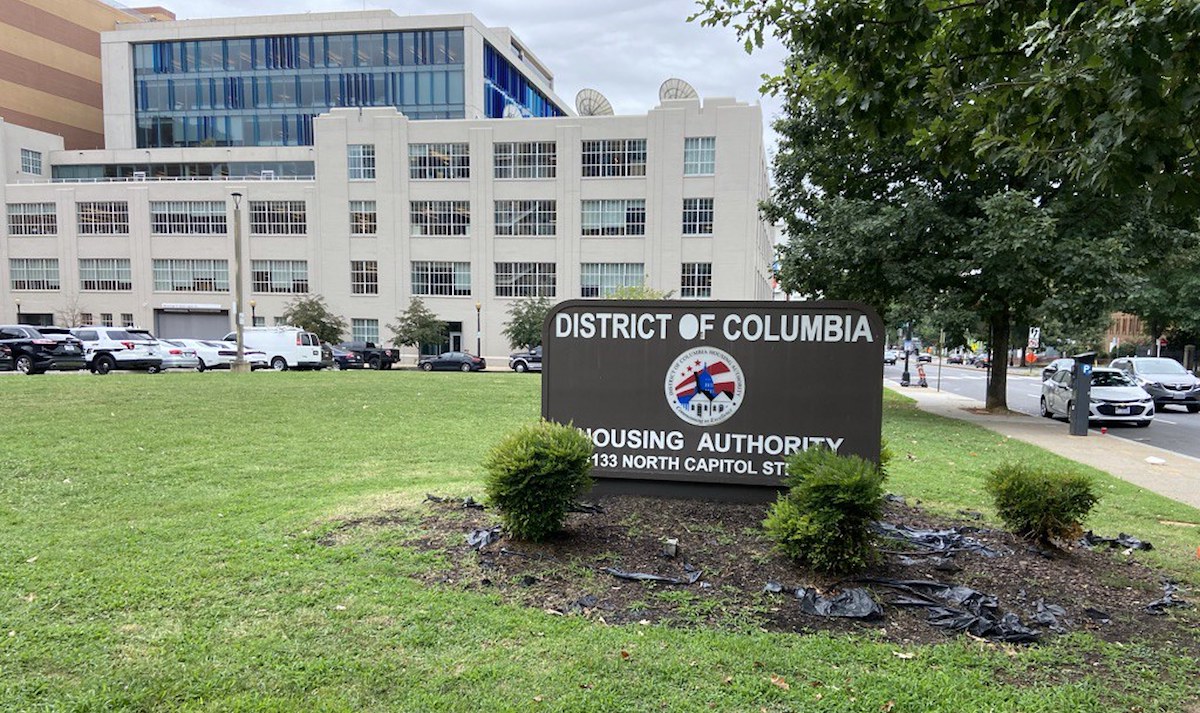
jonetta rose barras: Inside DC’s public housing hysteria
A fever broke out across the District earlier this week. It was unrelated to COVID-19 or any of its associated variants; it seemed to have affected some public housing leaders, their advocates and so-called progressive political operatives.
The fevered deliriously characterized a plan by Mayor Muriel Bowser and DC Council Chair Phil Mendelson that would reduce the size of the existing governing board of the DC Housing Authority (DCHA) as a “power grab” or a “takeover.” One member of the DCHA citywide advisory board described the effort as a “gangster move.”
What does that mean?
It’s not a power grab since the mayor already has the authority by law to appoint a majority of the DCHA Board of Commissioners. It’s not a takeover; the duties of the board aren’t changing under the Bowser-Mendelson legislation.
In my view, however, some kind of takeover is what the current situation demands.
The District should consider not just a smaller, streamlined version of the 13-member Board of Commissioners but a wholesale restructuring, including at least a temporary enhancement of its authority over the agency’s director and senior staff. Equally important, the council should ramp up its oversight of DCHA, beginning in January with the creation of a subcommittee on public housing.
I am less than sanguine about the adoption of my suggestions by the council, despite the fact that inside the palpable hysteria of the past week, there seem to be seeds of agreement on all sides.
Everyone has agreed that DCHA’s existing governing body is wholly dysfunctional, even if they disagree as to why. That is also how they have described the agency. And, though few people involved in the fight mentioned it during dizzying rounds of emails, tweets, retweets, dangerous doses of hyperbole and spoon-fed misinformation, there appears to have been consensus that public housing residents and housing voucher holders have not been well served by the tragic mess revealed in an assessment conducted by officials from the U.S. Department of Housing and Urban Development (HUD).
“I don’t know anybody who says that that board is working well,” Mendelson said Tuesday night during the council’s marathon legislative session. “Members of the board complain that it is dysfunctional. The advocates who are upset with the mayor’s proposal say that the current board is dysfunctional. Of course, the mayor in proposing this control board-like change is saying it is dysfunctional. A lot of council members are saying it is dysfunctional
“In fact, several weeks ago, it was my distinct impression that because of how difficult that board is, not only is the housing authority not being governed, but the executive director is frustrated to [the point that] I had the impression that she might want to quit,” Mendelson continued.
“But the interesting thing is that, even though everybody agrees that the board is dysfunctional, there is a lot of opposition to replacing it,” he added.
Noting that not every council member was present, Mendelson weighed the fate of the DCHA Stabilization and Reform Emergency Amendment Act of 2022. He decided to delay the vote until the council’s next legislative meeting, which is scheduled for Dec. 20.
“Time is not on our side to just wait and not do something now,” Mendelson told the legislators who were either in the council chamber at the John A. Wilson Building or attending the meeting virtually. “If we don’t replace [the current board], we are left with the status quo.”
That should be unacceptable. Advocates, public housing residents and elected officials can’t allow their mutual distrust or relational fatigue to dissuade them from working together to effect solid and measurable change at DCHA and on its properties. They also can’t afford the luxury of political one-upmanship or the gloating that frequently comes with such behavior.
HUD seems to be serious about its demand for improvements. Consider that in October, soon after its assessment became public, Bowser met with HUD Secretary Marcia Fudge. DCHA has since sent a written response to that federal report. The mayor followed with a letter of her own.
Mendelson indicated that more than two weeks ago, the mayor met with him and at-large Council member Anita Bonds, chair of the legislature’s committee on housing. They talked about a restructured board then, Mendelson said during a news briefing Monday.
Once upon a time, when Marion Barry was mayor, the District was under six court orders or receiverships, affecting nearly every human services agency or commission. Last year, Bowser’s administration negotiated the end of a 32-year lawsuit that involved a court-appointed monitor for the DC Child and Family Services Agency. CFSA — once headed by Brenda Donald, the current DCHA executive director — continues to be severely broken. But it’s safe to assume that neither Donald nor Bowser wants part of their legacy to be a federal takeover under their watch.
That may happen if District leaders don’t get their act together.
Initially, the mania that came over the District was mostly about the insufficient number of public housing residents proposed for the new oversight board. That matter was expected to be cured with an amendment proposed by At-large Council member Robert White — to which Mendelson had agreed — that would have added a housing voucher holder to the mix. Then, to ensure all bases were covered, proponents of the measure included the head of the DC Interagency Council on Homelessness as well. That meant expanding the number of voting members on the new Stabilization and Reform Board from seven to nine.
Problem solved, right?
Having won a few concessions, opponents then focused on retaining Bill Slover, an outspoken critic of DCHA’s leadership. While not a lawyer, he was reappointed to the board in 2015 by the Consortium of Legal Services Providers; he has been a reliable flamethrower, an inside connection for advocates and a prime source for the press. Some credit him with helping to initiate the HUD assessment.
Slover’s professional profile has raised some questions about his motivations. He is, after all, a commercial real estate developer.
Isn’t his type considered a pariah among progressive advocates? Didn’t they express concerns about developers taking over the DCHA board?
Interestingly, as a former member of The Robert Bobb Group, Slover has some experience in government takeovers. In 2009, Michigan Gov. Jennifer Granholm brought in Bobb, a former DC city administrator, to serve as the “emergency manager” for the Detroit public schools. That was a state takeover. Slover was hired as the “chief real estate consultant.”
In other words, Slover knows something about takeovers. And he knows that they are sometimes critical to actually turning around an agency or an entire government.
In my youth when I had a fever and was given to speaking foolishness, talking out of my head, my mother, great-grandmother or some adult in my home would suggest that I take my medicine and quiet myself. Depending on their diagnosis of my illness, I might be ladled with that bitter-tasting “three 6s” or castor oil. Sometimes there was cod liver oil that was a preventative, not necessarily a curative.
Unfortunately, the adults at the council caved, postponing their prescription. Mendelson admonished his colleagues against waiting, then suggested they wait — for two weeks. Will that produce the outcome he seeks?
The mayor appears intent on constituting a fresh board. “The Administration believes the board needs a reset to better serve its residents and the agency’s mission,” a Bowser spokesperson said in a statement sent to me on Thursday.
Council member Robert White said the delay, while costly, could be helpful. “I believe any delay in fixing the board is a delay that costs us valuable time in avoiding a federal receivership and, importantly, fixing the agency.
“However, I also know the value of public input, especially public housing residents, in guiding our reforms,” he continued in an email statement sent to me through his communications director. “The board is only one piece of the puzzle, but it’s a key piece in beginning the wholesale change DCHA needs in culture and leadership.
“I believe we will get something passed in two weeks. Federal law gives the mayor power to control the board, so we must work with her to get this done,” White added.
The two weeks might also give White’s colleagues and the mayor time to reflect on the efficacy of the DCHA prescription. What is the value of a new board without a fundamental change to its mission and mandate?
I have thought over the past several days about the public’s reaction to the congressionally mandated financial control board in the mid-1990s. I was no fan, especially because the authorizing legislation stripped the city of its annual payment from Congress and appended the city’s judicial branch to the federal government. It didn’t help that the board’s initial chair flaunted an intolerable imperial and impervious manner.
I had, however, covered the administration of Mayor Sharon Pratt and knew without a doubt she was mismanaging the government in such extraordinary ways that the city was on its way to ruin. The council, thinking it needed to support her, added a fifth quarter of revenue to a fiscal year at her request.
By the time Barry returned to the mayoral suite, the District had already hit bottom. It needed a rescue. Hence, the control board. As I’ve said, the five-member panel was not perfect. And, while I came to greatly admire Anthony Williams as the city’s first independent CFO and later as its mayor, there were many times we disagreed.
However, that board’s policies and programs — along with Williams’ mayoral administration — put DC on a success flight that lasted 20 years.
The DC Housing Authority is at that place where the District was. An ordinary Board of Commissioners is insufficient — and so is the Stabilization and Reform Board envisioned in the emergency legislation.
There needs to be a small, nimble innovative control board consisting of housing, property management and financing experts. They wouldn’t need training. They would know the city, understand public housing and unapologetically get to the business of reforming the agency. Donald could serve as that board’s director through the end of her current contract, but its members would be the ones designing and overseeing DCHA’s transformation.
The council ought to complement that panel by establishing a subcommittee on public housing, focused on DCHA as well as the voucher program inside the Department of Human Services. Part of the reason public housing has been failing its mission for a decade is that the council hasn’t provided robust and muscular oversight, even as it has allotted more DC taxpayers’ money to the agency’s operation.
The subcommittee could be placed under the Committee of the Whole. It would be required to conduct regular public hearings and other forums to ensure all residents are informed about what changes are underway at DCHA, while also measuring the impact of those changes.
When I suggested the creation of a subcommittee during Mendelson’s press briefing earlier this week, he said only that he would “give that thought.” I don’t know what he will do. Hopefully he won’t leave oversight of DCHA under Bonds’ purview and responsibility for vouchers split between two committees.
What I do know is that Mendelson and Bowser were reelected by District residents as their political and governmental leaders. They can’t sit around waiting for their most vulnerable constituents to become victims of circumstance and chance.
Leaders are expected to lead.
jonetta rose barras is an author and freelance journalist, covering national and local issues including politics, childhood trauma, public education, economic development and urban public policies. She can be reached at thebarrasreport@gmail.com.
Comments are closed.