

jonetta rose barras: Protecting neighborhood commercial corridors
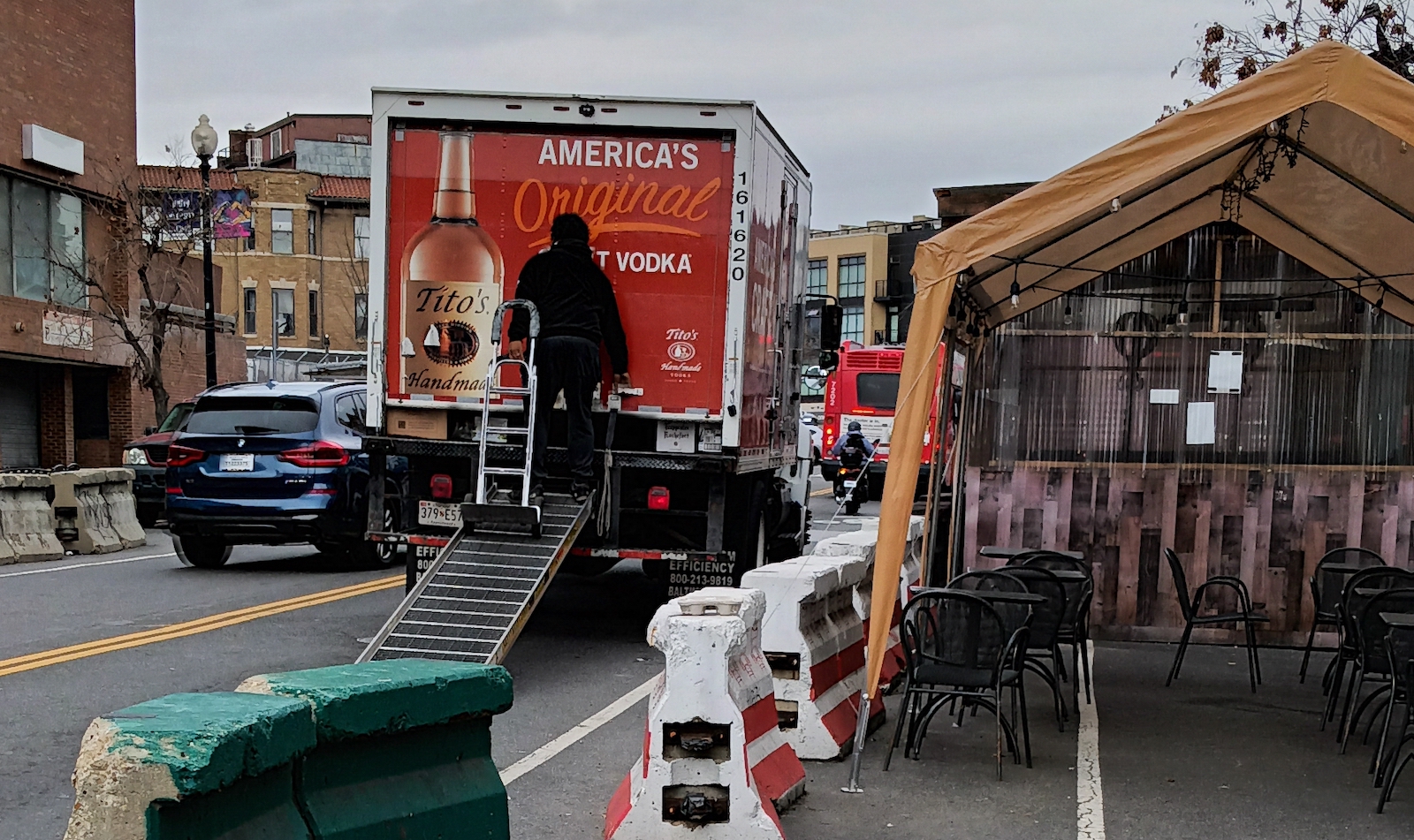
The disjointed mishmash of architecturally inferior structures mostly resembles a collection of shanties rather than outdoor cafes. There are concrete barriers and bollards that further distort Adams Morgan’s 18th Street NW commercial corridor, making parts of it evoke a bunkered war zone.
Unsurprisingly, large numbers of storefronts and restaurants are vacant. One business owner calculated the commercial corridor may have a vacancy rate of somewhere between 30% and 35%.
And then there is the crime: In the past several weeks, more than a half-dozen businesses have been the target of brazen daytime robberies and vandalism — windows broken, merchandise stolen before disbelieving owners, employees and customers.
“It’s not random. And we don’t believe these are young kids. They are targeting individual shops. We do believe it’s some of the same people,” Metropolitan Police Department (MPD) Third District Cmdr. James Boteler Jr. told me earlier this week during a telephone interview.
“There is the feeling that Adams Morgan is under attack. But crime is down in all areas except robberies and burglaries,” he said.
“There have been four armed robberies and eight commercial burglaries,” continued Boteler, adding that the perpetrators “seem to be doing their homework. They are probably scouting out” the businesses. In one case the criminal actually “fixed a drink and then took a drink [from the glass while] looking into the camera.”
That kind of behavior is compounded by what police and others characterize as an open-air drug market in Unity Park near Columbia Road and Euclid Street NW. There are also illegal marijuana shops that flagrantly flout local laws; the Capital Community News has reported a plausible connection between their arrival and the increase of criminal activity.
Boteler said the drug activity in Unity Park is caused mostly by people who are “dependent on narcotics” and resolving the issue has “a lot to do with DHS [the Department of Human Services] and DBH [the Department of Behavioral Health] getting them some place to go.
“The U.S. attorney is not going to prosecute low-level drug cases,” Boteler added.
Not unlike residents, he expressed concerns around the marijuana shops that are “trying to get around regulations. It’s illegal what they are doing.”
So why aren’t they being arrested? Low-level or not?
“Why is this happening in Adams Morgan?” asked Matt Wexler, a developer. “It isn’t about money. The leadership has failed the Adams Morgan community. Period.”
While Mayor Muriel Bowser has repeatedly pledged to bring back downtown — which she called the proverbial golden-egg-laying goose, responsible for revenues that fuel public education, the social safety net and public works — there has been no similar promise for the bevy of neighborhood commercial corridors: Georgetown, Shaw or Adams Morgan, for example.
They are home to hundreds of small businesses and restaurants that also bring in much-needed revenue. What’s more, Bowser doesn’t have to hustle new residents for those corridors; they already have tens of thousands of nearby homeowners and renters, ready to spend their money.
Still, the city has done nothing more than offer grants or loans to businesses handicapped by the nearly three-year pandemic. That has proved insufficient to stem the steady exodus of many establishments.
Several months ago, Jose Sueiro, a longtime Adams Morgan resident and current president and CEO of the Metro DC Hispanic Contractors Association, counted 10 empty storefronts in a two-block stretch. He asserted during interviews with me and on the neighborhood listserv that the minuses are adding up.
“There is a correlation between having so many empty storefronts, the dirty street frontage and less people. And then there is that huge eyesore on the corner of 18th and Columbia Road,” he said. The latter point is a reference to the former SunTrust Bank building, which has been the focal point of a contentious legal battle between developers who want to construct more than 50 condos and activists who seem to prefer the status quo — an empty concrete space.
It’s a version of the broken windows theory. It’s quite clear that an uninviting environment — littered with trash and empty, boarded buildings covered with graffiti or otherwise poorly maintained — can reduce the number of people who might visit nearby businesses or who might be inclined to rent or purchase property.
Kristen Barden, executive director of the Adams Morgan Partnership Business Improvement District, didn’t seem concerned about the issues raised by Sueiro and others. She disputed the vacancy rate estimated by the business owner. She said it’s “closer to 5%.”
Is she spinning, deliberately understating the economic problems in one of DC’s most popular entertainment and tourist destinations?
“Most of the [vacant] properties are leased, but there have been huge delays in getting permits done,” she said. It took “six months for [one restaurant] to get a certificate of occupancy. They almost lost their chef.”
She complained that the BID had to wait months for the District Department of Transportation (DDOT) to approve a permit for the organization to make repairs to its community kiosk located at Columbia and Adams Mill roads NW. Barden said it took so long the Department of Buildings at one point withdrew the BID’s application, thinking it had decided not to move forward.
Barden said she intended to raise concerns about service delays and request a more collaborative approach at the council’s oversight hearing for DDOT. “We have some exciting concepts coming.”
Pat Patrick, an independent real estate agent who has worked with Adams Morgan property owners for 25 years and is a former member of the BID’s board of directors, echoed Barden’s optimism. “By April or May, we are going to have 15 new restaurants.
“But this issue of breaking windows has got to be nipped in the bud. It may be a small situation, but if it’s left unattended it can grow into something large,” said Patrick.
Ward 1 DC Council member Brianne Nadeau was equally bullish on the neighborhood. “Adams Morgan continues to be incredibly vibrant. We have a strong BID that is working with small businesses … [and we have] vibrant streateries and people are out and about.”
It’s OK for elected officials, business owners or their advocates to aggressively promote their communities, creating a narrow lens for people to view current affairs. However, it’s not OK to deliberately mislead the public about quality-of-life conditions. Such misguided actions can reduce or delay any critical, organized citizen response.
This much is clear: Adams Morgan needs help. Quick. Fast. In a hurry.
Who will residents trust to deliver it? Are there sufficient police officers to take back the neighborhood from the criminals?
There seems to be a mixed evaluation about the capabilities of the BID. It doesn’t help that in November the Office of the Attorney General started an investigation into whether the organization violated DC nonprofit laws. Where are things with that? “It is our general practice not to comment on investigative activity,” an OAG spokesperson told me.
“You would think given the sheer number of attacks the BID would be organizing a real listening session with the community,” another local business owner said.
Barden said she is not “worried” about the investigation. “We don’t think we’ve done anything wrong.” She said the organization operates on a small amount of money, with a two-person administrative staff and a marketing consultant. Most of its funds are used, she said, to pay a team of workers — three full-time and three part-time — to clean the streets.
The BID has only one “security ambassador.” With a tour of duty between noon and 8 p.m., that person can’t possibly provide significant service to businesses that are busiest late at night.
Nadeau said she and Barden went through the neighborhood earlier this week providing information about the DC government’s camera rebate program. “What it comes down to at the end of the day is police being on patrol,” said Nadeau.
A community discussion finally took place Thursday, nearly two weeks after the recent series of robberies and burglaries began. Nadeau, Botelier and Council Chair Phil Mendelson attended the session, held by the Kalorama Citizens Association as part of its monthly meeting.
Not everyone has confidence in Nadeau’s determination to solve the problems. People who have paid attention to the public safety debate in the city know that she has been on the side of fewer police officers and more so-called violence interrupters, although for this fiscal year she supported Bowser’s police budget. She sidestepped my question about whether she will push to increase the budget for MPD, especially since Chief Robert Contee has indicated that with only around 3,400 officers, the department is at its smallest size in decades. Nadeau said she would wait for a couple of independent reports, including one being prepared by the Office of the DC Auditor, which will analyze MPD’s staffing needs and deployment.
“It seems like with more than 3,000, we should be able to get foot patrols,” added Nadeau — except during the years when crime seemed to be under control, there were as many as 4,000 officers on duty.
MPD’s Third District is one of the largest in the city based on population. Boteler said because of personnel reductions he is limited to how many officers he can deploy on foot or bikes. “We have too many city blocks and not enough officers to cover them,” he added.
Improving the streetscape could improve the quality of life in the neighborhood, said Sueiro, while inspiring more businesses to locate along the corridor and pushing against criminals.
Patrick and other people with whom I spoke agreed: Remove the bollards from the street. “The roadway has to be clean and clear because people get confused,” said Sueiro. “It’s a streetscape issue.”
One more thing: Establish stricter regulations for the streateries. “We are in a post-pandemic era now,” he added.
My vote is for complete elimination. If the city wants to widen the sidewalks for more expansive outdoor cafes, it should do that instead of upgrading the shanties that consume the streets.
Barden said changes to the rules governing streateries are expected this spring. Businesses may also be required to pay for the space. Still, she worries that too many adjustments could upend the business model for some establishments that pivoted during the pandemic. One restaurant, for example, has converted entirely to takeout with only exterior seating, although pre-pandemic it offered indoor service. That restaurant may have to settle for a smaller outdoor space.
What may be of greater importance is the impact the streateries have on public safety in Adams Morgan, particularly on 18th Street NW, which is narrow enough that it can quickly become overwhelmed by delivery trucks and other vehicular traffic.
“Even the police cars [sometimes] have nowhere to park,” explained Boteler, adding that he isn’t advocating against streateries. “We need bright lights and a clear view from the street.”
All of that is good. But Wexler identified Adams Morgan’s greatest long-term need: leadership that is organized and working collaboratively to rebuild a much-beloved neighborhood. Today isn’t too soon.
jonetta rose barras is an author and freelance journalist, covering national and local issues including politics, childhood trauma, public education, economic development and urban public policies. She can be reached at thebarrasreport@gmail.com.
The political dynamics of Adams Morgan are simple: A vocal group opposes each and every thing that would make it more difficult for car owners who live there to find parking on the street. It drives the opposition to new housing, closing 18th street, streeteries, bus lanes, bike lanes, bike kiosks, or even the removal of street parking that makes things more dangerous for pedestrians.
These people may be angry about the crime but having closed businesses and empty lots is what they are hoping to achieve.
18th St. hardly evokes a war zone; those of us who live in Adams Morgan find it eclectic and cozy and the bollards are not a problem. If you were to talk to the business owners that have left, you would find that the reason for vacant storefronts is that business owners can’t afford the exhorbitent rents and rent increases, and some property owners are seemingly more interested in speculation or tax writeoffs than in actively looking for renters — some of those buildings have been vacant for over 10 years. A row of 3 businesses on 18th St. all closed around the same time a few years ago when the landlord raised the rent by 25% in one year.
As for the plaza at the corner of 18th and Columbia Rd., it is ridiculous and uninformed to claim that activists would rather have a concrete eyesore than thriving businesses there. The activists are fighting to enforce the public easement that has been on the property since the 1970s, when Perpetual Bank made an agreement to stop their racist mortgage policies and also to provide that plaza space for public use, including festivals and the farmer’s market. The plaza turned into an eye sore when Truist Bank, the new owners, decided to fence up the square; before they did so it had been used weekly for the farmer’s market, as well as for community events like cook-outs, remembrances of the Knickerbocker theater fire, and a forum on women’s activism in the neighborhood in the 1970s. The activists and many others in the neighborhood support the refreshing of the plaza that was proposed in the Office of Planning’s Envisioning Adams Morgan proposal, which was to have updated the plaza from its 1970s look. There are ore options than just, leave the plaza as it is, and build luxury condos on top of it.
Also the marijuana shop theory doesn’t hold water; the vast majority of those shops have been there since long before the current space of break-ins.
And as for policing, what we need is community policing, where police officers walk the same beat every day and get to know people in the neighborhood. The current drive-by style of policing is ineffective.