

jonetta rose barras: Nine at-large DC Council Democratic primary candidates fight to win a political lottery
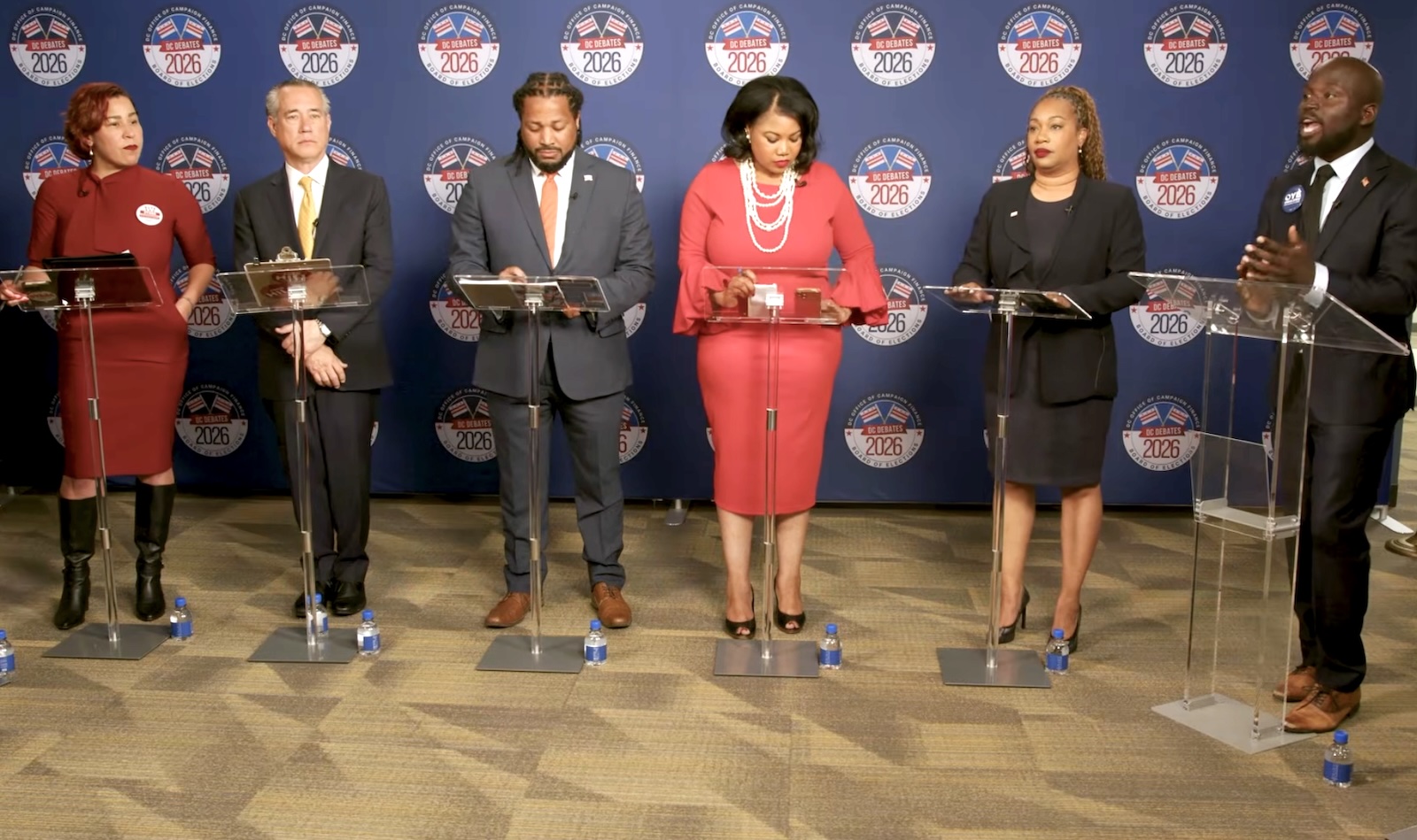
“While change is good, prepared leadership is better,” Kevin Chavous said as he introduced himself during the DC Office of Campaign Finance’s at-large primary debate late last month. He is one of nine Democrats hoping to hit the lottery and win the at-large nomination at stake in their party’s June 16 primary. If the past is prologue — which it usually is, even in a ranked choice voting world — who prevails in that election may well end up winning in the general election, making them one of at least two new members sitting on the DC Council come January.
When Anita Bonds, the longtime Democratic incumbent, announced in December her decision not to seek reelection, everyone and their uncle jumped into an already crowded race. The field only grew larger after Bonds endorsed Chavous, the former staff director of her Committee on Executive Administration and Labor.
Is Chavous a double legacy candidate?

Not only was he a Bonds staffer; his father, Kevin P. Chavous, was elected Ward 7 councilmember in 1992, unseating incumbent H.R. Crawford, a one-time assistant secretary of the U.S. Department of Housing and Urban Development. The elder Chavous aligned with “The Young Turks” — a group of councilmembers including Bill Lightfoot, Jack Evans and Harold Brazil — and went on to serve three terms on the council.
The younger Chavous’ political footprint hasn’t diminished the field of candidates, however. Dwight Davis, Fred Hill, Dyana Forester, Greg Jackson, Leniqua’dominique Jenkins, Candace Tiana Nelson, Oye Owolewa and Lisa Raymond are on the Democratic Party’s multi-page, 17-inch-long ballot.
“Leadership makes people feel seen, heard and valued,” said Nelson, who has her own legacy to tout: She was a former chief of staff to Ward 4 Councilmember Janeese Lewis George, a top mayoral candidate.
“I am prepared. I am principled,” added Nelson, in striking resemblance to Lewis George’s description of herself during another political forum.
Other candidates, particularly Jackson, stressed their dissatisfaction with the status quo and the parameters of political debate in DC.
“We need less talk and more action,” asserted Jackson, who described himself as a victim of violent crime in DC who fully recovered from his injuries only after six surgeries. Among other things, he advocated for the creation of more jobs and an increased focus on helping “students thrive.”
Primary and special election ballots began arriving at the homes of DC voters on May 11. Last week, on May 22, they could start putting their marked ballots in election drop boxes, scattered throughout the city. Early voting at select vote centers will be held June 8-14.
Anyone returning their ballot by mail must ensure it is postmarked by Election Day. It must reach the DC Board of Elections no later than 10 days after the election. There is a system set up to track ballots for those voters who may be worried about timely delivery by the U.S. Postal Service.
Is there anyone who isn’t?
Voting may be taking place already, but campaigning isn’t even close to stopping. Candidates are attending forums, knocking on doors, sending out fliers, and blasting emails regularly — considering the volume I receive, it feels like every 60 seconds, and I am not even a registered Democrat.
When Chavous mentioned preparedness for office at the OCF debate, he undoubtedly was attempting to distinguish himself — as a one-time rental housing counselor, a lawyer who has represented renters in Tenant Opportunity to Purchase Act cases, and a council staffer who has helped to draft legislation destined to become District law — from his opponents.
Who is actually prepared?
I have asked myself that question over the past several months while writing a series of articles highlighting candidates running for DC delegate (Eleanor Holmes Norton has at last decided to retire); running for council chair (Phil Mendelson is running unopposed, after former Ward 2 Councilmember Jack Evans, who was certainly prepared, withdrew in the face of a challenge to his qualifying petitions); running in the at-large special election (independents Elissa Silverman, Doni Crawford and Jacque Patterson); and, now, those running in the at-large council Democratic primary.
I generally have some inkling of which individuals can perform, maybe even excel, at the job for which they are applying. In this latest batch of pols there are no slouches.
This, however, is not an endorsement column.
Still, consider Raymond’s level of readiness: A former member of the DC State Board of Education (and, before that, the DC Board of Education in its final years), she has also been a senior adviser to the council’s Committee of the Whole and chief of staff to former Attorney General Karl Racine. Currently, she holds an executive position at Covenant House Washington, a nonprofit that works with young people between the ages of 18 and 24 who may be experiencing homelessness or other socioeconomic challenges.
Forester is a former president of the Metropolitan Washington Council of the AFL-CIO; she currently serves as senior director of labor relations for Maryland Gov. Wes Moore, though she’s on a limited work schedule during the campaign.
Jackson was a co-chair of DC for Obama; later he was the deputy director of the Office of Gun Violence and Prevention during President Joe Biden’s administration. He also spent time in the DC government as the mayor’s director of community relations and services and later as head of communication and community affairs at the Department of Parks and Recreation.
Hill has been a small-business owner for more than a decade. He was also chair of the DC Board of Zoning Adjustment until deciding to run for the council.
Owolewa, a pharmacist, is a former advisory neighborhood commissioner in Ward 8 and has advocated for statehood as DC’s current shadow representative, having won the citywide office three times.
Jenkins is a former advisory neighborhood commissioner, author of children’s literature and a small-business owner.
Davis is a former public school teacher and principal.
Most of the candidates have collected their share of endorsements from individuals and organizations. I won’t attempt to parse those garnered by each candidate. Truth be told, the whole “I am supporting” thing has gotten out of hand this year. Consider, for example, Davis posted a video endorsement from Martin Luther King III on his website.
One critical element of preparedness in a political campaign boils down to who has the money to finance their operation in the crucial final days before the election. In the delegate race, for example, Robert White for a time seemed to be in panic mode because his two major opponents had far more funds than he. Then City Cast DC released a poll that showed he was out ahead (38%) of his nearest competitor, Ward 2 Councilmember Brooke Pinto (21%) — although 29% of those surveyed were undecided. This week White has started running what many have categorized as negative ads; perhaps he sees the contest as wide open and recognizes that Pinto’s campaign is still flush with cash.
According to documents filed with OCF on May 10, the last reporting deadline for candidates participating in the Fair Elections Program, Owolewa topped the list of Democratic at-large council candidates with the most cash on hand — $230,240.11. Raymond had $162,287.00; Jackson had $116,460.42; Chavous reported $75,431.64; Forester had $66,233.85; and Nelson reported $45,126.68. Hill, who isn’t running under the Fair Elections program, had $71,720.07 as of March 10, the date of his committee’s most recent filing. Other candidates don’t have much: Jenkins listed $12,282.82, and Davis reported no cash on hand as of April 29.
Unsurprisingly, the same issues that have dominated other races this political season have also drawn the attention of candidates running to become the Democratic Party’s at-large council nominee: public safety, housing and the DC government’s budget.
Beyond the hiring of more police officers, candidates were asked at the OCF debate how they would respond to the problem of repeat youth offenders. Nearly everyone offered a course of action that included providing more attention to the needs of young people and increasing funding for mental health services.
Forester suggested giving youth the “opportunity to choose different programs” and cited the importance of believing in the youth.
“We need to expand the summer youth employment program, expand reentry jobs and fully fund MPD,” said Hill.
Jenkins said her father and brother were both returning citizens. “We need to give attention to the language that is being used when we are talking about minors,” she said.
DC should “focus on pathways rather than punishment,” argued Nelson.
“We are not doing a good job stopping guns from coming into our neighborhoods,” offered Jackson.
“We know the youth who are most likely to commit violent crime. We should give all the resources available to those youth,” reasoned Chavous.
Interestingly, there wasn’t a full-throated discussion about expanded youth curfews during the debate, although across the city many residents have been considering the effectiveness of such a program to restrain teen takeovers and otherwise keep youth safe during spring and summer breaks.
Weeks after the OCF forum, Chavous sent out an email suggesting that the “curfew has dominated the race” and “exposed something important about who is ready to lead and who is still figuring out what they believe.”
He said he doesn’t “support permanent curfews that apply in any place, at any time, to any one person” but does “support limited curfews justifiably targeted to a specific location for a temporary period.”
“Protecting civil liberties and maintaining public safety are not in conflict — and a leader shouldn’t have to choose a lane every time the wind shifts,” Chavous continued, arguing as had most of his opponents that effective intervention requires investment in youth.
In terms of the city’s housing crisis, investment isn’t the principal problem, however. Over the past decade, Mayor Muriel Bowser and councilmembers have allotted at least a billion dollars to the production and preservation of affordable housing, only for it to seem as if nothing has been done.
The debate’s moderator, journalist Michael Brice-Saddler, asked the candidates if they had to choose between faster production or deeper affordability requirements, which one should come first and what would be the trade-off.
“Deeply affordable is where I stand,” said Davis. Ditto, said Nelson, Forester and Jenkins, whose family had been evicted once. Jenkins went on to argue for cutting “red tape and expanding the Tenant Opportunity to Purchase Act program.”
“Of course we need deeply affordable,” said Raymond. “I don’t think it has to be an either/or. This is going to be delicate work.”
Chavous shared that sentiment. Jackson promised to “fight to make sure ‘housing to rent’ and affordable housing do not mean cheap.”
Owolewa sidestepped the question, arguing that “people built this District; it’s not fair for them to be displaced.”
Hill, likewise avoiding a direct answer, called the city’s system for producing and preserving affordable housing “broken” and promised “it is an issue I’m going to focus on if I get this job.”
Completing a candidate questionnaire developed by Greater Greater Washington — an advocacy organization focused on racial, economic and environmental justice in land use, transportation and housing in the metropolitan region — Hill and others said far more when expounding on some of the more controversial housing and business-related issues that might comprise a 2027 council agenda.
For example, Hill, Chavous, Raymond, Owolewa and Nelson all supported the notion of reducing the size of historic districts across the city where it “stymied” the development of affordable housing. Some developers have argued that preservation rules and regulations thwart housing production. The same candidates also embraced the idea of apartment buildings in traditional neighborhoods dominated by single-family homes.
Chavous agreed with the statement that “It is important to enable more homes and more types of homes, in more of our neighborhoods, even if that results in pushback for changing a neighborhood’s character.”
Like Chavous and Hill, Raymond supported increasing density in “all eight wards” particularly around Metrorail stations and transit hubs. She agreed to changing the city’s “construction code and permitting processes.” On her questionnaire, Nelson said she did not support the changes to enable increased density, however.
As a target for new housing production, Hill and Chavous decided on 36,000 units in five years — a goal similar to that set and realized by Bowser. Raymond and Owolewa chose 72,000; mayoral candidate Lewis George has set her sights on the same amount.
The other leading mayoral contender, Kenyan McDuffie, most recently has called for 12,000 new units, citing the city’s fiscal and economic challenges as reasons to set a more modest goal.
The real obstacle to solving the housing crisis, Hill said on his Greater Greater Washington questionnaire, is “overregulation.”
“No single process or regulation kills housing production. The problem is cumulative,” added Hill.
The city’s current fiscal constraints and the fact that Bowser put only $40 million in the Housing Production Trust Fund for fiscal year 2027 mean reaching stated goals or even getting close to a fix may be next to impossible without a real, comprehensive evaluation of the government.
The same could be said about the overall challenges facing the city, especially those related to service delivery and financial health. Each candidate was asked during the debate what program or subsidy should be cut or eliminated to deal with the city’s budget woes. They mostly remained in their wheelhouse.
Hill cited the Department of Small and Local Business Development as an example of where expenses could be reduced. Most said efforts should be spent looking at duplication, without identifying any particular cases.
“It’s difficult to say what to cut. … What’s not working should not be funded,” said Nelson, who cited programs at the Department of Employment Services as an example.
“A number of programs need to be cut,” said Forester, who advocated closing “tax loopholes for corporations that are not accountable to the District of Columbia.” That sounds like the Business Activity Tax that has been suggested by Lewis George.
Interestingly, money could be obtained by creating a regional commuter tax, which generally describes a charge that would be paid by non-District residents who live in Maryland or Virginia. The debate moderator’s question about support for such a mechanism drew mixed, maybe even confusing, responses.
Nelson said “yes” she supported one. Jackson said he is open to a “universal one.”
“It could end up hurting low-income workers,” said Hill.
“I think it is something that deserves real analysis,” Raymond said. “It’s [been] very profitable for other areas. People are paying $13 to get into New York City, and people are paying nothing to get into DC.”
Chavous cautioned against the idea. “Our businesses are suffering, and we don’t want to discourage people from coming to DC.”
Many of the comments seemed to conflate the issue of a congestion fee and a commuter tax, the latter being prohibited under the Home Rule Act as currently written. It’s certainly a concern when people running to be in the legislature, where laws are written and budgets are developed, appear to be uncertain about the difference between the two — one of which would be assessed on people who earn money in the city, while the other is related to people driving in the city. Confusion among even people who have been actively involved in local affairs for years begs the question of what is better: change or prepared leadership.
DC Democratic voters will have to decide what constitutes a tolerable knowledge gap.
jonetta rose barras is an author and DC-based freelance journalist, covering national and local issues. She can be reached at thebarrasreport@gmail.com.
Comments are closed.